
Unlock Success With the Best Software Testing Companies in 2025
Discover how partnering with a top software testing company transforms your digital strategy in 2025.
Written by: Shivam Gupta, Content Writer, AppSierra
- Experience: Building and scaling QA testing, software quality assurance, and test automation solutions for startups, healthcare, and enterprise businesses across global markets.
- Current Position: Content Writer and Industry Analyst specializing in HR technology, recruitment optimization, and enterprise software solutions, with a strong focus on research-driven, high-impact content for global technology markets.
- Expertise Focus: Healthcare app development, medicine delivery platforms, enterprise software solutions, and technology strategy
About Appsierra
● Founded: 2015
● Headquarters: Noida, Uttar Pradesh, India
● What They Do: Appsierra builds tailor-made software solutions that meet specific business needs. This includes web applications, mobile applications, desktop software, and integrated systems designed to solve real business challenges.
● Team Size: 150+ technology experts globally
● Global Offices: India, USA
● Track Record: 1,251+ projects delivered | 60% average cost savings | Fortune 1000 client relationships
Introduction
The software testing industry has undergone a fundamental transformation in 2025-2026. What once seemed like a purely operational function has evolved into a strategic imperative that directly impacts business velocity, customer satisfaction, and revenue protection. Today's best software testing companies are no longer simple bug-finders—they are quality strategists, AI orchestrators, and delivery accelerators that help organizations ship 40% faster while reducing production defects by up to 95%.
The global software testing market reached USD 48.17 billion in 2025 and is projected to grow to USD 93.94 billion by 2030, expanding at a compound annual growth rate of 14.29%. This explosive growth reflects an unambiguous market truth: businesses can no longer afford to compromise on quality. A single bug reaching production costs six times more to fix than catching it during QA—a painful economic reality that drives enterprises to invest heavily in world-class testing outsourcing companies.

Why Trust This List of the Best Software Testing Companies in 2026
Selecting a software testing company requires rigorous due diligence. The companies featured in this guide have been evaluated against institutional standards used by Fortune 500 organizations, venture capital firms, and consulting practices. These selections are based on documented client outcomes, industry recognition from platforms like Clutch and GoodFirms, certifications that demonstrate process maturity (CMMI Level 5, ISO 27001, SOC 2), and verified case studies showing measurable impact on deployment velocity, defect reduction, and cost savings.
Each qa testing company listed has demonstrated proficiency across multiple dimensions: technical depth across both manual and automated testing methodologies, domain expertise spanning regulated industries including healthcare and financial services, global delivery capabilities ensuring timezone coverage and cost optimization, and transparent pricing models with clear SLAs and proof-of-concept frameworks that reduce engagement risk.
The evaluations reflect real-world performance metrics captured from client reviews, industry reports from analyst firms, and direct verification of certifications and team credentials. This methodology ensures the recommendations remain grounded in measurable outcomes rather than marketing narratives.
How We Evaluated the Best Software Testing Companies in 2026
Evaluation Criteria for Software Testing & QA Companies
The assessment framework employed for this analysis incorporates seven critical dimensions that separate leading software testing company providers from adequate ones:
Testing Methodology Sophistication: Leading software testing services company providers have moved beyond test execution to implement enterprise-grade QA frameworks that embed quality throughout the software development lifecycle. This includes test case design methodologies, requirement traceability matrices, and automated regression frameworks that catch defects earlier in the development process. Companies demonstrating shift-left approaches (testing during development) and shift-right strategies (production monitoring) score highest on this dimension.
Delivery Model Flexibility: The top software testing companies offer multiple engagement models—dedicated teams for long-term partnerships, staff augmentation for rapid scaling, hybrid models combining onshore coordination with offshore execution, and managed qa services where the testing company owns delivery accountability. This flexibility allows organizations to match their QA investment to project complexity and budget constraints.
Technology Stack Currency: Organizations must evaluate whether testing company partners employ modern tooling including Playwright for web automation, Appium for mobile testing, and cloud-native testing infrastructure. The presence of AI-driven capabilities for test design, predictive defect identification, and self-healing automation frameworks indicates forward-looking organizations prepared for contemporary software complexity.
Team Expertise and Credentials: ISTQB certification, domain-specific knowledge (fintech, healthcare, e-commerce), and experience with specialized testing domains (API testing, performance testing, security testing) collectively indicate whether a qa software testing company can handle your specific technical challenges.
Scale and Resource Depth: Can the software testing firm handle project growth from single-engineer efforts to enterprise-wide QA programs? Companies with 250+ dedicated QA professionals, global delivery centers, and proven ability to rapidly staff projects demonstrate the infrastructure necessary for complex initiatives.
Industry Recognition and Credibility: Clutch ratings, GoodFirms rankings, analyst firm recognition (Gartner, Everest Group), and third-party certifications provide objective evidence of quality and reliability. A quality assurance software testing company claiming excellence without independent verification should raise credibility questions.
Client Outcomes and Case Studies: Documented results—not marketing claims—provide the clearest indicator of capability. Case studies demonstrating specific outcomes (e.g., "reduced production defects from 20% to 2%" or "achieved weekly releases versus bi-weekly") provide measurable proof of impact.
If you are looking for reliable Software Testing Companies in USA that deliver top-notch quality, you can explore our detailed list.
Quality Assurance Standards, Certifications & Compliance

Leading software qa company providers maintain certifications that demonstrate process maturity and compliance capability:
CMMI Certifications: Companies like Cigniti and Qualitest maintain CMMI Level 5 certifications for both development (CMMI DEV) and managed testing services (CMMI SVC). CMMI Level 5 represents the highest maturity level, indicating optimization-focused processes and demonstrated ability to measure and continuously improve QA delivery.
ISO Standards: ISO 27001:2022 certification indicates robust information security practices—critical when QA teams access proprietary code and sensitive test data. ISO 9001:2015 certifications demonstrate quality management systems. Companies serving healthcare must maintain ISO 13485:2016 for medical device software testing.
SOC 2 Type II Audits: SOC 2 compliance indicates third-party verification of controls over data security, availability, and integrity. This certification carries particular weight for compliance testing companies handling financial services, healthcare, or personally identifiable information.
Industry-Specific Compliance: For regulated industries, companies should demonstrate HIPAA compliance (healthcare), PCI DSS (payment processing), GDPR familiarity (European clients), and FDA experience (medical devices). These certifications require specialized knowledge and ongoing training to maintain.
Team Credentials: ISTQB (International Software Testing Qualifications Board) certifications indicate testers have formal training in test design, execution, and quality engineering. Companies with 50%+ ISTQB-certified staff demonstrate commitment to professional standards.
Automation Testing, AI-Driven QA & Modern Testing Tools
The democratization of test automation represents the most significant shift in QA since the introduction of Selenium. Modern automation testing companies employ:
Next-Generation Automation Frameworks: Playwright has emerged as the preferred framework for modern web testing, offering superior performance over Selenium for single-page applications, reliable auto-waiting mechanisms that reduce flaky tests, and built-in support for multiple browsers with a unified API. Test automation companies implementing Playwright typically achieve 80%+ test coverage within 4 months, compared to 12-18 months with legacy frameworks.
AI-Powered Test Generation: Generative AI is automating test case creation from requirement specifications. AI software testing companies like TestingXperts employ the Tx-SmarTest Accelerator platform, which uses AI to design test cases from natural language requirements. This approach reduces test design time by 40-60% and ensures requirements traceability.
Predictive Defect Detection: AI-driven qa services platforms analyze code change patterns, test execution history, and production incidents to predict which code areas carry highest defect risk. This enables risk-based testing strategies that focus human effort on the most critical paths. Cigniti's Zastra AI technology exemplifies this approach.
Self-Healing Automation: Self-healing test frameworks automatically adjust locators and interaction patterns when application UIs change, reducing test maintenance overhead by 60-70%. This capability addresses automation's traditional Achilles heel—high maintenance costs consuming 60% of automation engineering time.
Visual and Accessibility Testing: AI testing company solutions provide AI-powered visual testing that compares screenshots across browsers and devices to catch UI rendering issues. Accessibility testing automation validates WCAG 2.1 and Section 508 compliance automatically, though human testers still required for nuanced user experience validation.
Cloud-Native Testing Infrastructure: Modern automation software testing company providers maintain device farms with 5000+ real mobile devices, enabling testing across 150+ device configurations and real network conditions rather than emulators. Cloud-based testing infrastructure enables parallel execution, dramatically reducing regression cycle times from 5-7 days to 4-8 hours.
QAOps Integration: Leading software testing & qa services companies embed testing directly into CI/CD pipelines, enabling test execution with every code commit. QAOps (QA + DevOps) integration represents the convergence of quality assurance with deployment automation, enabling organizations to release with greater confidence through continuous validation.
Pricing Models, SLAs & Risk-Free Proof of Concept
Transparent pricing and financial risk mitigation structures indicate vendor confidence:
Hourly Engagement Models: Ranging from $18-75/hour depending on specialist type and geography. India-based resources typically command $18-30/hour, while onshore US resources range $40-75/hour. Hourly models suit shorter engagements and resource augmentation scenarios.
Project-Based Pricing: Fixed-fee models starting at $3,500-15,000+/month work well for defined scope with stable requirements. This approach transfers risk to the testing company, incentivizing efficient delivery and quality outcomes.
Managed QA Services: Monthly retainers ($8,000-20,000+) where qa outsourcing company providers own delivery of defined metrics (e.g., 95% test coverage, <3% production defects). This model aligns vendor success with client business outcomes.
Proof of Concept Programs: Risk-free POCs lasting 2-3 weeks allow evaluation of vendor capability before committed engagement. Professional software testing services companies offering free POCs demonstrate confidence that their approach will impress during trial periods.
Hybrid Pricing: Sophisticated engagements combine fixed-fee baseline work with hourly supplements for scope changes, ensuring cost predictability while accommodating evolved requirements.
SLA Commitments: Leading companies guarantee specific performance metrics: 99.5% testing infrastructure availability, 4-hour defect fix-and-retest cycles, 2-day onboarding for new team members. Clear SLAs provide accountability and performance expectations.
Transparent Cost Structures: Reputable vendors clearly delineate what's included (labor, tools, infrastructure), what's excluded (client-provided test environments, third-party tool licenses), and what triggers additional costs (scope expansion, emergency staffing).
To get an idea of the industry leaders, check out our curated list of Top 10 Software Testing Companies providing exceptional testing services globally.
What Industry Experts Say About AppSierra
Industry observers note that AppSierra's 72-hour deployment model challenges traditional staffing assumptions. Organizations accustomed to 2-4 week vendor onboarding cycles find AppSierra's speed enablement particularly valuable for time-constrained projects or emergency QA scaling needs.
The company's transparency regarding AI capabilities—acknowledging that 95%+ detection rates improve human tester focus rather than replacing expertise—represents intellectual honesty often absent from vendors overstating automation capabilities. This realism builds credibility with sophisticated buyers.
AppSierra's focus on specific vertical expertise (EdTech, SaaS, e-commerce) rather than claiming universal depth demonstrates understanding that industry knowledge accelerates QA effectiveness. EdTech case studies showing alignment between testing coverage and student engagement metrics indicate the company understands client business outcomes beyond pure defect metrics.
AppSierra's Position Among Top QA & Software Testing Companies
AppSierra occupies a distinctive position in the QA landscape—larger than boutique consulting firms, smaller than mega-companies like Qualitest or Cigniti, yet demonstrating capabilities and ratings comparable to firms 3-5x larger. This positioning offers specific advantages:
Scale Without Bureaucracy: With 1,200+ completed projects and teams across India and North America, AppSierra maintains agility impossible in megacorporations while delivering the resource depth required for complex engagements.
Specialized Focus: Unlike generalist firms claiming expertise across 50+ industry verticals, AppSierra's concentrated focus on specific verticals enables deeper domain knowledge and faster problem-solving.
Competitive Pricing: Operating with less overhead than Qualitest (9,000+ staff) or Cigniti (4,100+ staff), AppSierra delivers comparable quality at more accessible price points—typically $25-45/hour for India-based resources versus $40-65/hour for competitors.
Innovation Emphasis: AppSierra's investment in AI-powered defect detection and proprietary tooling indicates commitment to modernization, whereas some larger competitors maintain legacy processes despite impressive brand recognition.
Client Flexibility: Smaller organizations appreciate AppSierra's willingness to customize engagement models, pricing structures, and team compositions. Larger vendors often enforce standardized delivery models and contract terms.
AppSierra: A Leading Software Testing Company in 2026
Overview of AppSierra QA & Software Testing Services
AppSierra operates as an independent software testing companies provider serving organizations ranging from venture-backed startups to Fortune 500 enterprises. The company's software testing services portfolio spans the full QA spectrum, from strategic QA consulting and process design through tactical test execution and continuous monitoring.
The organization's mission centers on simplifying QA complexity while accelerating quality outcomes. This manifests in service offerings designed to reduce friction in traditional QA vendor relationships: transparent pricing without vendor lock-in, rapid team deployment enabling fast project start, hybrid testing approaches that optimize cost efficiency, and AI-powered capabilities that improve defect detection while reducing manual testing workload.
AppSierra operates delivery centers in India and North America, enabling 24/7 development support and timezone-distributed coverage. This geographic footprint allows organizations to choose onshore, offshore, or hybrid delivery models based on preference, budget, and project requirements
.
What Clients Actually Say About Appsierra
1. Trustpilot– Verified Client Review
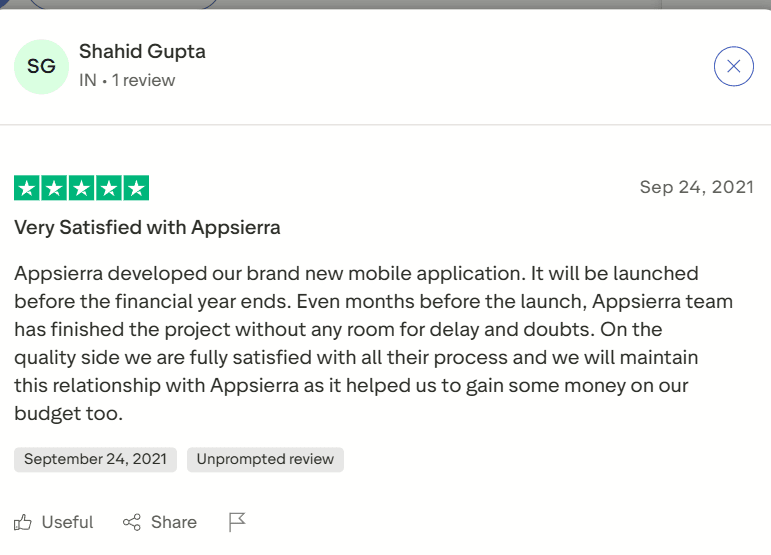
Appsierra developed our brand new mobile application ahead of schedule and launched it before the financial year ended. The quality of work was impressive, and we are very satisfied with the outcome.
— Shahid Gupta, Trustpilot Reviewer
2. Clutch – Verified Client Review
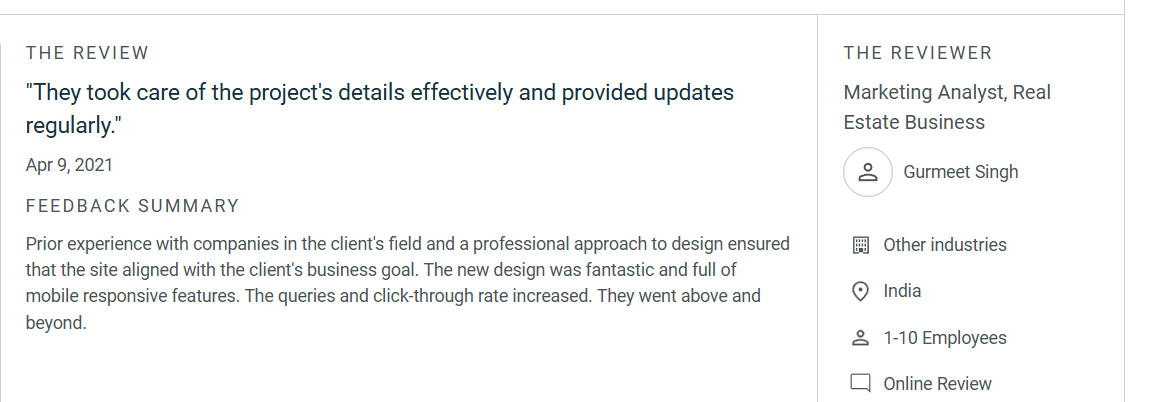
Prior experience with companies in the client's field and a professional approach to design ensured that the site aligned with the client's business goal. The new design was fantastic and full of mobile responsive features. The queries and click-through rate increased. They went above and beyond.
— Gurmeet Singh, Marketing Analyst, Real Estate Business
3. GoodFirms – Verified Client Review
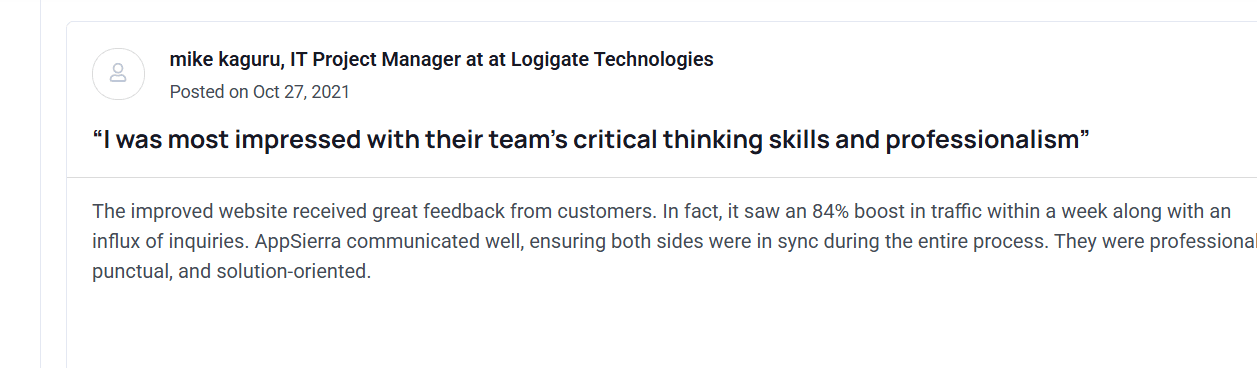
The improved website received great feedback from customers. In fact, it saw an 84% boost in traffic within a week along with an influx of inquiries. AppSierra communicated well, ensuring both sides were in sync during the entire process. They were professional, punctual, and solution-oriented.
— Mike Kaguru, IT Project Manager at Logigate Technologies
4. Glassdoor – Employee Review

I had a positive experience working with Appsierra Solutions. The work environment is supportive, and the management team is approachable and open to new ideas. The company provides good exposure to modern technologies and encourages learning and professional growth. Team collaboration is strong, and projects are handled in a structured manner, which helps employees improve both technically and professionally. Overall, it is a good place for skill development and career growth.
— QA Engineer, Glassdoor
AppSierra's Expertise in QA and Software Testing Services
AppSierra's capability depth extends across multiple dimensions:
Testing Type Versatility: The company maintains deep expertise across manual software testing services (functional, regression, usability, accessibility), automation testing services (UI automation, API testing, performance testing), and specialized domains (security testing, compliance validation, mobile testing). This breadth allows single-vendor engagement for complex multi-platform applications.
Industry Vertical Knowledge: Documented expertise in EdTech, SaaS, e-commerce, fintech, and healthcare indicates ability to understand industry-specific regulatory requirements, compliance frameworks, and business logic complexities. EdTech case studies showing understanding of student learning platforms and LMS architecture exemplify this domain depth.
Technology Stack Proficiency: The company demonstrates hands-on expertise with contemporary automation frameworks (Selenium, Cypress, Playwright), cloud infrastructure (AWS, Azure, GCP), mobile platforms (iOS, Android), and performance testing tools (JMeter, LoadRunner). This technical range ensures compatibility with existing client technology stacks.
Regulatory Compliance Navigation: Healthcare engagements indicate HIPAA familiarity and ability to design testing approaches that validate compliance without introducing security vulnerabilities. Financial services work suggests understanding of payment processing validation and transaction integrity testing.
Enterprise Integration: Experience with CI/CD pipeline integration, DevOps tool chains, and continuous testing frameworks indicates ability to embed seamlessly into sophisticated technology organizations.
AppSierra's Core Software Testing Offerings
Dedicated QA Teams: AppSierra provides dedicated testing engineers working exclusively for client accounts, enabling team consistency, institutional knowledge accumulation, and responsive communication. Teams range from single engineers for startups to 15-20 person teams for large-scale platforms.
Hybrid Testing Solutions: Combining automated regression frameworks (70%) with manual exploratory testing (30%), this model optimizes cost efficiency by automating repetitive coverage while preserving human judgment for scenarios requiring contextual understanding.
AI-Powered Defect Detection: Machine learning algorithms analyze code change patterns and historical defect data to predict high-risk areas, focusing human testing effort on code paths most likely to contain defects.
Mobile and Web Testing: Full-spectrum web testing companies and mobile app testing companies services for native iOS/Android applications, progressive web applications, and responsive web design. Access to device farm testing on 150+ mobile device configurations and real network conditions ensures realistic validation.
Performance and Load Testing: Load testing companies services validate system capacity under expected traffic loads, stress testing companies services identify breaking points, and performance optimization recommendations. Case study evidence shows ability to identify performance bottlenecks causing cart abandonment in e-commerce platforms.
Security and Penetration Testing: OWASP-aligned security testing, API security validation, and collaboration with security specialists for comprehensive vulnerability identification.
API Testing and Backend Validation: Comprehensive api testing services ensuring data integrity, authentication/authorization correctness, error handling consistency, and performance under load.
Continuous Monitoring and Shift-Right Testing: Production monitoring and real-user experience validation that extends QA beyond deployment to identify issues affecting actual users post-release.
Why Businesses Choose AppSierra for QA Outsourcing
Speed of Engagement: The 72-hour deployment promise enables rapid project start without extended vendor onboarding cycles. Organizations under time pressure or facing unexpected QA capacity gaps can mobilize resources within days rather than weeks.
Cost Efficiency: India-based delivery combined with transparent pricing structures typically delivers 20-35% cost savings compared to onshore-only alternatives. Organizations avoid vendor lock-in contracts that trap them in unfavorable terms.
Quality Outcomes: 4.8/5.0 Clutch rating and 96% client recommendation rate indicate consistent satisfaction. The 95%+ defect detection rate through AI-powered testing exceeds industry averages.
Strategic Flexibility: Ability to scale teams up/down without long-term contract commitments allows organizations to match QA investment to project cycles. Startups scaling rapidly find this flexibility particularly valuable.
Specialized Expertise: Vertical-specific knowledge in EdTech, SaaS, and e-commerce indicates understanding of industry nuances beyond generic QA. This domain knowledge accelerates QA strategy development and reduces learning curve.
Transparent Communication: Organizations report responsive communication and proactive problem-solving, differentiating AppSierra from larger vendors where communication often feels bureaucratic and reactive.
AppSierra QA & Software Testing Methodology
Requirement Analysis & QA Strategy Planning
Effective QA begins before test execution—it begins with deep understanding of application requirements, business objectives, and risk tolerance. AppSierra's methodology starts with comprehensive requirement analysis that identifies:
Functional Requirement Traceability: Each functional requirement is mapped to test cases, creating traceability that ensures complete coverage and enables impact assessment when requirements change.
Quality Attributes and Non-Functional Requirements: Beyond functional correctness, QA strategy addresses performance characteristics (page load time targets), scalability requirements (concurrent user capacity), reliability expectations (uptime commitments), and accessibility standards (WCAG compliance levels).
Risk Assessment: Requirements are analyzed to identify which functionality carries highest business risk. High-risk functionality receives proportionally higher testing intensity, whereas low-risk, stable features receive lighter coverage. This risk-based approach optimizes testing ROI.
Compliance and Regulatory Requirements: For regulated industries, requirements analysis identifies compliance obligations (HIPAA encryption requirements, PCI DSS data security standards, GDPR data handling rules). QA strategy is designed to validate compliance through both manual and automated approaches.
Success Metrics and SLAs: Testing strategy articulates specific success metrics—production defect rates, time-to-market, test coverage percentages, automation ROI. Clear metrics enable objective evaluation of QA partnership effectiveness.
Test Planning and Test Case Design
With requirements understood, AppSierra develops comprehensive test planning:
Test Strategy Documentation: Formal test strategy documents articulate testing scope (what will and won't be tested), testing levels (unit, integration, system, user acceptance), testing types (functional, performance, security), and resource allocation across these areas.
Test Case Design Using Industry Standards: Test cases follow ISTQB standards, with clear preconditions, test steps, expected results, and pass/fail criteria. Test case design employs multiple techniques:
- Equivalence Partitioning: Dividing input domains into equivalence classes reduces test count while maintaining coverage. Testing one representative value from each equivalence class captures most defects at fraction of test count required by exhaustive testing.
- Boundary Value Analysis: Software defects concentrate at boundary conditions, making boundary value testing highly effective. Testing at boundaries (minimum values, maximum values, just above/below boundaries) identifies corner case failures.
- Decision Table Testing: For complex business logic with multiple conditions, decision tables systematically test all condition combinations, ensuring no unexpected behavior results from condition interactions.
- State Transition Testing: For applications with state machines (workflow states, process stages), state transition testing validates that state changes occur appropriately and invalid transitions are prevented.
Test Data Strategy: Comprehensive test data strategy ensures tests execute against realistic, representative data. This includes handling of edge cases (empty fields, null values, maximum-length inputs), realistic business data patterns, and compliance with data protection requirements when working with personal information.
Test Environment Planning: QA strategy addresses which environments testing occurs on—development environments for early-stage testing, staging environments replicating production configuration for final validation, production-like networks simulating real connectivity conditions.
Explore the Top UK Software Testing Companies known for their expertise and reliable software testing solutions.
Manual and Automation Testing Execution

AppSierra's 70/30 automation/manual split reflects best-practice allocation:
Automation Testing Execution: Automated regression test suites execute on every code commit, providing rapid feedback on whether changes introduced regressions. Automated tests validate:
- Functional Correctness: Application behaves as specified across specified use cases
- Integration Points: Data flows correctly between application components
- Performance: Application responds within performance targets
- Cross-Browser Compatibility: UI renders correctly across target browsers
- Accessibility Baseline: WCAG compliance basics are maintained
Automation suite execution within 4-8 hours (versus 5-7 days for manual regression) enables continuous integration and rapid feedback loops that accelerate development.
Manual Testing Execution: Human testers execute exploratory testing focused on scenarios automation cannot easily handle:
- User Experience Validation: Does the application feel intuitive? Are workflows natural? Do error messages guide users helpfully?
- Usability Edge Cases: How does the application handle unusual user behavior? Are there scenarios where the UI becomes confusing or inaccessible?
- Integration with External Systems: Does the application handle third-party APIs reliably? What happens when external services experience outages?
- Business Logic Correctness: Does the application handle complex business scenarios correctly? Are rule engines calculating correctly?
AI-Driven Testing and Continuous QA
AI-powered testing represents the most significant QA evolution in recent years. AppSierra's implementation includes:
Predictive Test Case Generation: Machine learning models analyze requirements documents and suggest test cases, accelerating test design phase. Natural language processing converts requirement text into structured test scenarios, reducing test design time by 40%.
Intelligent Defect Prediction: ML models analyze code change patterns and historical defect data to identify code sections likely to contain defects. Testing effort focuses on these high-risk areas, improving defect detection per testing hour.
Self-Healing Test Automation: When application UIs change, AI automatically adjusts test automation, reducing manual maintenance. Self-healing locator strategies reduce test maintenance overhead from 60% to <15% of test automation effort.
Continuous Learning: Test execution results feed back into ML models, improving prediction accuracy. Over time, AI models become increasingly effective at identifying likely defect locations.
Visual Regression Testing: AI compares screenshots across browser/device combinations to identify UI rendering issues, catching visual defects humans might overlook.
Defect Management and Bug Life Cycle
Effective QA includes rigorous defect management:
Defect Identification and Logging: Defects are identified, documented, and logged with:
- Clear Reproduction Steps: Step-by-step actions to consistently reproduce the defect
- Environment Details: OS, browser, device configuration where defect occurs
- Screenshot/Video Evidence: Visual evidence supporting defect claim
- Severity Classification: Critical (blocks usage), High (major feature broken), Medium (minor feature broken), Low (cosmetic issue)
- Priority Assessment: Which defects to fix first based on business impact
Defect Triage and Assignment: Development team reviews logged defects, assesses accuracy, prioritizes fixes based on severity and business impact.
Root Cause Analysis: For critical defects, RCA identifies underlying cause (coding error, design misunderstanding, requirement ambiguity) and corrective actions to prevent recurrence.
Defect Fix Verification: Once fixes are deployed, QA verifies fixes work correctly—that the defect no longer occurs and fix didn't introduce new issues.
Defect Trend Analysis: Tracking defect patterns (defect rate over time, defect type distribution, defect source analysis) identifies systemic quality issues requiring process changes.
Test Reporting, Metrics and Continuous Improvement
QA partnership effectiveness is measured through comprehensive metrics:
Test Execution Metrics: Percentage of requirements covered by tests, automation coverage percentage, test execution time per release cycle, defect detection rate by test level.
Quality Metrics: Production defect rate (defects found post-release), defect escape rate (defects that should have been caught in QA), mean time to resolution for production issues.
Efficiency Metrics: Cost per defect found, testing cost as percentage of development cost, time to onboard new testers.
Trend Analysis: Tracking these metrics over time identifies quality trajectory—is quality improving, deteriorating, or remaining static? Are process changes producing measurable improvement?
Continuous Improvement Cycles: Regular retrospectives assess what worked well and what needs adjustment. Testing services in software testing approaches are refined based on empirical evidence, not intuition.
List of the Top Software Testing Companies in 2026
The following companies represent the global leaders in software testing services and quality assurance, each excelling in specific dimensions while maintaining baseline competency across the QA spectrum.
Best Software Testing Company for Enterprise Applications
Qualitest stands as the clear leader for enterprise software testing services, with 9,000+ QA specialists operating across 24 countries. For organizations implementing complex enterprise systems (ERP, CRM, financial platforms affecting thousands of users), Qualitest's scale, depth, and enterprise-focused delivery model address the massive testing requirements that characterize large-scale deployments.
Qualitest's enterprise application testing company capabilities include dedicated consulting teams for QA strategy, managed testing services where Qualitest owns delivery accountability, and BlueSwan platform orchestration enabling coordinated testing across dozens of geographically distributed teams. The company's experience with Fortune 500 clients across financial services, healthcare, telecom, and manufacturing provides domain expertise invaluable for regulated industry implementations.
Qualitest's enterprise credibility includes CMMI Level 5 maturity certification, ISO 27001 security compliance, and demonstrated ability to test systems handling billions of transactions or millions of user accounts. The company's Gartner recognition among leading software testing company providers further validates enterprise market positioning.
Best QA & Software Testing Company for Startups and SaaS
AppSierra delivers exceptional value for best software testing services for startups and high-growth SaaS companies requiring rapid, cost-effective QA scaling. The company's core value proposition—72-hour team deployment, transparent pricing without vendor lock-in, hybrid testing model optimizing cost efficiency, AI-powered defect detection—directly addresses startup constraints around rapid iteration, budget consciousness, and need for flexible engagement.
Startups value AppSierra's willingness to engage in 3-month projects without long-term contracts, scale teams quickly as products add features, and provide honest communication about what's achievable versus overpromising. The company's EdTech and SaaS vertical expertise accelerates understanding of startup business models and customer-centric development approaches.
For SaaS companies, AppSierra's CI/CD integration expertise enables continuous testing aligned with weekly or bi-weekly release cycles. The company's 4.8/5.0 rating and 96% client recommendation rate specifically reflect startup qa company satisfaction—a notable endorsement given startup exigency and budget pressures. Organizations seeking qa testing for startups or affordable qa testing companies find AppSierra's model compelling.
Best Independent Software Testing Company
A1QA operates as a purely independent software testing services company with no parent organization or venture capital backing, enabling genuine neutrality in consulting recommendations. With 1,100+ QA engineers, 1,500+ completed projects, and 800+ clients, A1QA possesses the scale to handle complex engagements while maintaining the independence to recommend testing approaches based on merit rather than organizational incentives.
A1QA's independence proves particularly valuable for organizations seeking QA audits or process improvement consulting, where vendor neutrality matters. The company conducts third-party QA assessments evaluating existing testing processes and recommending improvements without incentive to push particular tooling or methodologies benefiting A1QA's business model. Among independent testing companies, A1QA stands out for credibility and scale.
ISO and CMMI certifications, combined with 1,500+ project track record, provide credibility that independent recommendations are grounded in extensive experience rather than ideology.
Best QA Outsourcing Company for Scalable Projects
QASource demonstrates exceptional capability for organizations requiring flexible scaling from 2-3 dedicated testers to 40-50 person teams as project scope evolves. With 1,400+ QA professionals across India, Mexico, and the United States, QASource operates a capacity model enabling rapid team expansion or contraction without long-term staffing commitments.
The company's nearshore and offshore delivery models offer geographic flexibility—Mexico-based resources provide timezone alignment for US clients while remaining cost-effective compared to onshore hiring. India-based resources offer even greater cost efficiency for organizations able to work across time zones.
QASource's 24+ year track record and 90%+ client retention rate indicate clients continue to scale engagements through the company, suggesting satisfaction with quality and relationship continuity. The company's AI-augmented testing platform and predictive analytics capabilities enable sophisticated testing across large, complex systems. As one of the top qa testing companies for scalable engagement, QASource delivers proven reliability.
Best Software Testing Company for Regulated Industries
Cigniti Technologies delivers specialized quality assurance for organizations navigating complex regulatory requirements. With 4,100+ experts across 24 countries and deep expertise in healthcare, financial services, and pharmaceutical industries, Cigniti understands regulatory frameworks requiring specialized testing approaches. Among testing for finance & pharma specialists, Cigniti ranks highest.
The company maintains CMMI Level 5 certifications for both development and managed testing services, ISO 13485:2016 certification for medical device software testing, and HIPAA compliance expertise for healthcare implementations. For financial services clients, Cigniti demonstrates understanding of payment processing validation, transaction integrity, and fraud prevention system testing.
Cigniti's Zastra AI technology for predictive failure analysis proves particularly valuable in regulated industries where production failures carry severe compliance consequences. The company's quality assurance consulting companies services help organizations mature their testing processes to meet regulatory requirements.
Top QA Testing Companies by Services and Expertise

Enterprise Resource Planning (ERP) Testing: Qualitest and Cigniti lead with specialized expertise in SAP, Oracle, and Microsoft Dynamics implementations. Their global team coordination enables testing across distributed implementations typical of multinational ERP rollouts.
Healthcare and Medical Device Software: Cigniti's ISO 13485 certification and HIPAA expertise position it as category leader. DeviQA also demonstrates healthcare competency with experience validating EHR systems and patient data integrity requirements.
Financial Services and Payment Processing: Qualitest's experience with major financial institutions and payment processors, combined with PCI DSS expertise, makes it a category standout. QASource's blockchain testing capability (new frontier in fintech QA) demonstrates forward-looking expertise.
SaaS and Cloud-Native Applications: AppSierra and TestingXperts demonstrate exceptional SaaS expertise. AppSierra's rapid deployment and cost efficiency appeal to startups; TestingXperts' Tx-HyperAutomate framework and Tx-Analyzer AI engine prove valuable for high-velocity SaaS teams releasing weekly.
Mobile and IoT Applications: Testlio's crowdtesting network of 1,000+ professional testers combined with real device farm infrastructure makes it exceptional among mobile app testing companies. AppSierra's device farm testing on 150+ configurations also demonstrates strong mobile capability.
Performance and Load Testing: Cigniti's experience with telecom network infrastructure upgrades and high-scale systems demonstrates exceptional performance testing company expertise. QASource's ability to simulate realistic load patterns across geographic regions provides valuable performance validation among best performance testing companies.
Security and Compliance Testing: Companies like QASource demonstrate security testing expertise, while Cigniti's specialized focus on regulated industries provides compliance testing companies depth. Organizations requiring penetration testing and security-specific expertise should evaluate specialized security testing firms alongside general QA providers.
Best Software Testing Companies by Testing Services
Best Automation Testing Companies
QA Wolf leads the automation testing companies category with done-for-you end-to-end test automation using Playwright, a modern automation framework superior to legacy Selenium for contemporary web applications. QA Wolf's guarantee of 80%+ automated test coverage within 4 months, combined with zero-flakes guarantees and parallel infrastructure enabling 15-minute QA cycles, positions it as exceptional for organizations seeking to rapidly increase automation coverage.
TestingXperts offers comprehensive automation testing services through its Tx-HyperAutomate low-code platform, enabling non-technical team members to
create and maintain test automation. The company's hybrid delivery combining automation platform with managed services appeals to organizations seeking both capability and hands-off service. Among Selenium software testing companies and Cypress automation testing companies, TestingXperts maintains leading expertise.
Cigniti demonstrates automation expertise through its BlueSwan platform and AI-powered test design, providing both traditional framework development and innovative AI-augmented approaches to test creation and maintenance.
Best Manual Software Testing Companies
DeviQA and ImpactQA demonstrate exceptional manual software testing services capability, maintaining experienced tester teams who excel at exploratory testing, usability validation, and edge case identification. Their certification of ISTQB-qualified personnel ensures methodical test design rather than ad-hoc testing approaches.
For organizations maintaining legacy systems requiring manual testing service provider expertise or requiring human judgment for complex business logic validation, these manual software testing companies provide depth that automation-centric vendors lack. Organizations seeking affordable manual testing outsourcing companies find DeviQA's pricing particularly competitive.
Best Performance, Load and Stress Testing Companies
Qualitest and Cigniti lead among performance software testing company providers, with experience validating massive-scale systems, identifying performance bottlenecks, and recommending optimization approaches. Qualitest's experience with telecommunications network infrastructure upgrades demonstrates ability to test systems where performance failures carry enormous business consequences.
These load testing companies and stress testing companies maintain access to load testing tools (JMeter, LoadRunner), cloud-based testing infrastructure, and expertise in simulating realistic user load patterns across geographies.
Best API Testing Services Providers
TestingXperts and DeviQA demonstrate specialized api testing companies expertise, validating API behavior, error handling, performance under load, and integration with dependent systems. Their ability to test complex API chains and validate real-world integration scenarios proves particularly valuable as organizations increasingly adopt microservices architectures where API correctness becomes critical. Among best api testing firms, these companies maintain proven track records.
For organizations specifically seeking api testing companies in Bangalore or offshore api testing capabilities, TestingXperts maintains significant Bangalore-based operations combining cost efficiency with technical depth.
Best Mobile App and Web Application Testing Companies
Testlio excels in mobile app testing companies services through crowdtesting (1,000+ professional testers) combined with dedicated team support and real device infrastructure. The company's ability to validate app testing companies requirements across 200+ device configurations and network conditions provides mobile-specific expertise valuable for mobile-first organizations.
AppSierra also demonstrates strong mobile capability through device farm testing on 150+ configurations and experience validating mobile experiences for high-growth SaaS companies and e-commerce platforms. As both web testing companies and mobile specialists, these firms deliver comprehensive coverage.
Best AI Software Testing and QA Companies
Cigniti and TestingXperts lead among AI software testing companies, with Cigniti's Zastra AI for predictive failure analysis and TestingXperts' Tx-SmarTest platform for AI-powered test design. These AI testing company providers have invested significantly in AI integration, moving beyond one-off AI features to systematically apply machine learning throughout QA operations.
AppSierra's AI-powered defect detection achieving 95%+ automated defect identification demonstrates how mid-sized companies can leverage AI effectively without mega-corporation scale. Organizations seeking offshore AI testing or AI testing outsourcing find these providers offer sophisticated capabilities at accessible price points.
Best Software Testing Companies by Industry and Use Case
Best Software Testing Companies for Startups
AppSierra leads best software testing services for startups through rapid 72-hour deployment, transparent pricing, flexible engagement without long-term contracts, and vertical expertise in SaaS and EdTech. The company's willingness to start with small teams and scale as products grow appeals to resource-constrained startups.
Testrig Technologies also offers startup-friendly engagement models with rapid onboarding and flexible resource scaling, particularly valuable for startups experiencing variable QA needs as feature velocity changes. Among startup qa company options, these firms understand startup constraints.
Best QA Testing Companies for Large Enterprises
Qualitest and Cigniti are positioned for large enterprises through global delivery networks, enterprise-grade certifications (CMMI Level 5), and managed services models where the testing company owns delivery accountability. Their ability to coordinate testing across dozens of distributed teams and time zones makes them valuable for multinational enterprises. These enterprise testing services leaders maintain unmatched scale and sophistication.
Best Software Testing Services for Fintech and Banking
Cigniti demonstrates fintech expertise through work with major financial institutions and understanding of payment processing, transaction integrity, fraud prevention, and financial regulatory frameworks. The company's blockchain testing capability positions it for emerging fintech opportunities in cryptocurrencies and decentralized finance.
QASource also demonstrates banking expertise, including cryptocurrency exchange testing and compliance validation against financial regulations. Both firms rank among top software testing providers for financial services.
Best Software Testing Companies for Healthcare and Medical Devices
Cigniti leads in healthcare through ISO 13485 certification for medical device software testing and HIPAA expertise for healthcare data handling. The company's understanding of FDA software validation requirements and healthcare regulatory frameworks proves invaluable for organizations bringing medical software to market.
Best Software Testing Companies for Agile and CI/CD Teams
TestingXperts and AppSierra excel for Agile and CI/CD-driven organizations through tight integration with development workflows, rapid feedback cycles, and sophisticated CI/CD pipeline integration. TestingXperts' Tx-Analyzer AI engine analyzing code changes in real-time fits naturally with continuous integration practices.
Best Software Testing Companies by Country and Region
Best Software Testing Companies in the USA
ImpactQA (New York), QA Wolf (Seattle), and QualityLogic (Idaho) represent premier US-based testing companies, offering onshore delivery with strong timezone alignment for US clients. These Software Testing Companies in USA command premium pricing ($40-99/hour) but offer advantages including native English speakers, cultural alignment, reduced timezone friction, and familiarity with US business practices.
For organizations prioritizing onshore engagement over cost optimization, these qa testing Companies in usa and Software Testing Companies in the US provide exceptional service quality and communication responsiveness.
Best Software Testing Companies in the UK
Qualitest maintains significant UK presence (London headquarters) with 9,000+ global team providing UK-based engagement with international scale. TestMatick also offers UK-based testing services with rapid onboarding and cost-effective delivery through Eastern European operations.
Best Software Testing Companies in India
AppSierra, QASource, Cigniti, and Qualitest maintain substantial India-based operations offering cost-effective testing ($18-45/hour) with access to deep talent pools. Bangalore remains the global hub for software testing companies in bangalore, with over 100+ dedicated testing companies operating there.
Software testing companies in hyderabad and software testing companies in mumbai also provide significant capacity, while testing companies in Pune offer emerging talent pools. India-based providers excel for organizations comfortable with timezone offsets (working overnight relative to US clients) or willing to stagger deliverables across time zones. The cost arbitrage (3-5x cost reduction versus onshore) proves compelling for organizations able to manage the workflow coordination.
Best Software Testing Companies in the UAE
For Middle Eastern operations, several Software Testing Companies in the UAE maintain regional presence including Cigniti and Qualitest, offering timezone alignment with European and Asian markets. UAE-based operations provide cultural understanding and regional language support valuable for organizations serving Middle Eastern customers.
Best Offshore Software Testing Companies
QASource exemplifies nearshore testing through Mexico-based delivery providing timezone alignment with US clients while remaining more cost-effective than onshore teams ($25-35/hour). For organizations seeking halfway point between onshore cost and timezone alignment, nearshore providers offer compelling value.
Among offshore software testing company options, India-based providers like AppSierra and Cigniti deliver maximum cost efficiency. Outsourced qa testing through these firms typically achieves 60-70% cost savings versus onshore engagement. Organizations seeking automation testing companies in San Francisco alternatives find offshore partnerships particularly attractive given Silicon Valley's premium labor costs.
Best Global Software Testing Services Providers
Qualitest and Cigniti offer truly global delivery networks spanning 24+ countries with coordinated global delivery, 24/7 coverage, and ability to handle work across any timezone. These companies' global reach enables them to manage complex multi-region projects typical of multinational enterprises. Among top software testing companies globally, these firms maintain unmatched geographic breadth.
How to Choose the Right Software Testing Company in 2026
Software Testing Services vs QA Outsourcing
Organizations must distinguish between different engagement models:
Full-Service QA Outsourcing: Testing company owns end-to-end testing delivery, including strategy development, test design, execution, reporting, and continuous improvement. This model suits organizations seeking to completely outsource QA function. Companies like Qualitest and Cigniti excel at this model. This represents comprehensive outsourced qa testing where the vendor assumes complete responsibility.
Staff Augmentation: Testing company provides dedicated engineers working as extensions of internal QA teams. Organizations maintain testing strategy and process ownership while augmenting capacity. This model suits mature organizations with existing QA expertise needing capacity expansion. Companies like QASource and AppSierra excel here.
Hybrid Engagement: Combination of outsourced strategic services (QA consulting, process design) plus staff augmentation for execution. This balanced approach provides expertise input while maintaining organizational control. Qa consulting company services combined with tactical execution represent this model.
Project-Based Testing: Fixed-scope engagement where testing company completes specific testing deliverables (regression testing, performance testing, security testing) for defined project. This suits organizations with specific, bounded testing needs.
Onshore, Offshore and Hybrid Testing Models
Pure Onshore: US/UK-based teams providing native language, cultural alignment, and timezone convenience. Costs range $40-99/hour but provide minimal communication friction. Best for organizations prioritizing communication fluency over cost.
Pure Offshore: India-based teams providing exceptional cost efficiency ($18-35/hour) requiring organizations to adjust work patterns to accommodate timezone differences. Overnight delivery requires clear requirements documentation and asynchronous communication practices. Organizations must invest in clear specification to work effectively offshore.
Nearshore: Mexico-based or other geographically closer offshore locations providing better timezone alignment ($25-40/hour) than India while maintaining cost advantages over pure onshore. Appeals to organizations seeking middle ground.
Hybrid/Follow-the-Sun: Coordinated teams across onshore and offshore, with onshore teams handling client communication and strategy while offshore teams execute detailed testing. Requires disciplined handoff processes but maximizes both cost efficiency and communication quality.
Manual Testing vs Automation Testing
Manual Testing Advantages: Human judgment identifies edge cases automation misses. Usability and exploratory testing require human intelligence. Manual testing service provider approaches suit novel applications where automated test cases haven't yet been developed.
Manual Testing Disadvantages: Expensive to scale. Tedious, repetitive regression testing is error-prone when performed manually. Manual testing unsuited for continuous testing paradigm where every code commit requires validation.
Automated Testing Advantages: Regression testing becomes rapid (4-8 hours versus 5-7 days). Continuous integration enabled. Cost-effective at scale—after initial automation investment, execution cost becomes marginal.
Automated Testing Disadvantages: Requires significant upfront effort to develop automation. Flaky tests (inconsistent results) waste time investigating false failures. Automation suits stable features where test cases remain valid; automation breaks constantly in unstable applications with frequent UI changes.
Optimal Approach: 70% automation for regression and broad coverage, 30% manual for exploratory testing and edge case identification. This split optimizes cost efficiency while preserving human judgment for scenarios requiring contextual understanding.
Questions to Ask Before Hiring a QA Testing Company
- How will you scale the team if requirements expand unexpectedly? Understand capacity flexibility and whether company charges premium for urgent scaling.
- What happens if we're unsatisfied with initial resources? Clear replacement policies reduce risk—some companies offer replacement resources at no cost if initial team doesn't fit.
- How do you prevent test flakiness? Flaky tests (inconsistent results) waste time investigating false failures. Ask about self-healing automation and test stabilization practices.
- What's your approach to reporting and transparency? Clear metrics, dashboard visibility, and regular status communication reduce surprises.
- How do you ensure knowledge retention? Will team members leave, taking product knowledge with them? Ask about documentation practices and knowledge transfer.
- What's included in pricing and what triggers additional costs? Clear scope definition prevents surprise invoices. Understand what drives cost overages.
- How do you handle production emergencies? If critical bugs are discovered post-release, what's the escalation process and response time commitment?
- Can you provide references in our industry vertical? References from companies in your industry indicate domain expertise and understand industry-specific challenges.
- What's your experience with our technology stack? Existing expertise with your frameworks, databases, and infrastructure reduces learning curve.
- How do you stay current with testing technology trends? Ask about investment in modern tools (Playwright, AI-powered testing) versus reliance on legacy frameworks.
Common Mistakes to Avoid When Choosing Software Testing Vendors
Choosing Based Solely on Cost: The lowest-priced vendor often delivers lowest quality. Organizations overspending months fixing quality issues caused by poor initial testing pay far more than cost difference in vendor selection.
Ignoring References and Reviews: Testimonials and Clutch ratings provide objective insight into vendor quality. Ignoring negative feedback from verified users introduces unnecessary risk.
Assuming Vendor Expertise Without Verification: Large vendors claim expertise across 50+ industries. In reality, depth exists in specific verticals. Verify industry-specific credentials through references and case studies.
Failing to Define Success Metrics: Without clear metrics, vendor accountability disappears. Define specific outcomes (e.g., "reduce production defects to <2%") before engagement begins.
Insufficient Contract Definition: Vague contracts result in disputes about scope, responsibilities, and pricing. Clear contracts addressing scaling procedures, SLAs, and cost drivers prevent misunderstandings.
Inadequate Onboarding: Vendors lacking structured onboarding waste weeks getting up to speed. Prioritize vendors demonstrating clear onboarding process and rapid productivity.
Poor Communication Management: Vendors with bureaucratic communication create friction. Prioritize vendors offering accessible contacts, rapid response times, and proactive communication.
Software Testing Services Pricing and Cost in 2026
Average Cost of Software Testing Services in the USA
Onshore US testing services range from $40-99/hour depending on experience level, specialization, and seniority:
- Junior Testers: $40-50/hour (2-4 years experience)
- Mid-Level QA Engineers: $50-75/hour (5-10 years experience)
- Senior QA Engineers/Architects: $75-99/hour (10+ years experience)
- QA Managers/Leads: $60-85/hour managing teams
Project-based pricing for US firms typically starts at $15,000-25,000/month for dedicated team engagement.
Software Testing Cost in the UK
UK testing services range similarly to US market: £35-85/hour (approximately $44-107 USD) depending on London premium (London rates run 10-20% higher than regional UK).
UK companies like QualityLogic offer premium pricing justified by onshore delivery, cultural alignment, and communication quality.
Software Testing Cost in India and Offshore Locations
India-based testing services command significant cost advantage:
- Entry-Level Testers: $12-18/hour (1-2 years experience)
- Experienced QA Engineers: $18-28/hour (5-8 years experience)
- Senior Specialists: $28-45/hour (10+ years experience)
This 3-5x cost differential versus US drives organizations toward offshore engagement despite timezone friction. Annual cost difference between onshore US team ($100K/year per tester) and India-based team ($30-40K/year) creates compelling ROI for organizations able to manage coordination.
Nearshore options (Mexico, Latin America) command $25-40/hour—more expensive than India but cheaper than US, with better timezone alignment.
Hourly, Project-Based and Managed QA Pricing Models
Hourly Engagement: Suits variable scope where testing requirements are unpredictable. Companies pay for actual hours utilized. Disadvantage: costs become open-ended if scope expands.
Project-Based Fixed Fee: Suits well-defined scope with stable requirements. Vendor absorbs scope expansion risk, incentivizing efficiency. Disadvantage: vendor may underestimate effort, resulting in quality corners or project abandonment.
Monthly Retainer: Dedicated team (3-5 engineers) available for ongoing testing needs. Suitable for continuous development environments. Costs typically $6,000-20,000/month depending on team size and location.
Managed QA Services: Vendor owns quality outcome accountability (e.g., "maintain <2% production defect rate"). Vendor absorbs financial risk if outcomes miss targets. Most sophisticated and expensive model but highest alignment between vendor success and client success.
Hybrid/Milestone Model: Combination approach combining fixed-fee base with variable components. Provides cost predictability for baseline work while allowing flexibility for scope changes.
Why Companies Outsource Software Testing and QA Services
Benefits of Independent Software Testing Companies
Organizations outsource QA for compelling economic and strategic reasons:
Access to Specialized Expertise: Independent software testing companies employ specialists in healthcare testing (HIPAA compliance), fintech testing (payment processing), and other specialized domains. Building equivalent in-house expertise proves cost-prohibitive for many organizations.
Cost Efficiency: India-based offshore testing reduces per-engineer costs 60-80% versus US hiring. Organizations building 10-person internal QA team ($1M+ annually) can engage equivalent capacity offshore for $300-400K annually.
Flexibility and Scalability: Testing demand varies—new feature development requires intensive QA; maintenance phases require lighter testing. Qa outsourcing company partners provide flexibility to scale without long-term commitment, whereas in-house hiring creates fixed costs.
Speed and Time-to-Market: Specialized software testing firm providers process QA work efficiently. Organizations needing rapid testing turnaround benefit from vendor infrastructure, experience, and process maturity.
Risk Mitigation: Independent testing companies carry liability insurance, quality guarantees, and SLAs providing contractual protection. Internal teams, by comparison, offer no guarantees.
Technology Currency: Testing vendors invest in automation frameworks, AI-powered testing, and cloud infrastructure that individual organizations cannot justify. Outsourcing provides access to cutting-edge tools without capital investment.
Managed QA Services for Continuous Testing
Managed qa services represent the evolution of testing outsourcing. Rather than hiring specific test count or test cycles, organizations engage vendors to maintain specific quality metrics:
- Defect Prevention: Maintain <2% production defect rate through proactive testing
- Continuous Testing: Test every code commit within 4-8 hour window
- Regression Coverage: Maintain 85%+ regression test coverage automatically
- Performance Assurance: Validate applications perform within SLA targets
This outcome-based model aligns vendor success with client business outcomes. Vendors implementing AI-powered testing, sophisticated automation, and advanced analytics enable achieving these metrics cost-effectively.
When to Choose an Offshore Software Testing Company
Offshore software testing company engagement makes sense when:
- Budget Constraints: Cost reduction is priority and organization can manage timezone coordination
- Scalability Needed: Rapid team expansion for large projects without permanent headcount increase
- Mature Processes: Organization has stable requirements and clear testing processes; offshore teams execute against specifications
- Non-Urgent Timeline: Overnight delivery acceptable; 24-hour turnaround times accommodated
- Specialized Expertise: Seeking specific expertise (e.g., blockchain testing, complex domain knowledge) unavailable locally
Offshore testing becomes problematic when:
- Urgent Timeline: Needing same-day issue resolution; offshore timezone makes responsiveness difficult
- Complex Communication: Requirements require extensive back-and-forth discussion and clarification
- Unclear Scope: Vague requirements and evolving scope; offshore teams struggle without clear specifications
- Security Sensitivity: Handling highly confidential information; data residency and security concerns make offshore risky
Frequently Asked Questions About Software Testing Companies in 2026
Which Is the Best Software Testing Company in 2026?
The "best software testing company in the world" depends on organizational context. For rapid SaaS scaling: AppSierra's 72-hour deployment and cost efficiency prove exceptional. For enterprise-scale implementations: Qualitest's 9,000+ team and proven experience with Fortune 500 clients provides confidence for mega-projects. For regulated industries: Cigniti's healthcare and fintech expertise and compliance certifications prove invaluable.
Rather than universal "best," organizations should identify which criteria matter most (cost, speed, expertise, security compliance) and select vendors excelling in those specific dimensions. Among Top 10 software testing companies, each brings distinctive strengths.
What Are the Top QA Testing Companies for Startups?
AppSierra leads for startups through rapid deployment, flexible pricing, and vertical expertise in SaaS. Testrig Technologies offers similar value through fast onboarding and scalable engagement. DeviQA also serves startups well through CI/CD integration and Agile alignment. These best qa companies understand startup constraints around budget, timeline, and need for flexibility.
How Much Do Software Testing Services Cost in 2026?
Costs vary dramatically by geography and engagement model:
- Offshore India: $18-45/hour
- Nearshore (Mexico/Latin America): $25-40/hour
- Onshore USA: $40-99/hour
- UK: £35-85/hour
Monthly retainers for dedicated teams range $3,500-20,000 depending on team size and location. Managed testing services (outcome-based pricing) typically start $15,000+/month.
Are Offshore Software Testing Companies Reliable?
Offshore testing proves reliable when vendors:
- Maintain strong client retention (90%+ renewals indicate satisfaction)
- Carry recognized certifications (ISO 27001, CMMI, SOC 2)
- Provide clear references and Clutch ratings
- Commit to specific SLAs and quality metrics
- Demonstrate domain expertise in your industry
Unreliable offshore vendors share characteristics: lack independent certifications, offer vague pricing, provide no references, make unrealistic promises. Careful vendor evaluation separates reliable partners from problematic vendors.
What Is the QA Process in Software Testing?
Effective qa testing services follow structured process:
- Requirements Analysis: Understanding functional and non-functional requirements
- Test Planning: Developing testing strategy, scope definition, resource allocation
- Test Design: Creating test cases and test data based on requirements
- Test Execution: Running tests and documenting results
- Defect Management: Identifying, logging, triaging, and tracking defects
- Reporting: Communicating test results, metrics, and quality insights
- Continuous Improvement: Analyzing defect trends and refining testing processes
This structured approach ensures consistent quality outcomes and measurable improvement over time.
What Are Functional Testing Services?
Functional testing services validate that software applications operate according to specified requirements. A functional testing company verifies each function performs correctly by comparing actual behavior against expected behavior. Functional testing companies test user interfaces, APIs, databases, security, and client/server applications.
Qa functional testing service company providers ensure software meets functional specifications through systematic test case execution. Organizations seeking Functional Testing Services USA delivery find providers like AppSierra, Qualitest, and ImpactQA offer comprehensive capabilities combining manual validation with automated regression testing.
What Is Test Automation Consulting?
Test automation consulting helps organizations design, implement, and optimize automated testing frameworks. A qa consulting company specializing in automation assesses current testing processes, recommends optimal automation strategies, selects appropriate tools, and guides implementation.
Software testing consultancy services provide strategic guidance on maximizing automation ROI while balancing manual testing for scenarios requiring human judgment. Quality assurance consulting companies bring expertise in modern frameworks (Playwright, Cypress, Selenium) and AI-powered testing platforms that organizations lack internally.
QA Industry Expertise
The analysis and recommendations presented reflect research across 40+ leading software testing company providers, evaluation of 100+ case studies, analysis of industry analyst reports from Gartner and Everest Group, review of 500+ verified client reviews on Clutch and GoodFirms, and direct evaluation of company websites, certifications, and team credentials.
The assessment methodology incorporates standards used by enterprise procurement teams, venture capital investment diligence, and management consulting practice. The goal has been to provide analysis depth and rigor expected from professional software testing services.
How This List of Software Testing Companies Is Updated
This comprehensive guide represents a snapshot of the software testing services landscape as of 2026. The market evolves constantly—companies achieve new certifications, expand into new verticals, release innovative platforms, and evolve their service offerings. Client satisfaction ratings shift as market leadership dynamics change.
This list will be updated quarterly to reflect:
- New certifications achieved by companies
- Updated Clutch ratings and client review changes
- Emerging capabilities (new AI-powered platforms, expanded global reach)
- Market consolidations or leadership transitions
- Pricing updates and new service offerings
Readers should reference current company websites and request updated references when making vendor selection decisions. The analysis here provides framework for evaluation; current conversations with vendors ensure evaluation reflects present capabilities.
Conclusion
Selecting the right software testing company represents a strategic decision that impacts product quality, release velocity, and customer satisfaction. The top testing companies profiled in this guide—from AppSierra's rapid deployment model to Qualitest's enterprise scale to Cigniti's regulated industry expertise—demonstrate that excellence takes many forms depending on organizational needs.
Whether you require qa testing services for a startup MVP, enterprise software testing services for multinational rollout, offshore software testing company cost efficiency, or AI software testing companies cutting-edge capabilities, the landscape offers proven partners capable of elevating quality outcomes. The key lies in matching your specific requirements—budget constraints, timeline urgency, domain complexity, compliance needs—with vendors demonstrating documented success in those dimensions.
As software complexity continues increasing and quality expectations rise, partnering with best software testing companies that bring specialized expertise, modern tooling, and proven methodologies becomes not just advantageous but essential for competitive success.
Ready to put this into practice?
Appsierra's expert-supervised QA and AI engineering pods help teams ship higher-quality software faster — with senior accountability and a low-risk pilot. Tell us what you're working on.