
QA Testing Services: Find Top 10 QA Testing Companies
Discover how QA testing services provided by top software testing companies help businesses deliver flawless software.
About The Author
Written by: Shivam Gupta, Content Writer, AppSierra
- Experience: Building and scaling QA testing, software quality assurance, and test automation solutions for startups, healthcare, and enterprise businesses across global markets.
- Current Position: Content Writer and Industry Analyst specializing in HR technology, recruitment optimization, and enterprise software solutions, with a strong focus on research-driven, high-impact content for global technology markets.
- Expertise Focus: Healthcare app development, medicine delivery platforms, enterprise software solutions, and technology strategy
About Appsierra
● Founded: 2015
● Headquarters: Noida, Uttar Pradesh, India
● What They Do: Appsierra builds tailor-made software solutions that meet specific business needs. This includes web applications, mobile applications, desktop software, and integrated systems designed to solve real business challenges.
● Team Size: 150+ technology experts globally
● Global Offices: India, USA
● Track Record: 1,251+ projects delivered | 60% average cost savings | Fortune 1000 client relationships
Introduction
The software testing landscape is undergoing a profound transformation. As organizations push for faster release cycles, complex digital ecosystems, and stringent quality standards, Quality Assurance (QA) has evolved from a reactive verification process to a strategic business function. In 2026, qa testing services are not just about finding bugs—they're about proactively preventing failures, optimizing user experience, and embedding quality into the very DNA of software development.
This comprehensive guide explores the cutting-edge software qa testing services reshaping the industry, identifies the top qa companies driving innovation, and helps you select the right quality assurance service providers to elevate your software quality.

What Are QA Testing Services in 2026?

Definition and Purpose of QA Testing Services
Software qa services represent a comprehensive suite of specialized processes, methodologies, and tools designed to validate software applications before they reach end-users. Unlike traditional quality assurance software testing services that focused solely on identifying defects post-development, modern qa testing service models operate as a continuous, integrated function embedded throughout the software development lifecycle.
Quality assurance testing services encompass the entire spectrum of quality validation—from functional correctness and performance optimization to security hardening and user experience excellence. They serve as the critical bridge between development teams and user expectations, ensuring that every line of code, every feature integration, and every system interaction meets both technical specifications and real-world usability standards.
The core purpose extends beyond defect identification. Today's testing and qa services focus on delivering business value by reducing go-to-market delays, minimizing post-release failures that damage brand reputation, preventing costly security breaches, and ensuring consistent user satisfaction across all platforms and devices. Organizations that invest in comprehensive qa services typically experience a 25:1 return on investment through prevented production failures, reduced technical debt, and improved customer retention.
Key Benefits of QA Testing Services for Modern Software
Accelerated Time-to-Market: By implementing continuous testing and risk-based testing strategies, software testing services dramatically reduce release cycles. Automated testing frameworks allow teams to validate complex features in hours rather than weeks, enabling organizations to respond faster to market opportunities and competitive pressures.
Enhanced Product Reliability: Comprehensive qa software testing services identify critical defects before production deployment. This proactive approach prevents catastrophic failures that could compromise user data, damage brand reputation, or trigger regulatory penalties. For financial applications, effective quality assurance and testing services can prevent security disasters with ROI ratios exceeding 25:1.
Improved User Experience: Modern software qa testing service providers prioritize user-centric validation through real-world scenario testing, accessibility compliance verification (WCAG/ADA standards), and usability testing across diverse devices and platforms. This ensures that software doesn't just function—it delights users with seamless, intuitive experiences.
Cost Optimization: Strategic it software testing services reduce the exponential cost of fixing defects in production. A bug discovered during development costs mere dollars to fix; the same bug discovered after release costs hundreds or thousands. Outsourced software testing service providers in markets like India offer cost-effective alternatives, often delivering 94% bug detection rates at 30% of in-house costs.
Regulatory Compliance & Risk Mitigation: For regulated industries (healthcare, finance, fintech), qa services company providers ensure compliance with industry standards (ISO 27001, PCI-DSS, SOC 2 Type II). They document testing evidence required for audits and demonstrate due diligence against liability claims.
Scalability Without Infrastructure Burden: Testing services software solutions scale testing capacity on-demand without the capital expenditure and recruitment challenges of building in-house teams. Organizations can handle massive testing volumes, multi-platform compatibility verification, and 24/7 testing coverage through dedicated qa it services partners.
If you’re looking to partner with reliable QA providers, check out our list of top software testing companies that excel in delivering quality solutions.
Emerging QA Testing Trends Shaping 2026

The qa testing companies industry is experiencing four transformative trends that are redefining how organizations approach software quality:
AI and Autonomous Testing Agents: Artificial intelligence is moving from a support tool to an active testing partner. In 2026, AI agents autonomously analyze code changes, select relevant test cases, provision test environments, execute complete test suites, and classify failures—all without human intervention. Teams now supervise intelligent platforms rather than manually executing tests. Machine learning models predict defects with increasing accuracy, while natural language processing converts requirements written in plain English into executable test scripts.
Shift-Right Testing and Production Analytics: Testing no longer ends at release. Progressive organizations are embedding continuous monitoring in production environments, using AI to analyze user behavior patterns and derive new tests from actual usage. This shift-right approach reduces customer-reported defects by catching real-world failures that never surface in controlled testing environments. By 2026, 40% of large enterprises will have AI assistants integrated into CI/CD workflows, monitoring canary releases with real-time performance insights.
Unified End-to-End Quality Platforms: Teams are exhausted by fragmented tooling. The market is consolidating toward comprehensive platforms that deliver functional testing, regression testing, API validation, performance monitoring, accessibility audits, and security scanning in a single, integrated interface. These unified platforms reduce tool sprawl, accelerate onboarding, and eliminate data silos between testing disciplines.
Democratization of Testing: Low-code and no-code testing platforms are enabling business analysts, product managers, and non-technical stakeholders to contribute to quality assurance. This democratization removes bottlenecks created by limited tester availability, allowing organizations to achieve higher test coverage through broader team participation. Simultaneously, qa tester company professionals are elevating their roles from manual testers to automation strategists, DevOps engineers, and quality architects.
Types of QA Testing Services
Manual QA Testing Services
Manual qa testing services represent the human-centered approach to quality assurance, where skilled testers interact with software applications to validate functionality, identify usability issues, and explore edge cases that automated tests might miss.
When Manual Testing Excels: Manual testing is irreplaceable for exploratory testing (discovering issues without predefined test cases), user experience evaluation (assessing intuitiveness and workflow efficiency), accessibility testing (ensuring compliance with WCAG standards), usability testing with diverse user groups, and complex scenarios requiring human judgment and creativity. Manual software testing companies excel at identifying subtle behavioral issues, confusing user interfaces, and unexpected error handling that automated scripts often overlook.
Service Characteristics: Manual qa testing services typically employ experienced testers who specialize in specific domains or platforms. Providers offer flexible engagement models—from per-project assignments for startups conducting pre-launch testing to dedicated teams for ongoing QA coverage. Software Testing Company India providers offer manual testing services ranging from $8–12 per hour, making them cost-effective for organizations prioritizing exploratory and acceptance testing.
Modern Evolution: Manual testing is evolving toward hybrid models where skilled testers augment automated test suites, focusing human effort on high-value activities while automation handles repetitive regression testing. This hybrid approach optimizes team capacity and delivers superior quality compared to either approach in isolation.
Automated QA Testing Services
Automated qa testing services leverage specialized tools and frameworks to execute test cases programmatically, dramatically increasing test coverage, execution speed, and consistency while reducing human error and long-term costs.
Core Automation Services: Comprehensive qa automation testing services include functional automation (validating application features against requirements), regression automation (ensuring new changes don't break existing functionality), performance automation (simulating load and stress conditions), API automation (validating backend integrations and data flows), and continuous testing integration (running automated tests within CI/CD pipelines for immediate feedback).
Scalability and Efficiency: Automation qa testing services enable organizations to execute thousands of test cases in minutes—a task that would require weeks of manual effort. Automated tests run 24/7 without fatigue, executing consistently across multiple environments and device configurations. This capability is essential for modern development practices where code is released multiple times daily.
Technical Expertise Required: Effective automation requires expertise in scripting languages (Python, Java, JavaScript), testing frameworks (Selenium, Cypress, Appium), CI/CD integration, test data management, and maintenance strategies. Leading qa automation testing services company providers employ certified automation engineers who design maintainable test frameworks that adapt to application changes without constant rewriting.
Investment and ROI: While automation demands higher initial investment in tool licenses, framework development, and skilled personnel, the long-term ROI is compelling. Automated qa testing services company solutions reduce per-test execution costs by 60-70% compared to manual testing after the initial setup phase, and enable velocity that manual testing cannot match.
AI-Driven QA Testing Services
AI-driven testing represents the next evolution in quality assurance, where machine learning algorithms, predictive analytics, and autonomous agents transform how organizations identify and prevent quality issues.
Intelligent Test Case Generation: AI algorithms analyze application requirements, user stories, and acceptance criteria to automatically generate comprehensive test cases. This capability eliminates hours of manual test design while ensuring coverage of critical paths and edge cases that human testers might overlook. Natural language processing enables testers to specify test intent in conversational English, with AI converting these descriptions into executable test scripts.
Self-Healing Test Automation: A persistent challenge in automation is script brittleness—tests fail when UI elements change position, rename, or restructure. AI-driven self-healing tests automatically detect these changes and adapt test scripts dynamically, reducing maintenance overhead by up to 80%. This capability is transformative for automated software testing company operations releasing features frequently.
Predictive Defect Detection: Machine learning models trained on historical testing data can predict which application areas are most likely to contain defects based on code complexity, change frequency, and development team expertise. AI analyzes test execution patterns, log data, and anomalies to identify issues before they manifest in production. Some automated software testing companies claim to reduce testing cycles by 39% while maintaining or improving defect detection rates.
Intelligent Test Prioritization: With thousands of potential test cases and limited execution windows, AI systems prioritize tests based on risk assessment, business criticality, and historical failure patterns. This ensures that the most valuable tests execute first, maximizing defect detection within time constraints.
Adoption Momentum: 44% of organizations are actively piloting generative AI in QA, with documented reductions in testing cycles (39%) and expanded QA capacity for engineers conducting testing alongside coding responsibilities.
Learn how offshore software testing solutions can help scale your QA processes efficiently.
Functional, Performance & Security Testing Services
Beyond testing type (manual vs. automated), qa service company providers differentiate by functional domain:
Functional Testing Services: Qa functional testing service company providers validate that software features operate according to specifications. Testers execute predefined test cases, verify outputs match requirements, and document deviations. Functional testing ensures that the software does what it's supposed to do—essential for acceptance testing, regression validation, and new feature launches.
Performance and Load Testing Services: Evaluate how applications behave under stress. Load testing simulates thousands of concurrent users, stress testing identifies breaking points, and scalability testing confirms performance as data volumes grow. Organizations conducting performance testing services (ranging from $15-25/hour in Software Testing Companies in India) identify bottlenecks that would cause production outages, prevent revenue loss from slow transactions, and ensure user satisfaction during peak usage periods.
Security Testing Services: Penetration testing, vulnerability scanning, and threat modeling identify security weaknesses before malicious actors do. Security testing services company in India providers ($18-30/hour) are non-negotiable for applications handling sensitive data, conducting financial transactions, or operating in regulated industries. A single security vulnerability discovered in production can trigger regulatory fines, data breach notification costs, and irreversible reputational damage.
AppSierra – A Leading QA Testing Services Company in 2026

Overview of AppSierra QA Testing Services
AppSierra has positioned itself as a transformative force in the qa services companies industry, distinguished by its combination of traditional testing excellence and cutting-edge AI-powered innovation. The company exemplifies the future of quality assurance software testing company services through a comprehensive service portfolio addressing every segment of the market—from lean startups requiring rapid, affordable testing to Fortune 500 enterprises demanding enterprise qa testing services programs.
With over 1,200 projects successfully delivered and maintaining a remarkable 96% client recommendation rate, AppSierra has built a reputation for reliability, expertise, and business-centric quality solutions. The company's approach transcends traditional defect identification, focusing instead on how software quality assurance company services contribute to accelerated delivery, reduced risk, and enhanced user satisfaction.
What Clients Actually Say About Appsierra
1. Trustpilot– Verified Client Review
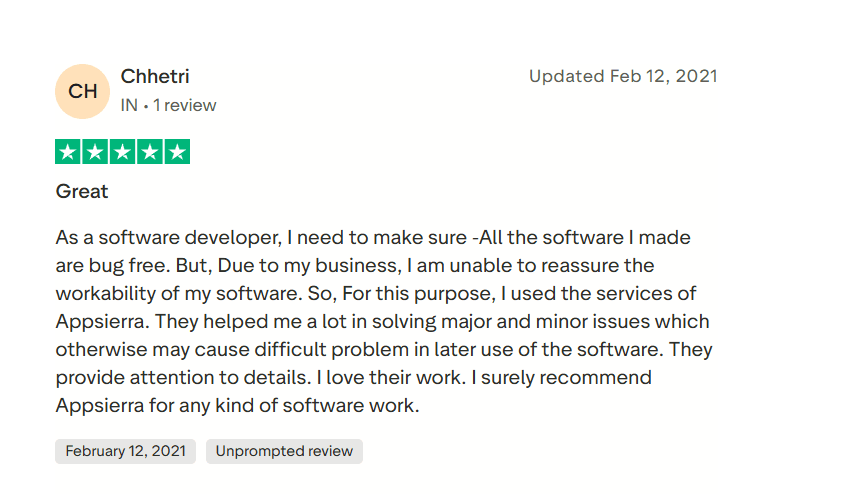
As a software developer, I need to make sure -All the software I make bug free. But, Due to my business, I am unable to reassure the workability of my software. So, for this purpose, I used the services of Appsierra. They helped me a lot in solving major and minor issues which otherwise may cause difficult problems in later use of the software. They provide attention to details. I love their work. I surely recommend Appsierra for any kind of software work.
— Chettri, Trustpilot Reviewer
2. Clutch – Verified Client Review
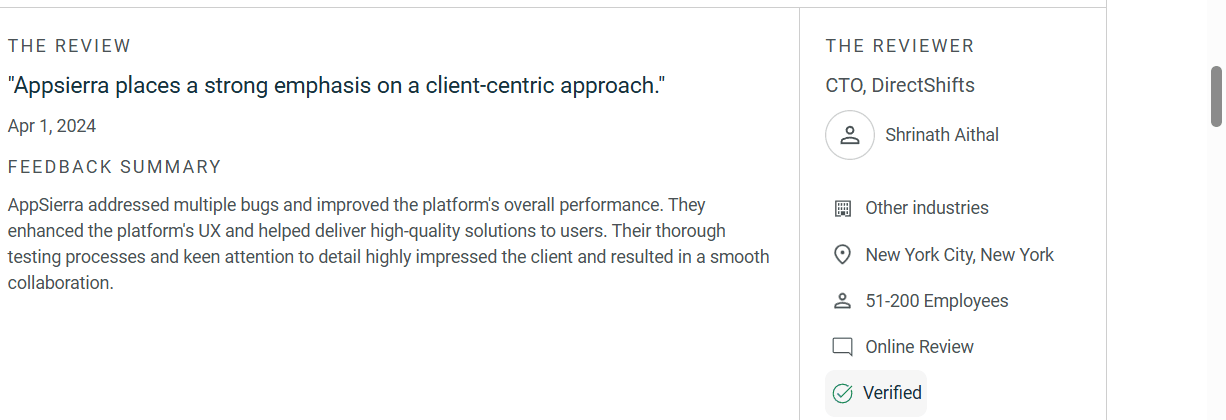
AppSierra addressed multiple bugs and improved the platform's overall performance. They enhanced the platform's UX and helped deliver high-quality solutions to users. Their thorough testing processes and keen attention to detail highly impressed the client and resulted in a smooth collaboration.
— Shrinath Aithal, Marketing Analyst, Real Estate Business
3. GoodFirms – Verified Client Review

Thanks to AppSierra's efforts, half of the content on the platform has been tested and completed. The team is also very timely on their deliverables, as they continue to find ways to improve the user experience and get it ready for launch.
—Johnstone Kamau, Human Resources Manager at FLAPAH CREDIT LIMITED
4. Glassdoor – Employee Review

I’ve enjoyed my experience working at AppSierra Solutions. The management is supportive and approachable, and there are great learning opportunities — especially for freshers. The collaborative work environment helped me develop both technical and professional skills, and I got valuable exposure to real-world projects that improved my growth.
— Digital Marketing Executive, AppSierra Solution
Why AppSierra Stands Out Among QA Testing Companies
Accelerated Deployment Model: AppSierra's distinctive competitive advantage is its 72-hour rapid deployment capability. Rather than spending weeks assembling teams and establishing processes, AppSierra deploys vetted, experienced QA engineers within 72 hours. This velocity is critical for startups launching products on aggressive timelines and enterprises responding to market opportunities with compressed project schedules.
AI-Powered Platform Integration: AppSierra has invested in proprietary AI platforms—Pitch N Hire for intelligent hiring and OnJob.io for testing orchestration—that multiply team productivity and reduce manual overhead. These platforms embed AI throughout the testing lifecycle, from test case generation to intelligent defect triage.
Proven Industry Trust: Clutch, the leading B2B services review platform, rates AppSierra at 4.9/5 stars, placing it among the best qa companies globally. This rating reflects consistent delivery, customer satisfaction, and proven expertise across diverse industries and technologies.
Comprehensive Service Coverage: AppSierra offers end-to-end comprehensive qa services spanning manual and automated testing, performance and security testing, API and integration testing, and strategic software qa consulting services. This breadth eliminates the complexity of managing multiple vendors and ensures aligned quality strategies.
Domain Expertise Across Verticals: The company's portfolio spans IT/software, healthcare/pharmaceuticals, finance/banking, manufacturing, real estate, retail, and restaurant technology—demonstrating the versatility required to serve diverse organizational needs with industry-specific testing strategies.
AppSierra QA Testing Services for Startups
Startups operate under unique constraints: compressed budgets, aggressive timelines, limited internal resources, and pressure to achieve product-market fit before capital depletes. AppSierra's startup-focused qa testing service offerings address these realities.
Rapid Time-to-Quality: Startup product launches demand testing velocity that in-house teams cannot achieve. AppSierra's 72-hour deployment model enables startups to conduct comprehensive testing in weeks rather than months, accelerating time-to-market and reducing opportunity cost of delays. For a startup testing a new mobile app before launch, comprehensive testing packages range from $8,000–$15,000 per testing cycle.
Flexible Engagement Models: Rather than locking startups into expensive long-term contracts, AppSierra offers project-based pricing ($5,000–$50,000 per project), hourly engagement ($15–25/hour per tester), and on-demand models for specific testing phases. Startups can right-size their QA investment to current development stage, scaling up as products mature and growth accelerates.
Cost-Effective Scaling: By leveraging offshore testing capacity, AppSierra delivers quality equivalent to in-house teams at 30% of domestic costs. Real case studies demonstrate that software testing provider offshore services achieve 94% bug detection rates compared to 87% for in-house teams, while reducing costs from $40,000/month to $12,000/month.
Startup-Specific Testing Prioritization: Recognizing that startups cannot test everything equally, AppSierra emphasizes risk-based testing strategies, focusing quality efforts on high-risk areas most likely to damage user retention or investor confidence. This prioritization ensures startups achieve maximum quality impact within budget constraints.
AppSierra Enterprise QA & Managed Testing Services
Enterprise organizations require a different QA model. Complexity increases exponentially—legacy system integration, regulatory compliance requirements, multi-platform rollouts, and continuous feature delivery demand managed qa services delivering end-to-end quality governance.
Managed QA Service Model: AppSierra's best managed qa testing services for startups and best managed testing services for qa assurance 2025 operate as an extension of enterprise quality organizations. Dedicated test leads coordinate integrated teams, establish QA processes aligned with enterprise standards, provide executive reporting on quality metrics, and continuously optimize testing strategies based on metrics and feedback. Monthly engagement ranges from $25,000–$100,000 depending on scope, complexity, and team size.
QA Audit and Assessment Services: AppSierra conducts comprehensive qa audit services evaluating existing testing maturity, identifying capability gaps, benchmarking against industry best practices, and recommending strategic improvements. This software qa audit service helps enterprises understand their current QA effectiveness and develop roadmaps for optimization through software qa audit services.
Compliance and Standards Management: Enterprise software testing services demand adherence to regulatory frameworks and industry standards. AppSierra ensures testing aligns with ISO 9001:2015 (quality management), ISO 27001:2013 (information security), and industry-specific requirements (HIPAA for healthcare, PCI-DSS for payment systems, SOC 2 for SaaS). Comprehensive documentation and audit trails satisfy regulatory requirements.
Multi-Channel Testing Integration: Enterprise applications demand testing across web, mobile, desktop, API layers, and backend systems. AppSierra coordinates comprehensive testing across all channels, ensuring feature parity, data consistency, and user experience consistency across platforms.
AppSierra QA Automation & AI-Driven Testing Capabilities
AppSierra's investment in AI-powered testing infrastructure positions it among the qa automation companies at the forefront of 2026's automation transformation. The company leverages autonomous agents, self-healing test frameworks, and predictive analytics to deliver testing efficiency that manual and traditional automation approaches cannot match.
Autonomous Test Case Generation: AppSierra's AI platform analyzes application requirements and generates comprehensive test cases automatically, eliminating hours of manual test design. This acceleration is particularly valuable for regression test suites that must cover hundreds of scenarios—AI generates initial test cases in hours, quality engineers refine and optimize, and automation engineers implement within days rather than weeks.
Self-Healing Test Automation Framework: Rather than test scripts breaking every time UI elements change, AppSierra's self-healing framework automatically adapts to application changes. Machine learning models understand element positioning and behavior patterns, dynamically adjusting test scripts and reducing maintenance overhead from weeks per quarter to virtually zero.
Intelligent Test Prioritization with Predictive Analytics: AppSierra's analytics engine analyzes code changes, historical defect patterns, and team expertise to predict high-risk areas. AI prioritizes test execution accordingly, ensuring critical paths receive maximum coverage while reducing time testing lower-risk areas.
CI/CD Pipeline Integration and Continuous Testing: AppSierra embeds automated testing directly into DevOps pipelines, enabling immediate feedback on every code commit. Tests execute automatically as code moves through development, staging, and pre-production environments, preventing defective code from reaching production.
Why Customers Choose AppSierra as Their QA Testing Partner
End-to-End Quality Expertise: Rather than requiring customers to coordinate multiple vendors for different testing types, AppSierra provides comprehensive qa services—manual, automation, performance, security, and emerging AI-driven testing—under a single partnership. This consolidation simplifies vendor management and ensures aligned quality strategies.
Accelerated Time-to-Quality: The 72-hour deployment model is transformative for organizations with compressed timelines. Whether launching a new product, preparing for a major platform upgrade, or responding to competitive threats, AppSierra delivers testing capacity immediately rather than requiring months of hiring and onboarding.
Transparent, Flexible Pricing: Rather than opaque enterprise contracts, AppSierra offers transparent pricing aligned with actual needs. Startups pay project-based fees; growing companies scale to hourly or dedicated team models; enterprises receive managed service agreements. This flexibility ensures customers never overpay for unused capacity.
Commitment to Your Quality Journey: AppSierra positions itself as a quality partner invested in long-term customer success rather than a transactional service vendor. Through qa audit services, process optimization, and continuous improvement partnerships, AppSierra helps customers build sustainable quality capabilities.
For projects that need careful human validation, manual quality assurance testing is still the best approach.
QA Testing Services for Startups
Why Startups Need Specialized QA Testing Services
Startups operate within a unique quality paradox. The pressure to achieve product-market fit quickly creates urgency around rapid feature delivery, yet a single critical quality failure—data breach, performance collapse, security vulnerability—can permanently damage user trust and investor confidence. Startups cannot afford the resource inefficiency of large in-house QA teams, yet they cannot accept the quality risks of untested deployments.
Rapid Iteration Demands: Startup development cycles compress weeks into days. Building in-house QA teams that match this velocity requires months of hiring and onboarding that startups don't have. Specialized qa testing services provide immediate testing capacity, enabling startups to maintain aggressive feature release schedules without sacrificing quality.
Limited Budget Reality: Startup capital is finite and precious. Investing $40,000–$50,000 monthly in in-house QA teams consumes runway without directly advancing product features. Outsourced software qa testing services ($5,000–$15,000 per testing cycle) deliver equivalent quality at one-third the cost, preserving capital for product development and market expansion.
Focused Risk Management: Startups cannot test everything equally. Specialized test advisory services consultants apply risk-based testing strategies, focusing quality efforts on features most critical to product viability—payment processing, user authentication, core workflows—while accepting calculated risks on less critical areas. This strategic prioritization achieves maximum quality impact within budget constraints.
Technology and Platform Expertise: Startups building innovative products often employ emerging technologies—AI/ML frameworks, blockchain, IoT platforms—that generalist QA teams lack expertise to test effectively. Specialized software test company providers maintain deep expertise across diverse technology stacks, understanding platform-specific challenges and best practices.
Best QA Testing Services for Early-Stage Startups
On-Demand Project-Based Testing: Early-stage startups (pre-MVP or early beta) typically require project-based testing for specific milestones—MVP validation, beta testing coordination, pre-launch quality assurance. Project-based pricing ($5,000–$50,000 per project) allows startups to engage qa testing company expertise for discrete phases without long-term commitment.
Mobile App Testing Specialists: Many startups prioritize mobile-first products. Specialized mobile qa testing services evaluate across device types, operating system versions, network conditions, and sensor behaviors. Mobile testing specialists ($8,000–$15,000 per cycle) identify platform-specific issues before user reviews damage reputation.
Crowdtesting Platforms: Crowdtesting leverages global networks of community testers to validate products across diverse locations, devices, and use cases. This approach is cost-effective for startups, provides real-world testing diversity, and has been adopted by 34% of software organizations. Platforms like Global App Testing and Testlio offer flexible per-test pricing.
Low-Code Testing Automation: Startups often lack QA engineers with deep automation expertise. Low-code testing platforms (Rainforest QA, testRigor) enable non-technical team members to create and maintain automated tests, reducing dependency on specialized resources while maintaining automation benefits.
Short-Term & On-Demand QA Testing Services
Per-Feature Testing: As startups iterate rapidly, they require immediate testing for new features without building permanent QA team capacity. On-demand software testing services engage for specific features, delivering test results within days and enabling quick release decisions.
Pre-Launch Quality Assurance: Before major releases, startups benefit from intensive, short-term QA engagement—a dedicated team conducting comprehensive testing across all platforms and scenarios for 2-4 weeks. This focused engagement ensures launch readiness and reduces post-launch critical issues.
Localization and Market-Specific Testing: Startups expanding to new geographies require regional testing expertise—language localization validation, regional payment systems, cultural sensitivity review, and local platform variations. On-demand regional qa software testing services ($4,000–$8,000 per cycle) accelerate geographic expansion.
Compliance and Security Audits: Before attracting enterprise customers or handling regulated data, startups require security and compliance testing ($5,000–$15,000 per engagement). These focused audits identify vulnerabilities and validate compliance with standards (GDPR for EU customers, HIPAA for healthcare).
Outsourced QA Testing vs In-House QA for Startups
The Cost-Quality Comparison: In-house QA demands full-time hiring, benefits, equipment, management overhead, and training—totaling $25,000–$50,000 monthly before productivity emerges. Outsourced quality assurance testing services deliver equivalent quality at $5,000–$15,000 per testing cycle, with expertise spanning technologies the in-house team might lack.
Real-world data demonstrates this paradox: an in-house team delivering 87% bug detection at $40,000/month versus offshore QA delivering 94% detection at $12,000/month. Companies adopting hybrid models (in-house architects + offshore execution) achieve 97% detection at $18,000/month—54% cost savings versus pure in-house approaches.
Flexibility and Scalability Advantages: Outsourced quality assurance and testing services scale with startup growth—engaging additional testers for major releases, scaling down during planning phases, and pivoting expertise as product direction evolves. In-house teams create fixed cost structures inflexible to business fluctuations.
Specialization and Expertise Access: Outsourced software testing provider teams maintain expertise across diverse technologies, platforms, and testing approaches. Startups access this expertise on-demand without investing in continuous team development. As startup product focus changes (mobile-first to web, monolith to microservices, domestic to international), QA expertise adapts accordingly.
The Hidden In-House Cost: In-house QA creates cultural debt through training, process documentation, tool maintenance, and knowledge continuity. When QA engineers leave, institutional knowledge departs with them. Outsourced providers carry this institutional knowledge, enabling continuity despite personnel changes.
When In-House Makes Sense: Mature startups (Series B+) with stable product focus, predictable testing workloads, and deep domain complexity may benefit from hybrid models—in-house leads establishing quality strategy and culture alongside outsourced execution. Pure in-house QA rarely justifies economics until organizations reach $10+ million annual revenue with established quality culture.
Enterprise QA Testing Services
Why Enterprises Require End-to-End QA Testing Services
Enterprise software environments are fundamentally different from startup or mid-market contexts. Complexity scales across multiple dimensions: legacy system integration, regulatory compliance requirements, multi-channel platform strategies, global localization demands, continuous feature delivery, and organizational structures spanning development, operations, and business units.
Legacy System Integration Complexity: Enterprise digital ecosystems often intertwine modern cloud-native applications with decades-old legacy systems (mainframes, SAP, Oracle EBS). Testing must validate not just individual applications but intricate integration patterns, data consistency across systems, and behavioral compatibility. Enterprise qa testing services orchestrate testing across this complexity, identifying integration failures before production impact.
Regulatory Compliance Non-Negotiability: Enterprises in regulated industries (finance, healthcare, insurance) operate within compliance frameworks (SOC 2, HIPAA, PCI-DSS) that demand documented testing evidence, audit trails, and quality assurance governance. Best qa service providers for enterprise software provide compliance-ready documentation, independent audit capabilities, and process governance meeting regulatory expectations.
Multi-Channel Consistency Requirements: Enterprise customers interact through web applications, mobile apps, API integrations, and emerging channels (voice assistants, IoT devices). Testing must ensure feature parity, data consistency, and experience quality across all channels. A feature working flawlessly on web but failing on mobile creates fractured customer experience and support costs.
Continuous Delivery at Enterprise Scale: Modern enterprises embrace CI/CD practices, deploying changes dozens of times daily. Manual testing cannot keep pace with this velocity. Enterprise software testing services embed automated testing directly into deployment pipelines, providing immediate feedback on code changes and enabling safe, rapid releases.
Risk Management and Business Continuity: Enterprise software powers critical business processes. A quality failure can disrupt operations enterprise-wide, trigger customer churn, and create regulatory exposure. Managed qa services function as quality insurance—identifying and preventing failures that would create business continuity risks.
Best Enterprise QA Testing Service Providers
Leading best qa service providers for enterprise software combine technological sophistication, industry expertise, and managed service maturity to handle complex environments:
QASource: Renowned for enterprise-scale QA, QASource delivers comprehensive services spanning API testing, artificial intelligence testing, blockchain validation, cloud-based application testing, load and performance testing, and security testing. Their offshore model enables cost-effective scaling while maintaining enterprise-grade quality standards, positioning them among top software testing companies.
Qualitest: Founded in 1997, Qualitest brings two decades of experience in enterprise quality engineering. Services include load and performance testing, test automation, accessibility testing, medical device testing (FDA compliance), mobile and web development testing, game testing (unique expertise), SAP testing, cyber security testing, and BFSI (banking/financial services) application testing. They're recognized as one of the leading software testing companies.
Coforge (formerly Cigniti): A global leader in independent quality engineering, Coforge delivers quality engineering, digital assurance, application testing advisory services. Their enterprise focus includes QA outsourcing, DevOps integration, test advisory services, and quality engineering platforms, making them one of the top testing companies.
ImpactQA: Specializes in managed qa services covering functional testing, performance testing, test automation, ERP testing (Oracle EBS, SAP S/4HANA), cloud testing, and API testing. Their managed service approach provides dedicated teams with oversight, ensuring quality governance across complex environments, positioning them among the best quality assurance testing services providers.
Testlio: Combines global crowdtesting networks (10,000+ community testers) with dedicated QA teams and enterprise oversight. Particularly strong for mobile-first companies requiring real-device testing and flexible global QA teams, recognized among top testing services companies.
Managed QA Testing & QA Audit Services
Managed QA Service Model: Rather than transactional testing projects, managed qa services operate as strategic partnerships. Dedicated QA teams, led by experienced test leads, establish testing strategies aligned with enterprise goals, implement quality processes, coordinate across development and operations teams, and provide continuous performance optimization.
Comprehensive Service Coverage: Managed qa services encompass the complete testing lifecycle—from requirements analysis and test strategy definition, through test case design and test data preparation, to execution, defect management, regression validation, and continuous quality monitoring. Services scale from single-product testing to enterprise-wide quality governance.
Executive Reporting and Quality Metrics: Managed services provide C-level visibility into quality status through executive dashboards, quality metrics tracking, risk assessment, and strategic recommendations. Quality leaders understand defect trends, testing coverage status, release readiness, and opportunities for process improvement.
QA Audit Services: Beyond ongoing testing, managed providers conduct comprehensive qa audit services—independent assessments of current testing maturity, capability benchmarking against industry peers, identification of gaps, and recommendations for strategic improvements. Software qa audit services typically cost $15,000–$50,000 but identify improvement opportunities worth multiples of the investment through software qa audit services.
Compliance and Standards Management: Managed qa services ensure testing aligns with regulatory frameworks, industry standards, and internal governance requirements. Providers document testing evidence satisfying audit requirements, maintain compliance-ready audit trails, and integrate regulatory expertise into testing strategies.
Continuous Improvement and Process Optimization: Experienced best managed testing services for qa assurance 2025 providers identify process efficiencies, recommend tool investments, suggest automation opportunities, and continuously optimize testing strategies. This consulting dimension through software qa consulting services helps enterprises reduce testing costs while maintaining or improving quality levels.
QA Testing Methodology Followed by Leading QA Companies

Requirement Analysis & Test Strategy Planning
Effective QA begins before testing starts. Leading software testing companies invest significant effort in understanding requirements, assessing risks, and developing comprehensive test strategies aligned with business objectives and risk tolerance.
Requirements Deep-Dive: QA teams conduct detailed requirements analysis, identifying functional requirements (what the system must do), non-functional requirements (performance, security, scalability), and acceptance criteria defining successful delivery. This phase identifies ambiguities, conflicting requirements, and assumptions that could cause misunderstandings during testing.
Risk Assessment and Prioritization: Rather than treating all features equally, top software testing provider teams assess risk—which features could create the greatest business impact if they fail? Performance risks, security risks, usability risks, and compliance risks are systematically evaluated. Testing resources concentrate on high-risk areas, ensuring maximum quality impact within time constraints.
Test Strategy Definition: Based on risk assessment and project scope, best software testing company QA teams develop comprehensive test strategies specifying testing types (functional, performance, security), testing approaches (manual, automated, hybrid), testing phases, resource requirements, timeline, and success criteria. This strategy document guides testing execution and aligns stakeholders on quality expectations.
Stakeholder Communication: Best software testing companies communicate strategy to development, product, and business stakeholders, ensuring shared understanding of what will be tested, what testing cannot achieve, and how quality gates will influence release decisions. This transparency prevents surprises and builds confidence in quality judgments.
Test Case Design & Test Data Preparation
Comprehensive test case design is foundational to quality assurance. Top software testing company providers apply rigorous methodologies ensuring test cases achieve comprehensive coverage while remaining maintainable and efficient.
Test Case Development: QA teams create detailed test cases specifying preconditions (system state before test execution), test steps (precise actions to execute), expected results (what should happen), and acceptance criteria. Well-designed test cases can be executed repeatedly with consistent results, whether manually or through automation.
Coverage Analysis: Leading software testing company providers use coverage metrics to ensure test cases comprehensively exercise application code paths and business scenarios. Code coverage analysis identifies untested code sections, structural testing ensures branch coverage, and business process testing validates end-to-end workflows. Coverage targets vary (typically 70-90%) based on risk and project constraints.
Test Data Strategy: Testing requires data representing real-world scenarios—customer profiles, transaction histories, edge cases, boundary conditions. Best quality assurance software testing companies develop test data strategies specifying data requirements, data sources, data privacy considerations, and data management processes
Continue
2:41 PM
. Some use synthetic test data generation (especially important for data privacy compliance) while others leverage production data snapshots (cleaned of sensitive information).
BDD and Specification by Example: Progressive software application testing firm teams collaborate with business stakeholders using Behavior-Driven Development (BDD), writing test cases in business language. Tools like Cucumber translate these business-readable specifications directly into executable tests, bridging communication gaps between testers, developers, and business teams.
Manual & Automated Test Execution
Effective testing combines human judgment and systematic execution, with the balance varying based on testing type, project phase, and risk profile.
Manual Test Execution: Experienced testers execute test cases systematically, observing actual application behavior, documenting results, and identifying unexpected issues. Manual execution is particularly valuable for exploratory testing (discovering unforeseen issues), usability evaluation (assessing user experience), accessibility validation (verifying WCAG compliance), and complex scenarios requiring adaptive testing approaches.
Automated Test Execution: Scripted tests run automatically through test automation frameworks, executing hundreds or thousands of test cases efficiently. Automation qa testing services are ideal for regression testing (validating that changes don't break existing functionality), performance testing (simulating load conditions), and repetitive validation that manual testers would perform inefficiently.
Continuous Testing Integration: Top software testing companies embed testing directly into CI/CD pipelines. Every code commit triggers automated tests, providing immediate feedback on code quality. Failures block problematic code from advancing, while successful tests enable rapid progression through staging and production environments.
Real-Device and Environment Testing: Rather than relying solely on simulated environments, best quality assurance testing services providers test on actual devices (iOS, Android, Windows, macOS), in real network conditions (3G, 4G, WiFi), and under production-like load. This real-world testing identifies platform-specific issues and environmental challenges that lab testing misses.
Defect Tracking, Reporting & Bug Lifecycle Management
Quality of defect management directly impacts development team productivity and software reliability. Best software quality assurance company providers implement sophisticated defect tracking and lifecycle management processes.
Standardized Defect Documentation: Bug testing services teams document defects with precise information—steps to reproduce, expected vs. actual behavior, environment details, severity assessment, screenshots, and logs. This documentation clarity enables developers to understand issues quickly and begin fixing without requesting clarification.
Severity and Priority Classification: Not all defects warrant equal attention. Top qa companies classify defects by severity (critical showstopper vs. minor cosmetic issue) and business priority (impacts core functionality vs. edge case). This classification helps development teams sequence fixes, addressing critical issues immediately while scheduling minor fixes appropriately.
Defect Lifecycle Tracking: From identification through resolution, best qa testing companies track defect status—reported, assigned, in-progress, fixed, verified, and closed. This transparency enables executives to monitor defect resolution velocity and identify bottlenecks. Some organizations maintain defect trend analysis, identifying if quality is improving or degrading over time.
Root Cause Analysis: Rather than just documenting "what failed," mature software quality assurance company organizations conduct root cause analysis—why did the failure occur? Did a developer misunderstand requirements? Was a configuration incorrect? Did an integration point fail? Root cause insights enable process improvements preventing similar defects in future development.
Regression Testing & Continuous Quality Assurance
Regression testing validates that new changes don't inadvertently break existing functionality—a critical quality safeguard as applications accumulate complexity through multiple release cycles.
Regression Test Suite Development: Best qa company providers develop comprehensive regression test suites exercising critical application paths, core features, and frequently-used workflows. These suites can expand to thousands of test cases, making automation essential for regular regression validation.
Risk-Based Regression Selection: Given that executing complete regression suites can consume weeks, top qa testing companies use risk-based approaches to select regression tests prioritizing areas most likely to be affected by changes. Machine learning models analyze code modifications and recommend regression tests with highest probability of detecting issues.
Continuous Regression Validation: Rather than regression testing only before major releases, leading software testing companies execute regression tests continuously—after every code merge, daily, or multiple times daily. This approach identifies regressions immediately, when fixes are simple, rather than months later when code context has been lost.
Automated Regression Frameworks: Best quality assurance testing services invest in automated regression frameworks that execute efficiently without manual intervention. Self-healing capabilities automatically adapt tests to minor UI changes, reducing maintenance burden and enabling sustainable regression automation at scale.
CI/CD Integration & Continuous Testing Process
Continuous integration and continuous deployment demand evolution beyond traditional testing approaches. Top software testing companies embed quality assurance directly into deployment pipelines.
Test Automation in CI/CD Pipelines: Comprehensive test automation—functional, performance, security testing—executes automatically on every code commit. Failures immediately alert developers to issues, preventing problematic code from advancing toward production. This rapid feedback loop (minutes vs. days) enables developers to fix issues while code context is fresh.
Quality Gates and Release Policies: CI/CD pipelines implement quality gates—automated checks that code must satisfy before progressing. Quality gates might require minimum test coverage (70%+), security scanning must pass, performance benchmarks must be met, or zero critical defects. These gates enforce quality discipline throughout the organization.
Canary Releases with Monitoring: Rather than deploying to all users simultaneously, top software testing provider organizations use canary releases—deploying to a small user percentage with continuous monitoring. If errors spike above thresholds, the release automatically rolls back. This approach enables safe continuous deployment while detecting issues affecting small populations before widespread impact.
Production Monitoring and Shift-Right Testing: Quality assurance extends beyond release. Best software testing companies monitor production environments, analyzing user behavior and system performance. AI algorithms detect anomalies, derive new tests from actual usage patterns, and continuously adapt quality checks. This shift-right approach catches real-world failures that controlled testing never surfaces.
How to Choose the Best QA Testing Services

Key Factors to Consider When Selecting a QA Testing Company
1. Industry and Domain Expertise
QA requirements vary dramatically across industries. A healthcare application demands HIPAA compliance expertise, medical device testing knowledge, and regulatory documentation. A fintech platform requires PCI-DSS certification, fraud pattern understanding, and security threat modeling. A gaming title needs performance optimization, cross-platform testing, and user experience prioritization.
Evaluate whether qa testing companies have specific experience in your industry. Client references from comparable companies, case studies demonstrating domain understanding, and industry certifications (ISO 27001 for healthcare, PCI-DSS for fintech) indicate genuine expertise. Avoid generic software tester companies claiming expertise across all industries—specialization correlates strongly with quality outcomes.
2. Technology Stack Alignment
QA effectiveness depends on understanding your technology choices. A company testing a React/Node.js SaaS platform requires expertise in JavaScript testing frameworks, Node.js backend testing, and cloud infrastructure testing. A company migrating a legacy mainframe application to cloud-native microservices requires different expertise entirely.
Review software testing companies expertise across your technology stack—programming languages, frameworks, databases, infrastructure platforms (AWS, Azure, GCP), and any emerging technologies (AI/ML, blockchain, IoT). Providers should speak fluently about your platforms, not require extensive learning curves.
3. Testing Type Capabilities
Define your testing requirements holistically—functional testing validates features, performance testing ensures scalability, security testing identifies vulnerabilities, accessibility testing validates WCAG compliance. Leading software testing companies deliver comprehensive testing types rather than specializing narrowly.
Evaluate whether potential software testing companies offer coverage across your required testing types. Some specialize (e.g., Testlio excels at mobile testing), which may be appropriate if mobile is your exclusive focus. But if you need comprehensive testing, confirm breadth before committing.
4. Automation Maturity and AI Integration
Modern QA emphasizes automation efficiency. Evaluate qa automation companies capabilities in test automation frameworks, automation tool expertise, CI/CD pipeline integration, and emerging AI-driven testing approaches. Providers should clearly articulate automation strategy—which tests should automate, what tools to deploy, how to maintain automation sustainability.
Ask specifically about AI integration—do they offer self-healing tests, intelligent test case generation, predictive defect detection? These capabilities are increasingly table-stakes among top software testing companies in 2026.
5. Reporting and Visibility
Quality assurance insights are only valuable if communicated effectively to stakeholders. Evaluate quality assurance service providers reporting capabilities—executive dashboards, quality metrics, defect trend analysis, coverage status, and risk assessments. Request sample reports and confirm they provide clarity executives require for release decisions.
Real-time visibility is preferable to weekly reports. Best software testing companies offer dashboards enabling continuous monitoring of quality status.
6. Scalability and Flexibility
Business needs change. Today you might need 3 testers for a focused project; next quarter you might need 10 testers for a major release, then scale down to 2 for maintenance. Evaluate whether software testing companies can scale elastically—add resources for spikes, reduce during planned downtime, and pivot expertise as needs evolve.
Inflexible software testing companies requiring long-term commitments create cost inefficiency. Best software testing companies offer flexible engagement models accommodating changing needs.
7. Communication and Collaboration
QA effectiveness depends on clear communication between testers and development teams. Evaluate software testing firm communication approaches—do they assign dedicated contacts? Provide time zone overlap for your organization? Conduct regular status meetings? Share real-time transparency on quality status?
For offshore providers, communication rigor is critical to success. Top software testing companies invest in robust communication practices rather than assuming developers will extract information reactively.
Pricing and Cost Considerations for QA Testing Services
QA Testing Services Pricing Models
Qa testing services employ diverse pricing models, each serving different organizational needs and risk profiles:
Project-Based Pricing: For well-defined testing scopes with clear boundaries, project-based pricing ($5,000–$50,000 per project) provides cost certainty and simplicity. Client and provider agree on testing scope, deliverables, timeline, and fixed price. This model suits one-time testing needs—MVP validation, pre-launch testing, specific feature testing. The clarity prevents scope creep surprises while enabling budget planning.
Hourly Engagement: For ongoing testing needs without fixed scope, hourly engagement ($15–$25/hour for standard testing, higher for specialized expertise) provides flexibility. Clients purchase testing hours as needed, scaling up or down based on development velocity. This model suits growing companies with variable testing demands and uncertain resource requirements.
Dedicated Team Model: For comprehensive, ongoing QA partnership, dedicated team models ($25,000–$100,000/month) assign a full-time testing team led by an experienced test lead. Pricing varies with team size, expertise level, and infrastructure. This model provides deepest expertise, best continuity, and strongest cultural integration but creates fixed costs requiring sustained testing demand.
Managed Services Agreements: For enterprise organizations requiring complete QA governance, managed services agreements combine dedicated staffing, testing infrastructure, quality assurance processes, executive reporting, and continuous improvement. These comprehensive agreements ($25,000–$150,000/month) function as outsourced quality departments, serving as complete QA function replacements.
Retainer Models: Some organizations prefer modest retainer fees ($5,000–$10,000/month) providing baseline testing capacity plus hourly burst capacity during intensive periods. Retainers ensure resource availability while enabling scaling for spikes, balancing cost efficiency with flexibility.
Affordable QA Testing Services for Fast-Paced Startups
Startup-Specific Cost Optimization:
Startups operating with limited capital require aggressive cost management while maintaining acceptable quality. Several strategies enable startups to achieve quality excellence affordably:
Offshore Testing Leverage: Offshore QA through Software Testing Companies in India, Vietnam, and Eastern Europe delivers equivalent quality at 60-70% cost reduction versus domestic providers. A manual tester costing $50/hour domestically costs $10-12/hour offshore through top software testing company in India providers; an automation engineer costing $70/hour domestically costs $20-25/hour offshore. For startups, offshore resources represent capital conservation without quality compromise—companies consistently report superior quality outcomes (94% vs. 87% bug detection) at lower costs through best software testing company in India services.
Risk-Based Testing Focus: Rather than comprehensive testing of all features equally, startups apply risk-based prioritization focusing resources on high-impact areas. Payment processing, user authentication, and core workflows receive intensive testing; peripheral features accept lower test coverage. This prioritization achieves maximum quality impact within budget constraints.
Hybrid In-House/Outsource Models: Growing startups benefit from hybrid approaches—hiring one experienced test architect/lead internally while outsourcing execution to qa and testing services in usa or top qa and testing agencies in india providers. This model provides strategic direction and continuity while leveraging external expertise and flexibility. Hybrid models typically cost $12,000–$25,000/month—significantly less than pure in-house yet more strategic than pure outsourced.
Automation Investment for Scale: Early-stage startups might emphasize manual testing (lower initial costs), but rapidly scaling startups should invest in automation. Despite higher setup costs, automation quickly becomes cost-effective as testing frequency increases. Companies running releases 10+ times monthly find automation ROI compelling—initial investment ($15,000–$30,000) pays back within 3-6 months.
Platform and Tool Optimization: Choose testing tools based on actual needs rather than feature richness. Many startups overspend on enterprise-grade tools when open-source or freemium alternatives suffice. Low-code testing platforms enable non-QA team members to contribute testing, multiplying capacity without hiring costs.
Phased Testing Approach: Rather than comprehensive testing from day one, implement phased approaches—intensive manual testing during MVP phase, automation introduction as product stabilizes, performance and security testing as user scale increases. This phased approach matches testing investment to business maturity.
Enterprise QA Testing Cost Planning & Budgeting
Enterprise QA requires different economic analysis:
Total Cost of Ownership (TCO) Analysis: Enterprises should calculate TCO comparing pure in-house, pure outsourced, and hybrid models. In-house QA typically costs $40,000–$50,000 monthly (salary, benefits, infrastructure, tools, management overhead). Offshore outsourcing through Software Testing Companies in India runs $12,000–$15,000 monthly. While offshore costs appear lower, enterprises should factor continuity costs, management overhead, and knowledge transfer investment. Hybrid models often optimize TCO while balancing control with cost efficiency.
Infrastructure and Tool Costs: Enterprise QA platforms, test automation tools, performance testing infrastructure, and security scanning tools require significant investment ($50,000–$200,000+ annually). Managed qa services often absorb these costs within service fees, improving enterprise economics by shifting from capital expenditure to operational expense.
Business Value Calculation: Enterprise QA ROI extends beyond cost avoidance to business value creation. Preventing even one critical production failure (estimated $500,000–$5,000,000+ business impact depending on application criticality) justifies comprehensive QA investment. Accelerated release cycles, reduced customer churn, and regulatory compliance risk mitigation create quantifiable business value.
Managed Services Premium Justification: Managed qa services cost 10-20% premium versus pure hourly outsourcing but provide dedicated teams, strategic oversight, process governance, and executive reporting. For enterprises, this premium typically delivers ROI through improved quality, faster releases, and reduced internal management burden. Enterprise decision-makers should evaluate managed qa services ROI beyond pure cost per test hour.
Scalability Cost Planning: Enterprise testing demands must scale with application complexity. A simple web application might require $5,000/month QA investment; a complex multi-platform enterprise system might demand $50,000+/month. During planning, estimate testing investment as percentage of development spending (typically 10-30%) rather than fixed budget. This approach automatically scales testing with development velocity.
Leading QA Testing Service Providers in 2026

Top Global QA Testing Companies
QASource stands among North America's most respected qa testing company providers, headquartered in California with global delivery centers. Services span API testing, artificial intelligence testing, blockchain validation, cloud-based application testing, comprehensive load and performance testing, extensive manual qa testing services, mobile app testing across iOS/Android, proactive software qa consulting services, Salesforce ecosystem testing, thorough security testing, intelligent test automation frameworks, and AI-driven testing services. QASource's offshore model delivers cost-effective enterprise-scale QA with reputation for reliability and professionalism, positioning them among best software testing companies.
Qualitest brings two decades of quality engineering experience, having evolved from a small testing firm to a comprehensive global quality assurance testing company partner. Service offerings include advanced load and performance testing, intelligent test automation, accessibility testing ensuring WCAG compliance, specialized medical device testing (FDA-regulated), mobile and web application qa testing services, niche gaming application testing, comprehensive SAP enterprise system testing, cyber security and penetration testing, and specialized BFSI (banking/financial services) application testing. Their industry breadth and regulatory compliance expertise position them among top qa companies.
Coforge (formerly Cigniti) claims position as a global leader in independent quality engineering and software testing services. The company provides quality engineering and digital assurance services, strategic testing advisory and transformation consulting, comprehensive QA outsourcing, DevOps-integrated testing services, test advisory services for testing strategy optimization, and quality engineering platforms enabling continuous testing. Coforge's enterprise focus and consulting capabilities appeal to organizations pursuing digital transformation, making them one of the leading software testing companies.
ImpactQA specializes in managed qa services delivering end-to-end quality assurance for business applications. Services include comprehensive functional testing, performance and load testing, intelligent test automation frameworks, specialized ERP testing (Oracle EBS, SAP S/4HANA), cloud application testing, and API/integration testing. ImpactQA's managed service model provides dedicated teams, comprehensive quality governance, and transparent communication ensuring quality excellence, positioning them among best qa service providers for enterprise software.
Testlio combines crowdtesting (leveraging 10,000+ global community testers) with dedicated QA teams and strategic enterprise oversight. Particularly strong for mobile-first companies requiring real-device testing, global device variety, and flexible scaling. Testlio pricing at $35/hour offers flexibility for mid-market organizations, recognized among best qa testing companies.
Top QA Testing Companies by Region
QA Testing Companies in India
India has evolved into the world's largest QA outsourcing hub, serving global clients across every industry vertical and technology stack. Key Software Testing Companies in India include:
AppSierra operates globally with strong India presence, delivering 1,200+ completed projects and maintaining 96% client recommendation rates. The company's 72-hour deployment capability, AI-powered testing platforms, and comprehensive service coverage make it appealing for both startups and enterprises, positioning it among top software testing company in India providers.
QASource maintains significant Indian delivery operations enabling cost-effective global delivery while leveraging offshore advantages. Indian QA specialists typically cost $10-15/hour, enabling enterprise-scale testing at startup budgets through best software testing company in India services.
Offshore QA Testing Specialists in India offer hourly engagement ($8-12/hour for manual qa testing services, $12-18/hour for qa automation testing services, $15-25/hour for performance testing, $18-30/hour for security testing services company in India services) providing cost-effective options for startups and enterprises seeking offshore support. Rates in major tech hubs (Bangalore, Pune, Hyderabad, Noida) vary slightly based on competition and talent density among Software Testing Companies in India.
QA Testing Companies in USA
American qa testing companies emphasize on-shore expertise, regulatory compliance familiarity, and premium service quality:
QASource (California-based) represents leading American QA outsourcing with global delivery capability. Their premium service positioning attracts enterprises prioritizing vendor proximity and regulatory compliance confidence, making them one of the best software testing companies in usa.
Qualitest maintains significant US operations with deep healthcare and financial services expertise, appealing to regulated industry organizations. They're among Software Testing Companies in usa known for excellence.
QA Mentor provides comprehensive qa testing services with US-based expertise, covering 30+ service specializations including automation, security testing, compliance auditing, and staff augmentation. They offer Software Testing Services USA clients trust.
Testlio (San Francisco-based) pioneered crowdtesting approach, combining global community testers with dedicated teams. Particularly strong for SaaS and mobile companies, recognized among qa testing Companies in usa.
QA Testing Companies in UK
UK-based qa testing companies serve European clients with local expertise:
Qualitest maintains UK operations serving British and European organizations with specific focus on regulated industry testing (financial services, healthcare). They're recognized as a leading software testing company in uk.
TestLogic and comparable UK-based providers offer European-proximate services with GDPR compliance expertise essential for European operations, serving as trusted software testing company in uk partners.
Startup-Focused QA Testing Service Providers
AppSierra stands out for startup focus through 72-hour deployment, flexible pricing ($5,000–$50,000 project-based, $15-25/hour), and startup-specific service packages. The company understands startup constraints and offers scalable solutions matching business evolution, positioning them among best managed qa testing services for startups.
Rainforest QA specializes in agile team support through no-code automation and crowdtesting, enabling startups to achieve testing velocity without hiring QA engineers. Flexible per-test pricing model suits variable startup testing demands.
Testlio appeals to mobile-first startups through combination of crowdtesting flexibility, dedicated team options, and $35/hour transparent pricing enabling budget predictability, recognized among best managed qa testing services for startups.
Global App Testing serves startup mobile and website qa testing services through crowdtesting networks, providing real-device testing diversity at flexible, affordable pricing.
DeviQA provides staff augmentation and flexible engagement models attractive to startups seeking specific expertise without long-term commitment. Hourly engagement ($30-60 depending on specialization) and project-based pricing accommodate startup variability.
Tools and Technologies Used in QA Testing Services 2026

Manual Testing Tools
Test Management Platforms: Modern manual qa testing services rely on centralized test management platforms organizing test cases, tracking execution status, and managing test results. Leading platforms (TestRail, Qase, AIO Tests) provide intuitive interfaces enabling testers to document results, attach screenshots, and communicate issues efficiently.
Communication and Collaboration Tools: Testers coordinate findings through Slack, Microsoft Teams, and project management tools (Jira, Azure DevOps) ensuring immediate communication of critical findings. Real-time collaboration accelerates defect diagnosis and resolution.
Bug and Defect Tracking: Jira and Azure DevOps serve as defect management systems, tracking bugs from discovery through resolution. Integration with development tools ensures defects appear directly in developer workflows.
Automated Testing & Test Automation Tools
Functional Automation Frameworks: Selenium, Cypress, and Playwright enable automated qa testing services of web applications across browsers. Appium serves mobile testing needs (iOS and Android). TestComplete and Eggplant address enterprise automation including legacy systems and mainframe testing.
Codeless Testing Platforms: Reflecting 2026's democratization trend, codeless platforms (testRigor, Rainforest QA, ACCELQ) enable non-developers to create and maintain automated tests using natural language or drag-and-drop interfaces. These platforms reduce dependency on specialized automation engineers while accelerating test creation.
Test Data Management: Synthetic test data generation tools create realistic data without privacy risks. Tools like CA Test Data Manager and Toad Data Modeler enable organizations to maintain secure test environments while ensuring realistic test scenarios.
API and Backend Testing: Postman and SoapUI/ReadyAPI specialize in API testing, validating backend integrations, contract testing, and performance. Essential for testing microservices architectures and backend-driven applications.
AI-Based QA & Predictive Testing Tools
AI-Powered Test Case Generation: ACCELQ, testRigor, and emerging platforms use machine learning to analyze requirements and automatically generate comprehensive test cases. These tools compress test design timelines from weeks to hours while improving coverage.
Self-Healing Test Automation: Advanced platforms like Momentic employ AI to automatically adapt test scripts when UI elements change, eliminating brittle script maintenance. Machine learning models understand element relationships, automatically adjusting selectors and interaction patterns.
Intelligent Test Execution and Prioritization: AI platforms analyze code changes and historical defect data to intelligently prioritize test execution. Rather than running all tests, AI recommends highest-risk tests, optimizing testing time within execution windows.
Predictive Defect Detection: Machine learning models trained on historical testing and development data predict which application areas are most likely to contain defects. Anomaly detection identifies unexpected patterns in test results suggesting potential failures.
CI/CD & DevOps Tools for QA Integration
Continuous Integration Platforms: Jenkins, GitLab CI, Azure Pipelines, and GitHub Actions orchestrate automated software testing companies within development pipelines. Every code commit triggers automated test suites, providing immediate feedback on code quality.
Test Orchestration Platforms: Sophisticated organizations use test orchestration tools coordinating multiple testing types—functional, performance, security—within unified pipelines. These platforms manage test sequencing, result aggregation, and quality gate enforcement.
Containerization and Infrastructure as Code: Docker and Kubernetes enable consistent test environments spanning development, staging, and production. Infrastructure as Code tools (Terraform, CloudFormation) reproduce exact test environments reliably.
Monitoring and Observability: Production monitoring tools (DataDog, New Relic, Splunk) provide real-time visibility into application performance and behavior. These tools enable shift-right testing by surfacing production issues for continuous quality monitoring.
FAQs – QA Testing Services Explained

What Are the Best QA Testing Services for Startups in 2026?
The best qa testing companies for startups balance cost efficiency with quality excellence, provide rapid deployment, and offer flexibility matching startup evolution. AppSierra stands out through 72-hour deployment, project-based pricing starting at $5,000–$15,000, and comprehensive service coverage addressing startup testing priorities. Rainforest QA appeals through codeless automation enabling non-technical team participation, while Testlio serves mobile-first startups through real-device testing and crowdtesting flexibility.
Beyond provider selection, startups optimize QA investment through risk-based testing prioritization (intense testing of critical paths, lighter testing of peripheral features), offshore engagement reducing costs 60-70%, and automation investment for sustainable scaling. The critical success factor is selecting qa services companies understanding startup constraints and offering flexible, cost-conscious engagement models rather than inflexible enterprise service agreements.
How Much Do QA Testing Services Cost in 2026?
Software qa testing services costs span a wide range depending on engagement model, provider location, and testing complexity:
Project-Based: $5,000–$50,000 per project depending on scope and complexity. Startups conducting MVP testing typically invest $8,000–$15,000; larger projects approach $50,000.
Hourly Engagement: $15–$25/hour for standard testing (manual, basic automation). India and offshore: $8–12/hour manual, $12–18/hour automation. Specialized expertise (performance, security): $25–60/hour depending on market and expertise level.
Dedicated Teams: $25,000–$100,000 monthly depending on team size and expertise. Typical enterprise: 3-5 person teams at $50,000–$75,000/month.
Managed Services: $25,000–$150,000+ monthly for comprehensive quality governance, dedicated leadership, process management, and executive reporting.
Startups typically invest $8,000–$15,000 per testing cycle; growing companies scale to $25,000–$50,000 monthly; enterprises investing in managed qa services approach $100,000+ monthly. Cost varies with testing scope, automation maturity, and geographic preferences (offshore provides 60-70% cost reduction).
Which QA Testing Tools Are Used by Top QA Companies?
Best qa companies employ sophisticated tool ecosystems addressing multiple testing dimensions:
Test Management: TestRail, Qase, AIO Tests, Xray (Jira-native) centralize test case management, execution tracking, and reporting.
Functional Automation: Selenium, Cypress, Playwright for web applications; Appium for mobile; TestComplete for enterprise legacy systems.
AI-Powered Testing: ACCELQ, testRigor, Momentic provide AI-driven test case generation and self-healing automation.
API Testing: Postman, SoapUI/ReadyAPI validate backend services and integrations.
Performance Testing: Apache JMeter, WebLOAD, and cloud-based platforms simulate load conditions.
CI/CD Integration: Jenkins, GitLab CI, Azure Pipelines orchestrate testing within development pipelines.
Monitoring: DataDog, New Relic, Splunk provide production monitoring for shift-right testing.
Tool selection depends on technology stack, testing priorities, and organizational maturity. Top qa testing companies avoid tool proliferation, instead standardizing on integrated platforms reducing complexity and improving data flow.
How to Compare QA Testing Service Providers for Enterprise Software?
Enterprise qa testing company provider evaluation requires comprehensive assessment across multiple dimensions:
Capability Assessment: Confirm provider breadth across testing types (functional, performance, security, accessibility, compliance), technology stack expertise, and industry-specific knowledge. Request case studies demonstrating comparable project complexity.
Managed Service Maturity: Evaluate governance rigor—do they assign dedicated test leads? Conduct strategic planning? Provide executive reporting? Implement continuous improvement? Mature managed qa services providers operate as quality departments, not transactional vendors.
Compliance and Standards: For regulated industries, verify ISO 27001, SOC 2 Type II, HIPAA, PCI-DSS, or relevant compliance certifications. Review audit procedures, data handling practices, and compliance documentation.
Scalability and Infrastructure: Confirm ability to scale testing to enterprise demands—can they provide 20+ testers for large programs? Do they have cloud infrastructure supporting on-demand scaling? What automation frameworks support enterprise complexity?
Communication and Transparency: Enterprise success depends on clear communication. Evaluate reporting capabilities, real-time dashboard access, escalation procedures, and stakeholder communication practices. Leading software testing company providers provide weekly status meetings, executive dashboards, and immediate issue escalation.
References and Track Record: Request references from comparable enterprises with similar technology, scale, and complexity. Speak directly with reference customers about their experience, service quality, and business impact.
Pricing and Contract Flexibility: Understand pricing model, contract terms, scalability provisions, service level agreements (SLAs), and exit provisions. Enterprise contracts should include performance metrics, quality guarantees, and recourse provisions for quality failures.
Can QA Testing Services Improve Product Stability and User Experience?
Absolutely. Comprehensive quality assurance software testing services directly improve product stability and user experience through multiple mechanisms:
Defect Prevention: Systematic testing identifies and prevents defects from reaching production. Early discovery when fixes are simple reduces post-release defect costs by 80-90%. Enhanced stability directly improves user retention and reduces support costs.
Performance Optimization: Performance testing identifies bottlenecks and scalability limits before production. Applications performing optimally across varied network conditions and usage patterns deliver superior user experience.
User-Centric Validation: Usability and accessibility testing ensure applications are intuitive and inclusive. Real-world scenario testing identifies issues that lab testing misses, directly improving user satisfaction and adoption.
Security and Trust: Security testing prevents vulnerabilities creating user harm or data breaches. User confidence in application security directly influences long-term adoption.
Consistency Across Platforms: Cross-platform testing ensures feature parity and experience consistency whether users access via web, mobile, or other channels. Consistent experience across touchpoints reduces friction and improves satisfaction.
Continuous Quality Monitoring: Shift-right testing monitors production behavior, identifying real-world issues not apparent in testing. Continuous monitoring enables rapid issue detection and fixes, maintaining excellence over time.
The business impact is measurable: organizations with mature qa software testing services practices report 25% higher customer retention, 40% faster feature delivery, and 60% reduction in post-release defects compared to organizations with immature QA practices.
Conclusion – Choosing the Right QA Testing Services in 2026

The qa testing services landscape of 2026 represents a fundamental transformation from traditional, reactive testing toward proactive, intelligent, continuous quality assurance embedded throughout software delivery. Organizations navigating this evolution must understand emerging trends, evaluate quality assurance service providers thoughtfully, and align QA strategies with business objectives.
Strategic Imperatives:
Quality assurance is no longer a cost center to minimize but a business capability enabling faster delivery, reduced risk, and superior customer experience. Organizations investing strategically in software qa services achieve competitive advantages through accelerated release cycles, higher product stability, stronger customer retention, and reduced support costs.
Choosing the Right Partner:
Selecting a qa testing services partner requires matching provider capabilities to organizational needs. Startups prioritize rapid deployment, cost efficiency, and flexible engagement—AppSierra's 72-hour turnaround and risk-based testing approach excel here. Enterprises require comprehensive governance, managed service maturity, and regulatory compliance confidence—managed qa services providers like ImpactQA and Qualitest excel in this context.
Technology Evolution:
AI-driven testing represents the frontier of QA evolution. Self-healing test automation, intelligent test prioritization, and autonomous agents multiply team productivity while reducing maintenance burden. Organizations embracing AI testing capabilities position themselves for sustainable competitive advantage as development velocity increases and software complexity grows.
Future-Readiness:
2026's software qa testing services landscape demands continuous learning and evolution. Organizations should evaluate quality assurance service providers investing in emerging capabilities, commit to automation modernization, embed testing in DevOps culture, and treat quality as strategic business function rather than operational overhead.
The organizations winning in 2026 and beyond will be those recognizing that quality assurance is not a constraint on speed but an enabler of sustainable velocity. Strategic investment in qa testing services—selecting the right qa services company, implementing modern methodologies, adopting AI-powered tools, and embedding quality throughout delivery—creates the foundation for lasting competitive advantage.
Call to Action – Get a Free QA Testing Consultation with AppSierra
Is your organization struggling with quality bottlenecks, extended release timelines, or post-release defects damaging customer trust? AppSierra's comprehensive software qa testing services—from rapid deployment to managed qa services governance—help organizations achieve quality excellence without constrained budgets or inflexible providers.
Schedule a Free QA Testing Consultation to evaluate your current QA maturity, identify capability gaps, explore tailored solutions addressing your specific challenges, and understand how strategic QA partnership accelerates delivery while reducing risk.
Ready to put this into practice?
Appsierra's expert-supervised QA and AI engineering pods help teams ship higher-quality software faster — with senior accountability and a low-risk pilot. Tell us what you're working on.