
PHP Full Stack Developer in 2026
Learn about PHP Full Stack Developer in 2026 – skills, tech stack, trends, and hiring tips for modern web development.
PHP Full Stack Developer in 2026
About the Author
Shivam Gupta, Content Writer, AppSierra
Has experience in building and scaling solutions in QA testing, software quality assurance, and test automation for startups, healthcare, and enterprise businesses in diverse global markets. Currently, he is a Content Writer and Industry Analyst in HR tech, recruitment process optimization, and enterprise software, focusing on researching and creating high-impact content for technology markets across the globe.
Expertise in healthcare app development, medicine delivery applications, enterprise software solutions, and technology strategy
About Appsierra
- Founded: 2015
- Headquarters: Noida, Uttar Pradesh, India
- What They Do: Appsierra creates and develops custom software solutions that address specific organizational requirements. This ranges from web applications, mobile applications, and desktop software, to integrated systems that address real business problems.
- Team Size: 150+ technology specialists worldwide
- Global Offices: USA, India
- Track Record: 1,251+ projects completed | 60% average cost reduction | Fortune 1000 client collaborations
What qualifies a person as a PHP Full Stack Developer?
A PHP full stack developer is a multiple-discipline software professional fully skilled in building from scratch multiple web applications. PHP full stack developers, as opposed to specialists who only concentrate on either front end or back end development, command proficiency across the entire development spectrum. They know how data flows from the user interface, through application logic to the databases, and back, so they are able to design integrated solutions that operate effectively across all layers.
In the case of PHP full stack developer 2026, these specialists have transformed to all inclusive tech specialists who, in addition to writing code, design and set up systems. They articulate the complex business logic that drives applications. A PHP full stack developer should be able to be make important decisions on technology, design and implementation systems, as these decisions extend to every phase in the system development life cycle.
Their ability to see the entire picture makes them highly sought after by startup companies, mid-size companies and large enterprises in need of PHP full stack developer services.
The Evolution of Full Stack Development with PHP
Since its inception in 1995, PHP has experienced impressive evolution. Development of PHP started when one of its creators, Rasmus Lerdorf, developed new versions of a template system he had previously created. PHP underwent further transformations when Lerdorf's created a new version in 1997, where the language acquired front-end capabilities. Throughout the 1990s, Lerdorf and a few other programmers developed a few more new versions of the language, which enhanced both the front-end and back-end capabilities of PHP. At this point, PHP had already acquired the ability to facilitate full stack development. By the early 2000s, PHP full stack development had been advanced to complete server-side scripting to cover dynamic HTML generation. Developers employed a manual approach to establish database connections, address security issues, and cover other interdependent issues of dependency management frameworks.
The development of new frameworks, such as Symfony and Laravel, in the early 2010s, offered other ways of developing PHP full stack applications. These frameworks, coupled with other modern development applications, introduced new ways of developing modern applications using the MVC architecture, the OOP (object-oriented programming) approach, and other dependency frameworks. The release of PHP version 8 in the year 2020 introduced many new features, such as PHP 8 Full Stack Development typed properties, named arguments, enhanced overall performance, and many more features that greatly modernized the language in many ways.
As we get closer to 2026, PHP full stack developers will have embraced containerization, microservices architecture, cloud-native patterns, and AI. Current PHP full stack developers use Docker, Kubernetes, and serverless along with the latest DevOps technologies. This evolution continues with modern PHP frameworks, as they have more built-in features for things like PHP API development, real-time applications, and scalable architectures. PHP full stack developers have also grown more in their roles with the cloud including more on security and integrating business logic to fully implement scalable solutions.
Why PHP Full Stack Developers will be in Demand in 2026
In 2026, the drive to hire PHP full stack developers will be fueled by three primary business opportunities. The first is that 77% of the web is running on PHP. This includes mega applications like Facebook, Wikipedia, and WordPress, as well as small personal blogs. This footprint needs continuous development to sustain and modernize it, which creates demand for PHP full stack developers in India and around the world.

The increasing demand for digital transformation has resulted in the need for developers able to build complete applications and deploy them without having to wait for specialized teams to isolate and finish each component. Companies realize that PHP full-stack developers for 2026 projects help them improve time-to-market and cut down coordination. Third, the PHP ecosystem has matured and so have the frameworks that allow rapid development of complex applications through enterprise PHP development processes that rival applications created using traditional enterprise stacks.
Fourth, internationally, PHP continues to be a cost-effective technology stack for many businesses. A single PHP full-stack developer for hire can do the work of what may take numerous specialized developers in an ecosystem. Fifth, as demand for applications, especially in the areas of PHP SaaS development, fintech, healthcare, and commerce continues to increase, satisfying this demand has resulted in a need for developers with a more sophisticated understanding of application architecture. Lastly, since there is a technical talent shortage, businesses are more focused on hiring PHP full-stack developers as a priority, as a result full stack developers are in high demand and there is a need to hire offshore PHP full stack developers.
A Modern Full Stack PHP Developer
Responsibilities pertaining to the front end of a Laravel full stack developer
In terms of front end duties, a Laravel full stack developer must, at a bare minimum, construct the essential elements of the applicable systems in the markup language, and style them through the style sheets. To fulfil full stack PHP developer responsibilities, a front end developer must be proficient in building, responsive, and accessible user interfaces. Moreover, they must perform across various operating systems and web browsers in order to test their systems thoroughly for effective user interactions. This places a burden on the developer to learn and master, at the very least one, of the JavaScript libraries listed such as Vue.js, React, or Alpine.js.
For roles that encompass front end responsibilities, a Laravel full stack developer must design and construct systems that are component based (thus, they must be able to construct systems that are component based (thus, they must be able to construct systems that are) to ensure component based systems possess reusable components that are maintainable and testable (i.e. they must be). To ensure components are responsive for a range of screens between 320 pixels and 4K displays, developers must implement and enforce standards of WCAG compliance, responsive design, and perform image and asset optimization for improved system performance. Also, they should implement modern tools such as Flexbox, CSS Grid, and custom properties.
Managing state, client-side routing, and implementing and building systems for progressive web applications (PWAs) are all operating systems that modern full stack PHP developers are expected to know in and out JavaScript as more than just a client-side scripting language. modern full stack PHP developers are expected to use JavaScript as a client-side scripting language. JavaScript is a sophisticated ecosystem that includes package managers, build tools, and testing frameworks. Managing state, client-side routing, and implementing and building systems for progressive web applications (PWAs) are all operating systems that modern full stack PHP developers are expected to know in and out JavaScript as more than just a client-side scripting language.
Frontend developers implement API integration, including asynchronous requests to backend systems, token authentication, back-end caching, and real-time updates using WebSockets or Server-Sent events. Also, the front-end developer's responsibilities include protection against cross-site scripting (XSS), cross-site request forgery (CSRF) token handlings, and proper Cross-Origin Resource Sharing (CORS) implementation. A modern frontend PHP full-stack developer is a designer, engineer, and advocate for the user.
Backend responsibilities of a PHP Full Stack developer
Backend responsibilities include core business logic, data processing, authentication and authorization, and PHP API creation for modern applications. A PHP full-stack developer must create clean, functional, and secure code that handles thousands or even millions of requests. This requires expert knowledge of modern PHP frameworks and understanding rapid application development techniques while maintaining code quality from Laravel or Symfony for full-stack developers.
Backend developers create APIs that are easy to use, well documented, and versioned. They implement different authentication methods (JWT, OAuth 2.0, or session based), various authorization (RBAC, ABAC) policies, and user data protection through encryption and secure programming. They create database schemas and run queries, implement caching, and optimize performance. These are essential skills for a PHP full-stack developer.
In addition to writing code, backend PHP full-stack developers operationalize business processes and logic, and breakdown intricate business requirements into processes that can be executed. This encompasses background jobs, scheduled tasks, email notifications, third-party service utilization, and asynchronous processing with message queues and brokers. They develop and operationalize rate limiting, logging, monitoring, and error handling business processes that stabilize and maintain system underpinning structures mesh to applications.
Backend tasks also involve API versioning and maintaining backward compatibility, documentation, and using OpenAPI/Swagger, as well as ensuring that APIs adhere to REST or optimally conform to GraphQL principles. When you engage a PHP full stack developer, you also engage their skills in subprocess design for transaction processing, business process synchronization and eventual consistency, and overcoming the complications associated with distributed systems. They also deal with middleware for cross-cutting concerns, dependency injection frameworks, and the design of code that can be easily tested, along with writing thorough unit and integration tests.
Database, Server & APIs
Managing databases is a vital obligation for PHP MySQL full stack developer professionals, who need to design and build schemas that are normalized, high-performing, and scalable. This also includes making the right database technology choices—relational databases such as PostgreSQL or MySQL for transactional data, NoSQL systems for unstructured data, and specialized databases for particular use cases. Developers apply vertical and horizontal partitioning, indexing, and assist with optimizing database structures and queries as applications evolve.
Managing servers includes configuring web servers, such as Nginx and Apache, as well as familiarity with the relevant HTTP protocols, resource management, and the implementation of caching systems, whether HTTP caching, Redis, or Memcached. A PHP full-stack developer must know hosting environments, including shared hosting, and the cloud (AWS, Google Cloud, Azure). A PHP developer must know how to properly configure the environments for his or her application, as part of PHP development services.
An important part of the development process is the construction of secure and efficient APIs, and this has become a predominant issue in the development of modern software applications. An efficient API must incorporate error handling and messaging and provide appropriate HTTP status response codes, as well as provide for and document the use of pagination, filtering, searching, and the rate of use. An API must also address versioning, backward compatibility, and deprecation as part of its documented policies.
The database, server, and API responsibilities all encompass a certain degree of intertwined security responsibilities. End to end, PHP full-stack developers incorporate the prevention of SQL injection through the use of parameterized queries, secure session management, and the use of (encryption of) sensitive data, as well as a number of other security vulnerabilities (cross-site scripting). They implement security best practices, maintain the use of HTTPS/TLS, and all entries are validated and sanitized. A developer must also incorporate some sort of protection against cross-site request forgery and observe the other vulnerabilities as well. Vulnerability scans, penetration testing, and security audits should be a part of a developer's regular routine.
Differences Between PHP Full Stack and PHP Backend Developers

Numerous professionals fall into two distinct categories based on the particular areas of expertise and the kinds of responsibilities allocated to the various roles. Regardless of their titles, both sorts of developers focus on the use of PHP for some part of their tasks. A PHP backend developer concentrates on things such as the craft of server-side logic, database schemata, the development of PHP APIs, and the necessary systems that support them. While their expertise is profound, it is also quite narrow. They understand PHP, databases, and server systems but may lack knowledge of things like frontend technologies, client-side optimizations, or user experience (UX) design.
On the other hand, a PHP full-stack developer is a lot better when it comes to the scope of work. That is, a PHP full-stack developer is far better than a PHP backend developer when it comes to addressing the overall systems. As a result, a PHP full-stack developer is far better than a server-side PHP backend developer in optimizing overall performance. A full-stack developer can conceptualize the entire architecture of the system based on their expertise and can build a system that is optimal on the basis of the backend and frontend components that will serve the end user. Backend developers, and particularly backend PHP developers, work with frontend developers and mobile developers. Hence, a PHP full-stack developer can work on the entire lifecycle of a system from conception to deployment rather than being responsible for a particular component or feature. That is why PHP full-stack developers are better suited for functions within an organization like start-ups and rapid development environments that require a more limited scope for the team size. In developed organizational structures with larger sized teams, backend developers, and especially PHP backend developers, will always possess a deeper level of expertise.
PHP Full Stack developers almost always earn more PHP Developer hourly rates than backend-only specialists, since they have more extensive skills. They can adapt to varying business demands more easily, as they can take on more than one role. In contrast, they may not possess the deep understanding of particular niche areas that specialization over the years may offer. More recent development trends seem to emphasize the importance of PHP full stack developers, simply because they can comprehend entire systems and can make system-wide optimization decisions. As a result, businesses are more interested in employing a remote PHP full stack developer or a dedicated PHP full stack developer for their business needs.
AppSierra: PHP Full Stack Development Specialists
Summary of AppSierra PHP Full Stack Development
AppSierra is one of the leading PHP full stack development companies in the world. We have built one of the biggest teams of seasoned architects, developers, and consultants, with decades of experience in designing and developing complex applications in PHP. We have expertise in every area of the PHP ecosystem, ranging from classical PHP applications to more recent implementations of Laravel full stack developer and Symfony full stack developer, as well as all kinds of architectures from monolithic systems to distributed architectures of PHP microservices. We have built a reputation of successfully completing projects in a variety of business verticals from multi-million transaction fintech platforms to healthcare systems with sensitive patient information.
Our team's expertise in PHP exemplifies our experience as a premier PHP development company. We don't merely accompany frameworks as they develop. We dive into the theories that accompany design patterns, architecture, and the technical compromises that support migration from startups to enterprises. Our PHP full-stack developers hold certifications, work on open-source contributions, and participate in the PHP community to ensure we are the pioneers of all tech advancements.
At AppSierra, we appreciate PHP full-stack development as an intersection of technique and originality. The originality is in developing seamless and clever approaches to complicated issues. The technique is in recognizing the impact of performance, security, and architecture of individual technical aspects. This amalgamation empowers us to develop applications that are highly functional, scalable, and secure, and can be sustained for years. Our PHP full-stack developer tech stack is the pinnacle of modern web development.
AppSierra PHP Full Stack Developers Reviews
1. GoodFirms – Reviewed Client
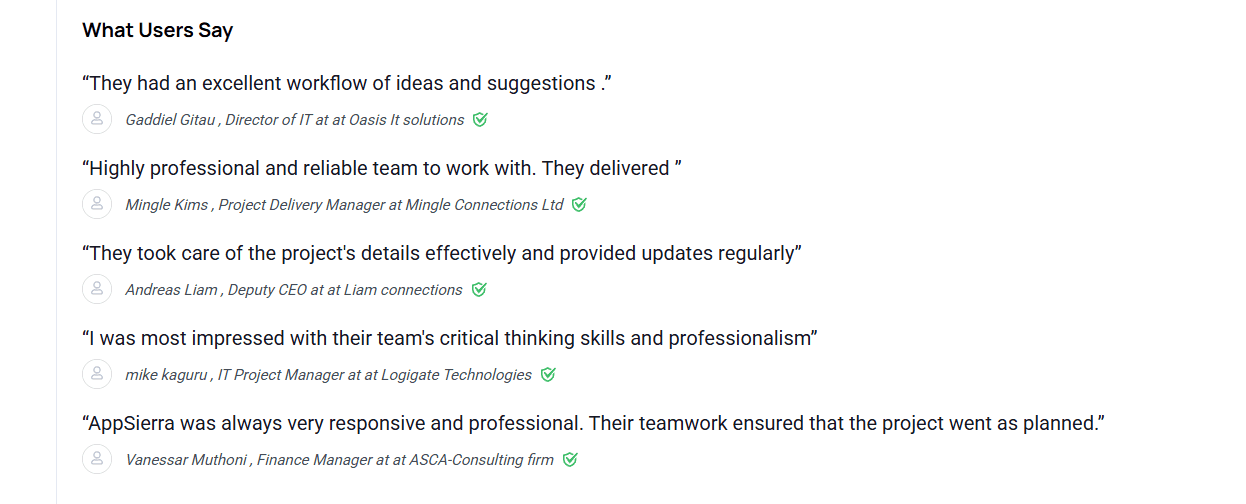
"The flow of ideas and suggestions was great. Because of AppSierra, half of the content on the platform has been tested and finished. The team is also very prompt in their deliverables. They continue to improve user experience and get the platform ready for launch."
Gaddiel Gitau, IT Director (GoodFirms)
2. Trustpilot– Reviewed Client

"We recommend AppSierra because of their quality work and follow-up support. The team was professional, responsive and delivered on what was discussed. There was great communication and all the questions were answered in time."
Solomon Korankye, Trustpilot Reviewer
3. Clutch – Reviewed Client
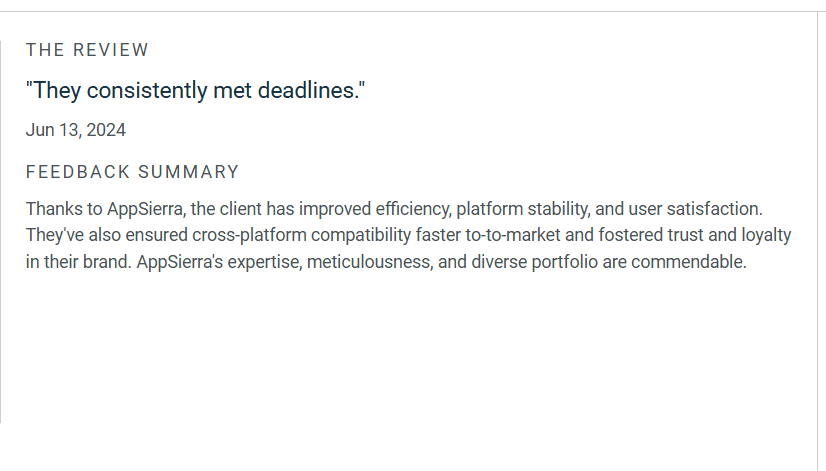
"AppSierra has helped their client increase efficiency, platform stability, and user satisfaction. They have also provided cross-platform compatibility, quicker time to market, and built trust and loyalty to their brand. AppSierra showed expertise, attention to detail and is diverse."
Manager, HCL Technologies Ltd
Industries Served by AppSierra PHP Full Stack Teams
The applications that our PHP full-stack development teams have created span across various industries. In the Financial Services sector, for instance, we have built reliable, fault-tolerant systems for processing and managing investments, as well as trading solutions and blockchain-based applications that manage millions of dollars. Fintech companies require enterprise PHP development for us to become their trusted partners, and we have built that trust by understanding compliance, security, and audit trails.
We have built systems for managing patients, electronic health records, telemedicine, and analytics for healthcare data in the healthcare industry. Our PHP full-stack developers are passionate about building applications where failure is not an option. We understand the critical nature of the industry, data privacy, and the importance of HIPAA compliance. The systems must be perfect and should prioritize the safety of patients at all times.
Our PHP expertise has enabled us to build marketplace platforms, inventory management systems, point-of-sale systems, and customer engagement systems for the e-commerce and retail industry. e-commerce industry has flash sales, inventory levels and payments to secure across multiple sales channels, and how to maximize conversion, and sales. Our applications aid retailers in providing high-quality shopping experiences that increase their bottom line.
We have built complete business applications in the SaaS industry, including CRM systems, project management, analytics, and enterprise applications. SaaS applications require high levels of scalability, secure, harmonious, and multi-tenancy, continuous, disruption-free evolution of features. Our SaaS platform development services experienced high levels of integration for software architecture, billing, and customer management.
We have built educational technology such as learning management systems, student information systems, and online course systems, as well as knowledge and complex content systems for publishers, news companies, and media companies to manage workflows and to serve content and serve to millions of users. Our PHP full-stack development company has been the choice of organizations world over for their mission-critical systems.
Reasons Why Businesses Rely on AppSierra for PHP Full Stack Development Services
AppSierra is a trusted partner for many businesses as we combine technical proficiency with a sincere partnership. Client projects are not for us mere transactions. Instead, we look at them as journeys where both parties invest for a common goal, and in this case, our success is entirely dependent on yours. During any partnership, this philosophy resonates and influences each and every action we take, whether it's during the initial discovery where we focus on your business objectives, development where we are fully communicative, or post deployment where we provide ongoing support and monitor on the system.
When hiring a PHP full stack developer for 2026 projects, businesses appreciate our dedication to security and compliance, which is a highly valued in the FinTech and Healthcare. Both industries are susceptible to the loss of sensitive data, and so we earn our customers' trust because we consider every aspect of security, and we take it seriously. It's not a check, just a task that needs to get done. It is the foundation of our development, and we embed it in our procedures and frameworks for code reviews, testing, and deployment. We are not reactive; we are ahead of the curve.
PHP Full Stack Developer Tech Stack 2026
Frontend Tech Stack for PHP Full Stack Development
A highly refined tech stack has emerged for frontend PHP full stack developers building modern PHP applications. The primary building block remains HTML5, now using semantic markup for enhanced accessibility and SEO purposes. CSS frameworks, especially utility-first approaches like Tailwind CSS, bolster styling maintainability. In terms of structure, modern frontend development has shifted towards component-based approaches rather than page-based ones.
To develop interactive experiences, JavaScript frameworks are invaluable. Using Vue.js with Laravel via Inertia.js for developing modern single-page applications is increasingly popular. Other alternatives for PHP full stack developer 2026 applications include React, Angular, and Svelte, each advocating for varied philosophies with regards to frontend development.
Development sophistication continues to climb in respect to build tools. For local development, Vite is a rapid new alternative to Webpack, featuring instant module replacement and fast feedback. Complex applications with higher levels of bundling configuration will continue to need Webpack.
The npm JavaScript ecosystem allows for extensive package management, reusable library access, and modern frontend development reliance on dependency management, security, and build optimization.
The frontend code's quality is ensured by using testing frameworks such as Jest and Vitest, as well as testing libraries for components. Cypress and Playwright, for example, can be used to do end-to-end testing to confirm complete user workflows.
Backend PHP Tech Stack
The Laravel ecosystem is the representative example for the standard in modern PHP full-stack development. Laravel as a framework, quickly and with a lot of built in conventions, provides the views (Blade templating), the controllers to respond to requests and routing, the models to interact with the data, the migrations for management of the schemas of the databases, and a vast number of conventions to accelerate the development of the system. Laravel provides other specialized packages like Laravel Arena for queue management, Octane for improving performance, and Livewire for adding real-time capabilities.
Working with relational databases through the Eloquent ORM is natural, simple, and safe. Programmatically constructing queries of various levels of complexity is possible with the use of query builders. Sophisticated relationships such as one-to-many and many-to-many are also handled without having to write a lot of code.
The architecture of middleware enables cross-cutting concerns such as authentication. and authorization, as well as the building of logic for logging, and the transformation of requests and responses. The use of service provides clear dependency injection, and the management of configuration. Through the use of facades, clean access to the underlying services is possible.
For PHP API development, Laravel Sanctum (to address simpler use cases) and for complex OAuth flows, with more complexity, the Passport framework, takes care of the authentication. The API's documentation is vital and meshes with tools like Swagger and Open API, to offer interactive documentation.
The Laravel Scheduler, Redis, and AWS SQS provide background processing and maintain responsive user experiences, as slow operations are removed from request/response cycles. Laravel Scheduler aids background processing, driving periodic maintenance, notifications, and the processing of scheduled data tasks.
Database & Caching Technologies
Because of its robustness, advanced features, and extensive tooling, PostgreSQL has become the leading relational database for serious applications, and it has advanced features such as JSON support, full-text search, and array types. Although MySQL/MariaDB may lack some of PostgreSQL's advanced features, it still remains appropriate for many applications that need PHP full stack developer professionals.
In modern and speed sensitive architectures, Redis is cache for frequently accessed data, a session store, a message broker for queues, and a pub/sub system for real-time features. Because of its overwhelming speed and flexibility, it is essential in modern architectures.
Elasticsearch is used to power search functionalities and log analysis. It is ideal for applications that need a powerful search because of its sophisticated search capabilities and distributed architecture. Specialized database systems such as MongoDB, Cassandra, and Memcached also serve to specific needs.
Replication and clustering for data availability and performance are also standard. Primary-replica replication is used for read scaling, sharding is used for write scaling, and backups are used for disaster recovery.
DevOps, Cloud & CI/CD Tools
Version control and collaborative tools include GitLab and GitHub. Actions and GitLab CI provide Integrated CI/CD solutions which reduce the need for external systems. Docker provides consistency for deployments across environments. Kubernetes include scheduling for containers, networking, and service discovery at scale.
Cloud services provide managed services that minimize operational overhead. AWS includes EC2 which provides virtual machines, serverless databases with RDS, function with Lambda, and storage with S3. Google Cloud and Azure provide services with varying strengths comparable to AWS. Terraform is infrastructure as code which provides reproducibility as well as version control for infrastructure.
New Relic, Datadog, and other cloud centered tools provide integrated observability into the behavior of the application during production. ELK stack, Splunk, or cloud tools provides a center for logs that enables analysis and for troubleshooting. Systems that provide alerting are able to help teams before consumers are able to notice problems.
PHP Full Stack Development Trends in 2026
PHP Development with an Focus on APIs
More applications are starting to develop using an API-first approach. In this methodology, back-end and front-end development are completed in parallel, based on a defined contract for how they will interact with one another. Because of this, teams can work independently; front-end developers can simulate API calls for development, and backend changes won't impact the frontend as long as the API contract is followed. This is particularly useful with a PHP full-stack developer as a team member.
PHP API development has improved with the use of PHP frameworks. Laravel is an example of this in which its API resources offer consistent formatting, while authentication via Sanctum allows for state-less API operations, and middleware supports customized authorization. This API-first approach works excellently with a PHP microservices architecture and allows the simultaneous development of multiple consumer applications (web, mobile, third-party integrations) for the same APIs.
It is now a common practice to use OpenAPI/Swagger for documenting APIs. This allows the creation of both human-readable documentation, while also providing a machine-readable version for code generation and API testing. APIs are now being versioned, which allows for additional enhancements without the fear of breaking changes to the current consumers.
Headless CMS and PHP
A headless CMS lets users manage content separately from how it is presented. By managing content centrally and using APIs to provide access to multiple front-ends (web, mobile, other websites), the presentation layer can be altered. Different PHP developers can tailor and build headless CMS services to meet the needs of different APIs.
Developers in PHP full-stack are employing headless systems like Contentful, Strapi, and Sanity. They are also using self-hosted solutions. Developers build advanced front-end systems that integrate APIs, and add layers of caching and search. This structure allows content teams to be in focus and work separately from the developers. It allows the marketing teams to manage content without technical knowledge and deploy content across various systems without the developers managing the code.
Microservices architecture in PHP
The PHP microservices architecture is the newest approach in large-scale PHP applications. It enables the breaking down of monolithic applications into microservices—independent units that can be separately deployed. This also allows teams to work independently, scale different services separately, and deploy mini changes without destabilizing the whole application. This is a critical factor to consider in the development of enterprise PHP applications.
Microservices are best done in PHP considering it is lightweight, can be easily integrated, and can build focused solutions quickly. The services operate through a shared access API, allowing connection via message queueing or streamed events. Operations to microservices can be easily done using a Docker container and orchestrated with Kubernetes.
A primary concern with microservices architecture is how it complicates the management of distributed transactions, eventual consistency, and the added operational complexity. Developers adopting this architecture must implement the saga pattern for distributed transactions, coupled with event sourcing for consistency, and circuit breakers for fault tolerance. These can be viewed as the operational trade-offs that come with this architecture.
AI & Automation in PHP Development
The integration of artificial intelligence is an emerging trend, and equally important, in the development of PHP full-stack applications. With the integration of language models like GPT-4, applications can provide fully automated customer support, dynamic content generation, and even code generation and analysis. The automation of customer support is, in fact, one of the primary AI-driven enhancements PHP full-stack developers are working on.
This involves the use of OpenAI, Google Cloud AI, and even some proprietary models through API integrations. Developers must possess some basic knowledge in prompt engineering, API expense management, rate limit monitoring, and provide alternative solutions in case AI services are temporarily unreachable and/or provide undesired outputs.
The use of AI tools for code generation and subsequent development has become an emerging reality. With AI tools such as GitHub Copilot, ChatGPT, and countless others, PHP full-stack developers can accelerate coding. It must be emphasized that AI code generation needs extensive post-production, but the intrinsic value of AI to code generation is the increased productivity it offers.
Serverless & Cloud-Native PHP
The beauty of serverless has to do with the fact that server maintenance does not have to be a concern when deploying PHP code. AWS Lambda, Google Cloud Functions, and Azure Functions support serverless PHP, which means that developers can seamlessly deploy microservices that scale automatically.
The quick startup time and small memory consumption make PHP suitable for serverless applications, although, for applications that are sensitive to latency, cold start time is still a factor to consider. With a modified approach, even frameworks, such as Laravel, can be used in a serverless fashion.
The focus of cloud native development is on building applications that utilize the full potential of cloud platforms. This encompasses incorporating fully managed databases, cloud-based message queues, storage, and other managed services instead of building everything yourself. Applications that are cloud native tend to be more resilient and scalable and offer better cost efficiency compared to applications that are meant to be cloud agnostic.
The Benefits of Hiring PHP Full Stack Developers
Cost Efficiency of PHP Full Stack Development
There are several cost-related reasons that explain the value that businesses derive from hiring PHP full stack developers. Firstly, compared to other languages, PHP is a lot more budget-friendly, and an even more considerable budget efficiency can be realized when a PHP full stack developer is hired because a single full stack developer can do the same amount of work that would in other stacks require several developers. Consequently, teams can be smaller while the time to develop and the amount of functionality to be delivered are still considerable. This is why the cost of PHP full stack development is very high competitive.
Second, the PHP ecosystem is stable and mature. PHP 8 full stack development has proven stability, unlike younger technologies that need more constant updates and framework changes. Code written five years ago in Laravel still compiles and runs with minor modifications. This stability decreases the long-term maintenance costs of PHP development services.
Third, hosting costs for PHP applications are cheaper than many alternatives. PHP works efficiently with low-end hardware, which also lowers cloud costs compared to other stacks, and many hosting providers are specialized in PHP and have favorable prices. These factors make PHP applications cheaper to run at scale, and improves the overall cost equation for PHP full stack development.
Fourth, the competition for PHP full stack developer roles is higher than for other stacks, which translates into more reasonable rates for PHP developers, and makes it easier for businesses to find qualified developers, whether it is offshore PHP full stack developers or PHP full stack developers in India.
Lastly, the abundance of tools, frameworks, and libraries that come with PHP's maturity means that for almost every requirement there are pre-existing solutions. This is a result of the developer community, and it should be expected that development time and costs are less when compared with other technologies.
Benefits in Performance and Scalabaility
Modern full-stack development has pushed beyond traditional performance boundaries. With PHP 8 full-stack development utilizing JIT compilation, PHP applications perform at an unparalleled level. Consider Facebook, which has developed applications that are capable of scaling to the highest demands of the market.
Caching strategies available to PHP full-stack developers, such as Redis, Memcached, and database query caching, allow applications to sustain extraordinary traffic. With the right caching in place, a system can transform from a performance constrained system into one that is stress-cured.
Techniques in database optimization can be applied to scale to millions of operations that include proper indexing and query optimization along with connection pooling and read replicas. Performing asynchronous job processing removes slow operations from the request/response cycles in order to control the pace of the system.
Stateless PHP applications enable a practice of horizontal scaling. With the use of load balancers to distribute traffic, and Redis for session storage, applications can seamlessly scale from hundreds to millions of concurrent users.
Enterprise & Legacy System Modernization
A large number of companies utilize critical business systems created using outdated versions of PHP and its frameworks. A frequent type of engagement that companies obtain from PHP full stack developers for enterprise PHP development is system modernization. This entails improving security and performance, as well as updating PHP versions and frameworks.
The process of modernization is not easy. This is mainly because such systems generally have deep business logic that is embedded as a result of complex customizations and modifications done by numerous developers over many years. There is a disruption-free, constructive, incremental modernization approach that skilled PHP full stack developers use to transform existing code systems into ones that can support additional and innovative business operations.
One of the best strategies for such an incremental modernization process is the use of APIs. PHP APIs allow modern applications to be built over legacy systems, which can continue to operate. Business logic and modern business operations can be integrated on an ongoing basis, and with minimal risk, throughout the modernization process by implementing new systems one business function at a time.
PHP for SaaS, Fintech & Enterprise Applications
Development of PHP-based SaaS applications is a well-established practice. PHP SaaS development, alongside its ability to quickly innovate, is ideal for SaaS applications of varying complexities. This is due to the extensive flexibility offered at an operational level given its framework with multi-tenancy, and with its framework, it can be economically scaled up. PHP is a part of the technology stack for many successful SaaS applications such as Slack, Shopify, and Etsy, to name a few.
Fintech and banking applications need PHP full-stack development for security, compliance, auditability, and reliability. With modern PHP, errors can now be caught at compile time due to its type system. Laravel, which is security-focused, helps protect applications from most vulnerabilities. Extensive logging and monitoring features can provide the trail auditing needed for regulated industries.
Fewer strict design rules, as opposed to architectural compliance, allow for more innovation. These traits help PHP frameworks meet important enterprise software goals. PHP's cost-effectiveness, coupled with needing less development time, helps enterprises with large development budgets and multiple projects. Most enterprise development teams find PHP frameworks help them meet important goals.
Industry-based Use Cases for PHP Full Stack Development
Development of SaaS Products
PHP SaaS development shines with SaaS applications. Rapid product development, scalable at a low cost, is primarily due to the advanced frameworks and the ready availability of remote PHP full-stack developers or dedicated PHP full-stack developers. Laravel and modern frameworks allow for the development of multi-tenant applications, which means multiple customers can be served with a single application.
Through the services of a PHP full stack developer, you can easily implement subscription management, account management, API integration with third-party services, and usage-based billing. PHP effectively manages each step, helping the application grow from a few users in the early stages of development to millions as the business expands.
Fintech & Banking Applications
Financial apps need the most modern PHP full stack development because of the need for security, reliability, and audibility. The ability to be type-safe with PHP 8 full stack development, use a broad range of testing frameworks, and employ security-oriented libraries makes it possible to build apps that can be ent
rusted with consumers' financial resources. PHP demonstrates excellence in transaction management, encryption, PCI compliance, and fraud detection.
Because it allows for the rapid development of intricate financial systems without requiring the hiring of a large number of employees, many fintech startups opt to employ PHP full stack developer specialists. Fintech companies working with tight budgets are also attracted to the affordable PHP full stack development.
Healthcare & Medical Platforms
Medical applications require reliability and data integrity, as well as the ability to handle sensitive patient information, comply with HIPAA and similar regulations, and more. The ability of a PHP full stack developer to implement strong security and provide reliable scaling makes it a good fit for healthcare in this context, especially for 2026 projects.
Patient management systems, scheduling systems, telemedicine platforms, and medical records management systems utilize PHP for its strengths. In healthcare technology, PHP is valued for its extensibility, custom application development, and seamless integration with a wide range of medical devices and systems.
E-Commerce & Marketplace Solutions
E-commerce is a traditional domain of PHP full stack development. Successful e-commerce applications include payment processing, inventory management, order processing, shipment tracking, and customer relationship management. There are proven product patterns to address almost any issue due to the maturity of PHP in this domain.
Additionally, PHP is frequently used for marketplaces, which are more complex than standard e-commerce systems due to features such as multi-vendor support, commission splitting, and dispute resolution. In complex workflows and advanced data relationships, PHP is highly efficient.
ERP, CRM & Enterprise Systems
Customer Relationship Management Systems (CRM) and Enterprise Resource Planning (ERP) systems are examples of complex systems that require a high level of customization. Once again, PHP's adaptability allows for the development of a system that changes with the organization's defined processes through enterprise PHP development.
The current trend is to build ERP and CRM systems on the cloud as SaaS (Software as a Service) with PHP. he cloud-based systems are more efficient because vendors provide the same version to all customers and all customers benefit from system updates and enhancements.
Steps for Hiring PHP Full Stack Developers in 2026
Hire Freelance PHP Full Stack Developer
Hire freelance PHP full stack developers who offer short term project options, certain feature development, or temporary team scale shifting. Use sites such as Upwork, Fiverr, or other developer specific networks offering freelance access to developers globally. Freelance development relationships work best in situations with a project scope, deliverables, and little ongoing support.
Benefits of freelance relationships include low operational costs, quick scaling of team resources, and access to diverse talent. Some complexities include low quality works, and little commitment to projects, as they are not full time developers and may not focus on tasks as they have multiple projects to work on.
When hiring PHP full stack developers freelancers, it is important to maintain a strong focus and define project goals, create detailed outlines, and maintain strong communication throughout the process.
Hire a Dedicated PHP Full Stack Developer
Hire dedicated PHP full stack developers on your team for long term projects. This is especially important for ongoing development, for project knowledge transfer, and when appropriate continuity is required. Dedicated developers create the need for ownership.
Engagement options include hourly, project-based, and retainer agreements. Retainers are best for ongoing feature development and maintenance contracts, where availability is consistent, though the workload is unpredictable.
Benefits when employing dedicated PHP full stack developers include improved quality (due to focus and ownership), enhanced communication ( resulting from continual interaction), and continuity (developers maintain momentum across projects). This comes with disadvantages such as increased costs and reduced flexibility to scale down or eliminate project elements.
Hire Remote PHP Full Stack Developers
You can hire remote PHP full stack developers from anywhere since modern communication and cloud infrastructure have made remote work seamlessly. PHP full stack developers also remote work from different locations and presents you with global talent, more affordable options than hiring locally, and flexibility in work schedules.
Remote work comes with the challenges of communication, reliance on clear asynchronous documentation, and supportive collaborative tools. These challenges are mitigated with careful scheduling to create time zone overlaps and with planned asynchronous documentation and messages to cover the collaborative gaps. Remote teams often work in a combination of these channels.
In-House vs Remote PHP Full Stack Developers
In-house developers gained features such as seamless cultural integration, clear communication, and integration with the rest of the team. These are offset by the fixed costs, long term commitments, and the benefits of hiring in-house. It takes a significant investment to build a strong in-house team.
From the beginning, remote arrangements foster flexibility and allow companies access to worldwide talent when hiring full stack PHP developers. In addition, hiring full stack PHP developers remotely means that companies have to make stronger communication arrangements and may have to deal with in poor cultural fit. Hybrid approaches - a combination of in person and remote PHP full stack developers - ultimately provide better flexibility.
Checklist of essential skills to evaluate in a potential PHP full stack developer
When hiring a PHP full stack developer, the applicant should demonstrate the following core competencies: Modern PHP 8 full stack development (especially PHP 8 and new features), coding with security in mind, one or more frameworks (ideally with Laravel or Symfony), full stack development with relevant front end technologies such as HTML and CSS, JavaScript, and related frameworks, designing and optimizing databases (especially PHP MySQL), development and integration of PHP APIs, a full range of testing skills (unit, integration, end to end), version control with Git, a full range of deployment and DevOps skills, and communication skills to work in a team or solo.
In addition to the above technical skills, new potential PHP full stack developers should be evaluated to assess interest in problem solving, attention to detail, adaptability, and communication clarity. A developer that can break down complex problems to a non technical audience, pose the right questions, and in the beginning consider edge cases and performance issues is more valuable than a peer that lacks essential soft skills.
Interviewing and Evaluating PHP Full Stack Developers

Technical skills evaluation
Evaluate PHP full stack developer candidates utilizing various means to assess their level of expertise qualitatively. Reviewing candidate work will provide insights into work quality, critical thinking, and their ability to manage and solve complex problems. Coding problems, such as creating an implementation of a feature, and solving a work-related challenge will demonstrate their ability to code and solve problems under pressure.
Test core PHP concepts, such as type hints, traits, and abstract classes. Query schema design, normalization, and indexing, and examine loss of database knowledge and optimization. Test knowledge of architecture, routing, and ORM of frameworks. Test JavaScript and front-end skills relative to the role.
PHP full stack developers should consider performance when writing code, think about security, and write code they themselves would want to maintain in three years. Developers who explain their choices demonstrated a deeper understanding of the concepts than those who simply followed the conventions.
Architecture & System Design Assessment
When evaluating architectural thinking, what would you do to address a feature with vague requirements? How would you scale an application for millions of users? What is your strategy for refactoring an old problematic legacy module? Strong PHP full stack developers considers trade-offs, a number of solutions to a problem, and makes reasonable choices.
Evaluating skills in defining APIs, databases, and system elements. Are they able to determine when to utilize relational and when to use NoSQL databases? Are they able to recognize when microservices must be extracted and when features should be retained in a monolith using PHP microservices architecture? Can they recognize possible bottlenecks and design solutions before they arise?
Evaluating system design also determines how PHP full-stack developers think about complicated issues, whether they take time to collect information before they design, and whether they think about design and operational issues such as monitoring and deployment during the design phase.
Coding and Review of Real-World Projects
Analyze the actual code the developer has compiled. Look for the quality of the code: is it understandable? Are there names for functions and variables? Is there an appropriate level of complexity? Is there consideration for edge cases? Is there sufficient error handling? Are there any security vulnerabilities?
Look into the Testing: is there any code that has been tested? Are the tests meaningful, or are they only to satisfy coverage? Are the tests to check behaviors or simply to go through the code paths? A developer's philosophy of testing shows how committed they are to quality and maintainability.
Consider how the PHP full-stack developer managed code quality over time, including refactoring and dealing with legacy code. Developers who consistently improve codebases show a level of maturity that is higher than those who merely add new features.
Security Evaluation and Performance Evaluation
Evaluating their security knowledge involves asking about the common vulnerabilities (i.e. OWASP Top 10) and doing a code review. Can they spot security problems in code? Do they think about security in design? Have they done authentication and authorization? Can they talk about encryption and secure the data?
Evaluating performance looks at whether the php full stack developer thinks about performance during the implementation. Do they consider efficiency when writing queries? what about when writing caching strategies? Do they think about asset optimization? Are they capable of using profiling tools to discover bottleneck? Do they understand the trade-off between performance and a variety of other optimization methods?
Proactive design likely considers all of these factors much earlier in development, rather than solving problems post factum when the system already has broken.
Predicting the Cost of Hiring a PHP Full Stack Developer in 2026
Cost per Hour for PHP Full Stack Developers
The hourly rate for a PHP developer depends on the geographical location, years of experience, and the level of skill of the developer. A PHP developer in a developing country will charge much less than a senior PHP developer in a developed country. In addition, the hourly rate is based on the level of experience and specialization.
Typically, experienced PHP full-stack developers possess more skills and take on more tasks than specialists, enabling them to work on entire projects solo, which is why they charge more. Because of their ability to handle complex requirements for certain industries (fintech, healthcare, e-commerce), there is a high demand for senior developers, which is why they charge the highest PHP developers hourly rate.
Contracting PHP developers on a monthly basis
For ongoing PHP development services, a monthly contract provides predictability on spending, which is why it is often chosen for a budget. Retainers can be structured as a fixed monthly charge for a certain number of hours, which is ideal for ongoing maintenance and the development of new features. Monthly costs are a function of the number of developers needed, their seniority, and the length of the contract.
As PHP full stack developers, their level of experience decreases the onboarding time, allowing them to work more efficiently. Because of this, they provide the best value for longer-term contracts.
Regional Cost Differences
The geography of PHP full stack developers can also be the PHP full stack developers' pricing. PHP full stack developers in high-priced regions (i.e. San Francisco, New York, London, and almost all of Europe) charge significantly more than those in developing regions like India. However, developed regions do not necessarily provide a better quality service than their developing counterparts. Experience onshore PHP full stack developers in developing regions often provide great service for lower costs.
Firms are more often recognizing the advantages of geographic distribution, where project leads assign different roles to optimize cost and quality across different geographies. For example, senior architects are recruited from premium markets, and junior developers are added from cost-effective markets, where both the quality and cost of PHP full-stack development are optimized.
Factors Influencing the Hiring Cost of PHP Developers
The extent of experience is one of the most significant determinants of the cost of PHP full-stack developers. Junior developers typically cost less; however, they tend to require more supervision and may initially produce lower quality work to meet required standards. On the other hand, senior developers cost more, but are more likely to produce higher quality work and more optimal project architectures, while also making fewer mistakes overall. Imbalance between the size of the developer and the project impacts overall developer pricing.
The amount of project work also plays a significant role in determining the overall cost of PHP full-stack development. Large development projects are often more costly and less desirable than simple projects, such as CRUD, where completed builds are deployed. On the other hand, in projects where time is constrained, more costly adjustments are likely to occur. For development projects where a capped cost has been set, the overall project cost may appear higher, despite the result being more optimal from a cost certainty perspective.
Common Errors in Hiring PHP Full Stack Developers
Recruiting Only Backend-Focused PHP Developers
One such error is recruiting developers who are primarily focused only on the back-end with little to no experience on the front-end. These developers are wrongly assumed to function as PHP full-stack developers. True PHP full-stack developers are proficient across all layers, and not only the back-end.
This mistake results in inadequate front-end implementations, poor user experience, and friction among team members with varying expertise. Assess candidates based on their actual PHP full stack developer competencies, and not on false expectations of what they are supposed to know.
Overlooking the Importance of Security and Scalability
When the emphasis is on cost and time, while overlooking security and scalability, applications are created that will only require damaging retrofitting in the future. Post-launch security flaws and scalability bottlenecks are way more costly to fix than during development.
Security knowledge and the ability to think in terms of scalability ought to be considered in candidates. Address concerns on how they mitigate the risk of security flaws, how they deal with it, and their strategies on performance optimization. PHP full stack developers with significant and successful experience in this area ought to be of priority.
Insufficient Technical Screening
Recruiting without adequate technical assessment results in the recruitment of PHP full stack developers who oversell their abilities. Apply your efforts to sufficient technical screening such as code evaluation, hands-on skills assessment, architectural discourse, and reference confirmation.
Technical screening revolves validating claims, thoughtfulness, and the ability to tackle challenges as a PHP full-stack developer. It isn't about knowledge that is obscure and trivia type questions.
Choosing Cheap PHP Full-stack Developers over Quality Code
Not all low-cost PHP full-stack developers lead to the best value. For example, one developer delivering low caliber and inexpensive code tends to generate technical debt and incur significant costs further down the line, spending more than is necessary to fix the low caliber code that offers challenges in the areas of maintenance, security, or overall architecture.
Assess your PHP full-stack developers based on the merit of their code and not strictly their hourly rates as PHP developers. It will be best with developing cost efficacious code over the life of a project.
Individual Developer vs. PHP Full Stack Development Company
Benefits of Engagements in a PHP Development Company
Having a PHP Development Company increases the breadth of the knowledge and skills. Working with a single developer has limitations, but with a development company, there are specialists and more experts in each sub-domain—they are all able to work together. Having this breadth of knowledge and skill, allows the development of more complex architectures to be bug free with more robust solutions.
Companies offer dependability and assurance. If one developer becomes unavailable, other team members can step in and keep the projects moving. Companies have procedures that guarantee quality, security, and the right documentation is in place. They offer project management and keep the communication and delivery on time seamless.
A PHP development company has acquired knowledge and experience of working on a variety of projects in several industries and fields of expertise. With this wide experience, it is possible to recognize issues, to offer solutions that have been proven to work, and to steer clear of mistakes that less experienced developers might make.
A PHP full-stack development company can be trusted to tackle mission-critical projects with complex requirements, or situations where continuity is needed.
When to Select a Dedicated PHP Development Team
When projects are substantial, have a long duration, or are of great strategic value, there is often substantial value in dedicated development teams versus individual developers. Development teams have the ability to work on several features simultaneously, and possess specialized skills in different areas, and continuity when individuals are unavailable.
Strategic projects, which include entirely new products, platform rewrites, and significant system implementations, are much better when it comes to the coordinated skills that teams offer. Although the PHP full-stack development team costs are higher in the short term, they tend to provide better results in the long term.
Benefits of Long Term Support and Maintenance
Through PHP development services, a PHP software development company offers support, maintenance, and evolution. Instead of having to search for a former developer to add a new feature or fix a bug years down the road, companies provide relationship stability for long-term support. This is particularly important for software solutions that need to adapt over several years.
When development teams provide maintenance, it helps ensure that business-critical applications remain supportable over the long term. Maintenance is one of the most vital components of a successful application, and it helps to ensure that it is safe from newly discovered vulnerabilities, adaptable to growing data, and flexible to changing business needs.
Why Select AppSierra for Full Stack PHP Development
AppSierra's PHP Full Stack Developers Are Highly Experienced
AppSierra's PHP full-stack software developers have several decades of cumulative experience working on a variety of projects in a range of industries. Our developers have built everything from small sites to large-scale applications serving millions of users. This allows us to draw from a large pool of experience to implement successful patterns, forecast obstacles, and provide management of frameworks that will best serve your organization over the long term when you choose to hire professional PHP full-stack developers from AppSierra.
Our developers stay knowledgeable about the state of the industry through their progressive learning, conference participation, and community engagement in the PHP ecosystem. We prioritize the improvement of our staff so that our developers are able to keep pace with the constantly changing PHP and full-stack developer tech stacks and best practices.
Tailored PHP Full Stack Solutions
Through our PHP full-stack developer services, we do not just create applications; we construct solutions that address distinct industry challenges. We can create safe and compliant financial systems due to our experience in fintech. Our healthcare sector expertise guarantees reliability and HIPAA compliance. Our e-commerce experience means we appreciate conversion optimization, payment processing, and scalable solutions to accommodate top-traffic periods.
This level of industry expertise means we not only the technology, but we also understand the business, compliance, and operational landscapes that enterprise PHP development applications must fulfill.
Flexible Hiring Models and Honest Pricing
We focus on providing honest PHP full-stack developer pricing with no hidden fees and unanticipated overages. We are upfront about costs and provide clarity on the scope of work and stay in touch for budget-related updates. Our adaptable hiring models—retainers, project-based, and hourly—vary to fit your needs and budget.
We provide tailored engagement strategies. Whether you want to hire a PHP full stack developer remotely for part-time work, a PHP full stack developer dedicated to full-time work, or need project-based development, we provide flexibility.
Long-Term Collaboration & Dedicated Assistance
We view a client's relationship as a collaboration, where we mutually depend on each other for success. We spend time learning about your business, goals, and obstacles. Because of this partnership attitude, we are committed to going beyond what is in the contract to help you achieve your goals.
The PHP development services we provide after launch do not stop when your applications go live. We provide consistent updates, monitoring, and maintenance. We take a tailored approach to each of your issues, and your unique needs. We get to know your entire system to ensure we meet your needs when adding new features instead of adding code.
FAQs: PHP Full Stack Developer 2026
Is PHP Still Relevant in 2026?
Sure. More than 77% of the websites on the internet are made with PHP, making it the most used and the most deployed server-side language in the world. It is still used by large companies, such as Slack, Facebook/Meta, Etsy, WordPress, and many others. New projects still choose PHP full stack development for its ecosystem, cost-effectiveness, and practicality.
PHP's full stack relevance is in effectively solving problems. PHP full stack developer professionals will continue to be in demand in 2026 as long as companies require necessity-driven web applications. Application sophistication in PHP 8 full stack development coupled with Laravel and Symfony can rival other programming languages.
Which is the Best PHP Framework for Full Stack Development?
Over the years, Laravel has become the most popular PHP framework for full stack development. Its elegant syntax, rich feature set, and a very active community have been some of the reasons why Laravel has been dominant. Laravel full stack developer professionals, for example, have everything covered to provide a complete and cohesive system for everything from frontend templating to backend logic and job queue to database abstraction.
Symfony full stack developer professionals provide another option for companies that want to offer the most flexibility and decoupled components. Symfony employs a component-based framework where with one of the complete components, you can provide an entire solution without having to use the full framework.
The ideal solution is dependent on the project. Laravel full stack developer professionals will often provide the quickest time to production for most projects. Symfony full stack developer professionals will be preferred when the project requires significant customization.
How Long Does PHP Full Stack Development Take?
The timeline varies based fully on the scope of the project when hiring PHP Full Stack Developer teams. In the case of simple applications, such as CRUD systems or informational sites, the timeline is measured in weeks. More advanced systems, such as eCommerce or PHP SaaS development applications, are measured in months. For intricate systems that involve integration with other systems, the time estimation increases significantly.
Conclusion
The PHP full-stack development for 2026 forecasts a finishing approach to modern web application development. PHP's cost efficiency combined with an established ecosystem and the expertise of a PHP full-stack developer attracts businesses of all sizes.
From PHP SaaS development applications to enterprise PHP development and customizing legacy systems or enterprise solutions, PHP full-stack developers, serve modern businesses with all the versatility, value and expertise. There is a clearly outlined need for PHP full-stack developer 2026 and this is backed with solid reasoning since the end product is achieved quickly within a period of time and with a PHP full-stack developer great cost.
Employing PHP full-stack developer professionals provides a solid combination of both experienced personnel and tested technology. This solid combination is present whether you employ a remote PHP full-stack developer, or an offshore PHP full-stack developer, or even a dedicated PHP full-stack developer. Comprehensively experienced professionals are an absolute must with the modern PHP full-stack developer technology.
At AppSierra, we believe in forming genuine partnerships. We have the proven methodologies, industry specific knowledge, and experience to assist you in your PHP development services. Established as a PHP development company and PHP full-stack development company, we value the transparent PHP full-stack developer pricing and reasonable PHP full-stack development cost just as you do. As expert PHP full-stack developers, your project success is our goal. We assist you in expert PHP full-stack development from discovery through deployment and continue to provide ongoing support, be it a Symfony full-stack developer, Laravel full-stack developer, PHP MySQL full-stack developer, or PHP API development.
Want to contact AppSierra to hire PHP full-stack developer for 2026 projects, or looking for a PHP full-stack developer for hire? We have PHP full-stack developers in India and Offshore PHP full-stack developers. Our PHP full stack developers provide premium services that impact your business positively through state-of-the-art PHP 8 full-stack development, PHP microservices architecture, and extensive PHP development services.
Ready to put this into practice?
Appsierra's expert-supervised QA and AI engineering pods help teams ship higher-quality software faster — with senior accountability and a low-risk pilot. Tell us what you're working on.