
Mobile App Developer in Chennai 2026
Mobile App Developer in Chennai 2026 guide covering latest technologies, hiring tips, costs, and top development practices.
Mobile App Developer in Chennai 2026
About The Author
Written by: Shivam Gupta, Content Writer, AppSierra
Shivam has extensive experience in building, scaling, and managing solutions related to QA testing, software quality assurance, and test automation, for startups and businesses in the healthcare and enterprise sectors across the globe.
Currently, he holds the position of Content Writer and Industry Analyst focused on HR technology, recruitment optimization, and enterprise software, and has a keen interest in producing research-oriented and high-impact content for the global tech market.
Area of Expertise: Healthcare mobile applications, platforms for medicine delivery, enterprise software solutions, and technology strategy.
About Appsierra
Founded: 2015
Headquarters: Noida, Uttar Pradesh, India
What They Do: Appsierra develops customized software solutions, including web applications, mobile applications, desktop software, and integrated systems to address various business needs.
Team Size: Over 150 technology experts
Global Offices: India, the USA
Track Record: More than 1,251 delivered projects, 60% average cost savings, and partnerships with Fortune 1000 companies.
Introduction
Chennai has established itself as one of the best technology hubs in India. It is home to many global companies looking for reliable and skilled employees for their digital transformation projects. In 2026, the competitive IT ecosystem in the city is providing companies with high-quality talent and new development opportunities.
How Chennai Became a Global Player in App Development
Chennai is becoming a global tech powerhouse. More than 600 IT companies employ over 400,000 tech professionals, creating a self-sustaining ecosystem that enables innovation and deep expertise in every specialty.
Chennai's IT Ecosystem and Talent Pool
Chennai is home to several prestigious institutions that produce thousands of engineering graduates every year, including IIT Madras, Anna University, and many others. Newly minted graduates join seasoned professionals as a result of the city's excellent IT global exposure and the city's clientele. This allows the city to produce high-performing workforces that tackle the multi-dimensional areas of cross-border IT global exposure and clientele.
Chennai's IT corridors, such as OMR (Old Mahabalipuram Road), Thoraipakkam, and Guindy, have become benchmarks of tech verticals. These areas have a wide variety of tech players with multinationals and several tech startups, creating ecosystems of cross-pollination and sharing of best practices.
Why Global Companies Use Chennai
Chennai offers several advantages, including low cost and great quality. Chennai is the only city in the world that has the best quality of mobile applications in the world. The technical capability of the staff and the ability to meet the global standards of project delivery is unparalleled.
Real-time collaboration is facilitated by the time zone overlaps with the European and Middle Eastern markets, and English proficiency across the workforce streamlines communication during project lifecycles. Furthermore, the consistent political climate and well-developed frameworks of Chennai give enterprise clients the dependability needed for mission-critical work.
Mobile App Development Market Growth Trends
There has been significant growth of the mobile application market within Chennai, with the sector expanding by nearly 23% annually within the last three years. This growth is indicative of Chennai's increasing ability to deliver results and the heightened demand from domestic companies undergoing the digital transformation.
Mobile apps with advanced technologies like artificial intelligence (AI), machine learning (ML), and Internet of Things (IoT) integration have become the norm instead of the exception. Chennai-based companies are positioned among the best in technological innovation because of their ability to regularly include advanced features in their mobile apps.
What Decision-Makers Search Before Hiring Developers
When conducting their evaluations, business leaders as potential partners consider several key factors first. They demonstrate the technical ability through their portfolios and case studies, and then look for such domain knowledge, based on industry, that showcases experience to answer the case, and finally, they assess the level of communication to ensure the project remains within the business parameters.
The evaluation of security credentials, compliance certifications, and scalability track records is particularly relevant for businesses in regulated industries or those anticipating major increases in user volume.
Why is AppSierra Mobile App Developer in Chennai Preferred?
About AppSierra
As a leader in mobile app development in Chennai, AppSierra offers end-to-end services that help clients turn their business concepts into revenue-generating mobile applications. AppSierra has been developing mobile applications in Chennai for several years, and in that time, has earned significant recognition for producing mobile applications that are impactful, scalable, and economical from a business perspective.
As a result of the combination of technical and business skills possessed by our mobile app developers in Chennai, an application focuses not only on achieving the prescribed technical parameters, but also on achieving the prescribed business goals. Mobile app development in Chennai goes beyond programming. It requires strategy, a design that focuses on the user, and an unwavering desire to achieve a decisive end result.
AppSierra Mobile App Development Proficiency
AppSierra mobile app development in Chennai is front-to-back as it pertains to the development life cycle. It encompasses all phases from the initial consultation to planning, deployment, and post-launch updates. Our Chennai mobile app development services encompass all components associated with mobile app development, such as front-end and back-end development, design of the user interface and user experience, cloud infrastructure, quality testing, and post-launch maintenance.
When collaborating with AppSierra for your app development Chennai projects, you can expect a team with a proven track record for delivering successful applications in multiple industries. Our portfolio speaks volumes about our competence in managing a variety of expectations, and obtaining client satisfaction in our delivered solutions.
AppSierra's Android, iOS & Cross-Platform App Development
As prominent iOS & Android app developers in Chennai, AppSierra specializes in native and cross-platform development. Using Kotlin and Java, our Android development team crafts sturdy and adaptable applications. Our iOS development team, using Swift, creates high performing applications for Apple devices.
Moreover, for iOS and Android development, when businesses need to expand their markets while managing their development costs, our cross-platform development services using Flutter and React Native is a viable option. This flexibility means that our mobile app developers in Chennai can provide you with native apps or cross-platform solutions to meet your custom needs.
AppSierra Mobile App Development Methodology
Best practices of the mobile app development industry and the Agile methodology guide our mobile app development approach in Chennai. This means that we value transparency, flexibility, and timely delivery. Each project begins with a highly detailed business consultancy and requirements gathering to obtain your objectives, and to understand your needs before development begins.
You are involved every step of the way in our iterative development processes, from wireframing and design to development and testing. This collaborative end-to-end mobile app development approach in Chennai guarantees alignment with your business goals and vision.
AppSierra Mobile App Services is rated by Experts
1. Trustpilot – Verified Client Review
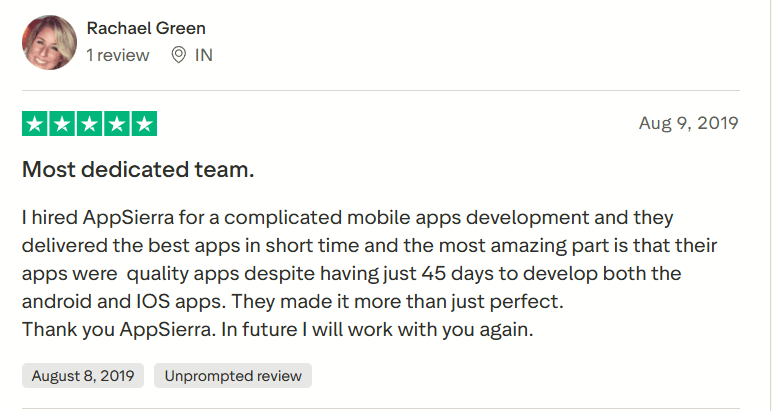
I hired AppSierra for a complicated mobile apps development and they delivered the best apps in short time and the most amazing part is that their apps were quality apps despite having just 45 days to develop both the android and IOS apps. They made it more than just perfect. Thank you AppSierra. In future I will work with you again.
Rachael Green, Reviewer on Trustpilot AppSierra Solutions
2. Clutch - Client Case Study
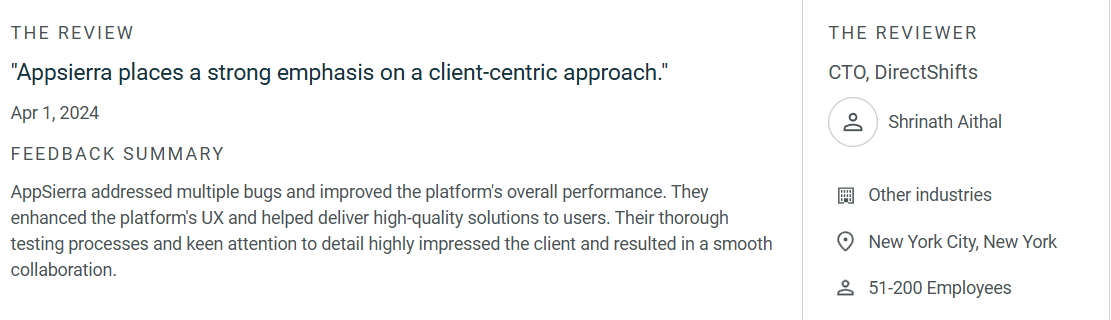
AppSierra took care of the bugs, thus improving the overall performance of the platform. They helped in improving the platform's user experience, providing users with quality solutions. Client's detail-oriented approach to testing impressed the client, enabling smooth collaboration.
Shrinath Aithal, Marketing Analyst, Real Estate Sector
3. GoodFirms – Client Case Study
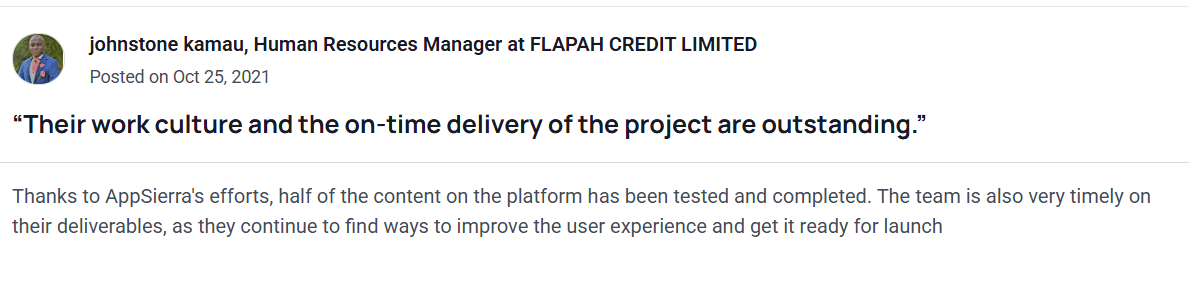
Due to AppSierra's effort, testing and content on the platform is now 50% complete. Also, the team is punctual with their deadlines and continues to improve user experience to prepare for the upcoming launch.
Johnstone Kamau, Human Resource Manager at FLAPAH CREDIT LIMITED
Categories of Mobile App Development Companies in Chennai
Knowing the different types of service providers available allows clients to find developers whose skill sets match their specific needs. Chennai's varied ecosystem provides ample specializations and business models.
App Development Companies Focused on Startups
These flexible and creative companies get the specific obstacles that new businesses face. They usually have a variety of pricing structures, and can adapt their development styles to be more efficient and cost effective.
Start-up development companies can take ambitious concepts and transform them into minimum viable products (MVPs) that can obtain funding or confirm a market for the product. These companies typically have employees with entrepreneurial backgrounds who can provide a greater breadth of knowledge than just engineering.
Most ideal for:
- Startups that are in the early stages and need an MVP
- Companies that are able to change quickly and need successive iterations
- Programs that are in the early stages and have constrained budgets
- Companies that need out of the box thinking
Mobile App Development Companies for Enterprises
Companies that are enterprise focused have extensive structure, paperwork, and a high level of a control when it comes to big projects. They have a variety of employees in different specializations to ensure all of the facets of their more complex applications.
Since these companies work in regulated industries, they are now business partners due to their certifications in legacy system integration and compliance. Additionally, they are able to meet complicated system needs. differentiated venture enterprise level sophisticated complex architectural
Best suited for:
- Large firms with sophisticated IT systems
- Extensive third party integration projects
- Applications with regulated or sensitive data
- Organizations focused on high Scale and Sustain long-term Maintenance
Developers of SaaS Apps and Product Engineering
Product-centered firms consider entire life cycles of products during projects, beyond just completing the tasks. Additionally, they help the client to shape and prioritize roadmaps and develop apps to adapt to changing environments through technical development collaboration.
These specialists grasp the principles of subscription models. Invaluable to companies with a large user base, their experience with thousands or millions of users has contributed significantly to user experience, system performance, and enhancement scalability.
Best suited for:
- Subscription based SaaS companies
- Companies with consumer end products
- Organizations with long-term planning for the evolution of products
- Businesses requiring the development of product strategy and development integration
Cross-Platform vs Native App Specialists
The differentiation between native development and cross platforms frameworks encases many fundamental choices that will impact costs, timelines, and flexibility in the long run. Chennai has specialists for each of the approaches, who come with their own unique benefits.
Cross-Platform Specialists use Flutter and React Native to create apps for both iOS and Android. Using a single codebase for both platforms can cut development time by 30 to 40% and make ongoing maintenance easier. This can be a great option for businesses with budget and time constraints.
Native App Specialists use platform-specific development for both iOS and Android using Swift and Kotlin, respectively. This offers the best performance, full access to platform capabilities, and great user experience. This does come with high costs and long timelines.
Before Hiring a Mobile App Developer, Evaluate Some Key Factors
Choosing a partner requires careful consideration. The businesses that make the most time to deeply evaluate the partnership often have the most streamlined projects and best results.
Technical Mastery (Android, iOS, Flutter, React Native)
The technical foundation is the most important part of successful delivery of a project. Evaluate your potential partner based on their previous work, especially in the relevant technologies and propose the right technical methods for the needs at hand.
Details regarding the development teams' skillsets, years of experience with particular frameworks, certifications, or any open-source contributions would help streamline the potential partnerships with each company, as each company will utilize the breadth of their technical expertise to design the most appropriate solutions as project needs evolve instead of forcing a preferred technology solution.
Some of the primary technical skills to investigate are as follows:
- Specialization (iOS, Android)
- Cross-Platform Development (Flutter, React Native)
- Backend Development (Node.js, Python, Ruby, Java)
- Cloud Development (AWS, Google Cloud, Azure)
- Database Systems (SQL, NoSQL, and other real-time databases)
- Security
- Integration APIs
- Development of Testing and Quality Assurance
- Industry (Health, FinTech, E-commerce, and Logistics)
When working within a specific domain, expertise is especially pertinent. Healthcare is a highly regulated field with complex business structures, and this domain is one of the most challenging. In this regard, it is important to have developers that not only understand the technical aspects of telemedicine but also the safe harbor laws, HIPAA, and other patient data protections.
Developers on FinTech projects must understand the in-country laws regarding financial transactions, as well as the technical aspects of fraud mitigation and payment processing. E-commerce projects require strong knowledge on conversion optimization, as well as the technical aspects of payment processing and operational structures in the inventory systems.
Look at references and case studies within the same areas. Specify the details of the challenges faced and how those challenges were met in a given project.
Development Methodology (Agile, DevOps, and Scrum)
Methodologies shape how teams structure their workflow, communicate, and manage progress toward goals, especially with changing priorities. Knowing a potential partner's methodology helps define realistic expectations around their collaboration and how visible the project will be.
Agile Development involves adapting as necessary during the development process, with periodic feedback influencing how work is done. Agile teams work iteratively, building functioning software during short development cycles (known as sprints) and then refreshing the software based on stakeholder feedback. These cycles are usually between two and four weeks long.
DevOps Practices and Scrum Framework both focus on collaboration and structure, with DevOps Practices integrating development and operations, and Scrum integrating with Agile Methodology and focusing on creation. Each provides a framework for collaboration through the use of automation, continuous integration, and rapid deployment, facilitating the DevOps approach of shorter release cycles and more reliable applications.
The Scrum Framework and DevOps both work to make workflows better by working and having a clear plan. This helps to get things done faster and have reliable applications. The Scrum Framework and DevOps are all about people working together. They have ways of doing things, like the Scrum Frameworks daily meetings, planning sessions and reviews. The Scrum Framework has stand-ups, sprint planning and retrospectives to make sure the team is always getting better and on the same page. The Scrum Framework and DevOps use these practices to make sure everything runs smoothly and that the team is always improving.
When you are looking for someone to work with you should ask them to tell you how they do things. You want to know about their work and how they handle the things that need to be done. How do they talk to each other and to you? What is their system, for keeping track of progress and making changes when needed? Development cycles can be complicated so you need to know how they will make sure the work is quality. You need to ask about the development cycles. How they keep the quality high during this time.
Security, Compliance & Scalability
When you are looking for development partners you have to think about the problems that can happen if security is not good and if there are compliance failures. You need to look at how the development partners handle these security and compliance issues. It is very important to think about security and compliance at the beginning of a project not at the end. This way you can make sure that the development partners are doing things the way from the start, with security and compliance.
Security Evaluation Points:
- Secure coding guidelines and code review practices
- Methods of data encryption (in transit and at rest)
- Implementation of authentication and authorization
- Security of third party and penetration testing
- Incident response processes
- Security patching and updates
Compliance Considerations:
- Industry-specific regulations (HIPAA, GDPR, PCI-DSS)
- Data privacy frameworks
- Compliance certification(s)
- Familiarity with compliance audits
- Compliance supporting documentation practices
Scalability Assessment:
- Growth supporting architecture patterns (microservices, serverless)
- Familiarity with load testing and performance tuning
- Database strategies for scaling
- Implementation of caching and CDN
- Dynamic scaling
Transparency and Pricing Models
When you know about the ways that companies price things you can make good choices that work for you and your money. You have to think about what you're willing to risk too. Some pricing plans are better for kinds of projects and some companies like one way of pricing more, than another. Pricing models are important because they help you decide what to do based on how money you have and what you are willing to risk. Different pricing models fit projects and what the company wants.
Pricing Models Comparison
Model | How it Works | Best For | Advantages | Considerations |
| Fixed Price | The total cost is something that people agree on when they know what work needs to be done. This is called the scope of the project. The total cost is agreed upon for this defined scope. | Well-defined projects with clear requirements | Predictable budgeting with clear deliverables | The thing is, you do not have a lot of flexibility with this. If you want to make any changes the change requests will cost you money. The change requests are not free so you have to pay for them. |
| Time & Material | You pay for the service by using daily rates and then they are multiplied by the amount of time you actually spend using it. The cost is figured out by taking the daily rates for the service and multiplying that, by the time spent. | Evolving projects with unclear initial scope. | You have the flexibility because you are paying for the actual work that gets done. This means you only pay for the things that the people working for you actually do. You get to decide what work is important and what you want to pay for. The payment is for the actual work done. | We have a budget that's not certain and it needs to be watched closely. The budget needs people to keep an eye on it all the time to make sure everything is okay. The budget uncertainty is a deal and it requires active oversight of the budget. |
| Dedicated Team | There is a monthly fee for the dedicated resources. | Best for long-term projects with ongoing development needs. | You have control over everything and you also get to work with a team that you are familiar, with which means the quality of the work is always consistent. The team familiarity is really important because it helps to get the job done well. You get quality from the team, which is great. | There is higher commitment with minimum engagement periods. |
| Milestone-Based | There is a payment structure tied to specific deliverables. | Best for medium complexity projects. | You have the freedom to make changes when you need to. At the same time you know what to expect from the system. This means you get a balance of flexibility and predictability. The flexibility of the system is really helpful. The predictability of the system is also very important. You get to enjoy the benefits of flexibility and predictability. | To do this thing properly we need to have a clear idea of what we are trying to achieve with the project. The project requires milestone definition. This means we have to define each milestone of the project clearly. The project milestones need to be defined in a way so that everyone understands what they are doing. Clear milestone definition is very important, for the project. |
When you work with partners you should get a clear idea of what things cost and why. They should tell you what they are thinking and what they are doing. You need to ask them about things that might cost you money, like computers and servers or if they need to use other companies to help them or if you have to pay to keep things running or if you want to make things better.
Top Mobile App Development Companies in Chennai
The coding and mobile app development scene in Chennai is really big. It has all kinds of companies from international ones to tiny specialized ones. The companies I am talking about are. Mobile app development companies of all sizes. They can be big coding and mobile app development companies or very small coding and mobile app development companies. It depends on what coding and mobile app development services they offer how well known they are, in the market what their customers say about them and how good their coding and mobile app development technology is. This is not about saying which company is better than the others. It is like a helper for people, in charge who need to choose a company.
AppSierra
AppSierra does two things for its clients in Chennai. It helps make things and it also makes sure these things are good quality. This is a good thing because AppSierra uses both development and quality assurance. When AppSierra combines development and quality assurance clients get a check on the quality of the work at every step of the project. This is what makes AppSierra special, in Chennai where there are other companies doing similar things. AppSierras development and quality assurance teams work together to make sure clients get the results.
Core Strengths:
- Integration of QA and development processes from the very beginning
- Cross-industry expertise in healthcare, finance, and e-commerce
- Adoption of Agile frameworks with a focus on continuous testing and integration
- Implementation of scalable architecture to foster business growth
This is best for applications that're mid-size to really big and complicated. These applications need to make sure they are working correctly and that they are developed properly. This is especially true for industries that have a lot of rules to follow, like finance or healthcare where the quality and security of the application's very important. The companies in these industries have a lot to lose if something goes wrong so they need to get it right. Quality assurance and development expertise are crucial for applications, in these industries.
Tata Consultancy Services (TCS)
As one of the most prominent IT service companies in India, TCS has meaningful presence in Chennai with operations spanning the globes with enterprise clients in most industries. Their fully-fledged digital services includes mobile app development as part of other transformational activities.
Core Strengths:
- Massive scale and resource availability
- Proven track record with Fortune 500 companies
- Comprehensive service offerings beyond app development
- Global delivery network and standardized processes
Best for: Large scale enterprise applications with major integration requirements with existing systems, especially for companies already partnering with TCS for other IT services or those looking for complete digital transformation solutions.
Infosys
Infosys is in Chennai. This makes Infosys stronger when it comes to delivering services to clients around the world. In Chennai Infosys does IT. Consulting work. This helps clients figure out what technology they should use and build applications. Infosys in Chennai is really good at this. Infosys helps clients in Chennai and other places by using technology to solve problems. Infosys is very good at what it does, in Chennai.
Core Strengths:
- When you combine consulting with technical development it is really about bringing together two important things: strategic consulting and technical development. Strategic consulting helps companies figure out what they want to do and technical development makes it happen. So strategic consulting and technical development work together to make things work smoothly. This means that strategic consulting and technical development are, like two pieces of a puzzle that fit together perfectly.
- Innovation labs focusing on emerging technologies
- Experience with complex, multi-year transformation programs
Best for: Digital transformation initiatives, particularly those where application development constitutes one aspect of a larger organizational change, and where strategic consulting combined with technical execution is a priority.
Tech Mahindra
Tech Mahindra has been around in the telecom industries for a time and this is helped by the fact that Tech Mahindra is also involved in many other areas, like mobile and enterprise solutions. The work that Tech Mahindra does in Chennai really helps Tech Mahindra deliver its services to the world especially when it comes to solutions that are focused on mobility, which is a big part of what Tech Mahindra does.
Core Strengths:
- Extensive expertise in enterprise mobility and telecommunications.
- Extensive experience in integration of connected devices and the Internet of Things.
- Global delivery capability paired with local presence.
- Knowledgeable in network infrastructure as it relates to mobile applications.
Best Fitted: Large enterprises, especially in the logistics, manufacturing, and telecommunications industries, that require complex mobile solutions coupled with integration to enterprise systems and Internet of Things devices.
Zoho (Chennai HQ Ecosystem Mention)
Although considered a typical SaaS company, the Chennai headquarters of Zoho has an ecosystem effect, shaping the regional development norms and ecosystem, and attracting talent specialized in product development. The company has established a reputation for developing scalable applications with a focus on ease of use.
Core Strengths:
- Development focused on the product.
- Improvement of the user experience through own product development.
- Long-term vision for the product as opposed to a short-term view.
- Robust knowledge of various SaaS business models.
Best Fitted: SaaS and business applications where product development, user experience, and product vision, along with future growth, are of equal importance as initial development, especially for organizations developing their own product platforms.
Smaller Boutique App Studios
Chennai has a lot of companies that do very specific work. These companies are really good at what they do. They take care of their customers. They do things that big companies cannot do. These small companies in Chennai focus on things like a particular area of work or a particular kind of technical work. Chennai companies like these are very good, at what they do.
When to Select Niche Teams:
Boutique studios are really good at handling requirements that need specialized knowledge. They are also very creative when it comes to solving problems. Boutique studios give you support throughout every stage of development. Because boutique studios are small they can communicate better. Be more flexible when working with senior staff. This makes it easier to collaborate with the people in charge. Boutique studios and their small size are a plus, in this case.
Advantages:
- Tailored support and collaboration with senior developers
- Attractive cost offer
- Greater flexibility in methodology and in collaboration
- Deep domain knowledge and specialization in a particular technology
- Ability to make rapid changes
Disadvantages:
- Smaller scope for very large projects
- Less mature operational processes
- When key people who have a lot of knowledge leave the company the company loses that knowledge. This is a problem because the key people have information that is important to the company. If they leave the company will not have that information anymore. The company needs to find a way to keep the knowledge of personnel so that it does not lose it when they leave. This is especially true for personnel who have a lot of experience and know a lot about the company. The loss of knowledge of personnel can hurt the company and make it harder for it to do its job. Key personnel have a lot of knowledge that's important, to the company.
- Reduced specialization across all technologies
- Lesser scale support
Comparison Matrix: Selecting the Right Company
Organizations are made for things. This framework helps to balance what the organizations need with what they want in a partner. Organizations have to work with partners. This framework makes sure that the organizations and the partners are a good match. Organizations use this framework to make sure they are working with the partner for their needs.
Startup and Enterprise Needs
Startup Needs:
Speed is really important when you are trying to get something done. It is more important, than making sure everything is perfect. When you can get things done quickly you can find out if your product is what people want to buy. This is what people call product-market fit. Speed helps you get to that product-market fit.
When people have to work with budgets they often come up with really creative ideas. This is because they have to think of ways to do things with the money they have. Limited budgets actually inspire thinking and help people find solutions that they might not have thought of otherwise. Limited budgets are a way to get people to think outside the box and be more innovative.
- The ability to pivot based on market feedback
- Expertise in MVP development
- A preference to negotiate on equity or deferred payments
Enterprise Needs:
- Built-in scalability from the start to accommodate future growth
- Security and compliance from the start
- The ability to integrate with legacy enterprise systems
- Thorough documentation and knowledge transfer
- We need to have processes in place that meet all the governance requirements. These mature processes are really important because they help us meet the governance requirements. When we talk about processes we are talking about things that meet governance requirements. Mature processes are necessary. They must meet governance requirements. Mature processes that meet governance requirementsre essential for our work.
Budget Based Decision Making
If you have a budget, which is under ₹10 Lakhs you should consider boutique firms. These firms have pricing and they focus on making a minimum viable product. They can also do -platform development.
You should think about what featuresre really important for your project and focus on those first. The nice things that are not really necessary can be added later. This way you can save some money.
Remember, boutique firms with pricing and a focus on the minimum viable product can be a good option for you if you have a tight budget of, under ₹10 Lakhs.
Medium budget (₹10-30 Lakhs): Work with boutique firms, specialist divisions of larger firms, or mid-tier firms. Expect good quality, and trade-offs, such as limited customization or use of the latest innovative tech.
Large budget (₹30 Lakhs +): Work with top-tier enterprise firms. Expect to get all the bells and whistles including a native build, extensive testing, and documentation.
Speed Versus Scalability
Speed Trade-Offs:
- Cross-platform tools
- Templates + Frameworks
- Lean dev approach
- Narrow focus on features
- Parallel tracks
Scalability Trade-Offs:
- Native dev
- Microservices
- Load testing
- Strong back end
- Thick docs
The Balanced Approach:
- Phased delivery with core features first
- Hybrid approach with microservices
- Scalable back end with iterative front end
- Continuous integration with rapid deployment
- Regular architecture review for sustained viability
Mobile App Development Cost in Chennai (2026)
When you know how much things cost you can make a budget that actually works. This helps you figure out if someone is asking for little money, which probably means they are not going to do a good job or if they are asking for too much money, which probably means they are not doing things in a smart way. Understanding cost structures is really important for making a budget and, for identifying proposals that are too low which is a sign of poor quality expectations or proposals that are too high which is a sign of inefficient approaches.
Cost Breakdown Based on App Complexity
The cost of an application can be very different depending on what features it has. How complex it is. This also includes what the design looks like and what kind of things it needs. We made these estimates using the prices that're normal in the Chennai market in the year 2026. When we actually figure out the cost of an application we will look at the details of the application and the partners we choose to work with. The cost of an application will really depend on these things.
Simple Apps: ₹3 to 8 Lakh Rupees
To make Simple Apps you will have to pay between 3 to 8 Lakh Rupees. This amount of money will get you a basic user interface and about 5 to 10 screens of content. When you are making Simple Apps you need to think about how users will log in and set up their profiles. You will also need a backend to make it work. You can use a Backend-, as-a-Service to make things easier. Simple Apps will only work on one kind of phone either an iOS phone or an Android phone. It will take about 2 to 3 months to finish making Simple Apps. Example apps that would fall into this category are basic information apps and simple content viewers.
Moderate Complexity Apps: ₹8-20 Lakhs
When we talk about Moderate Complexity Apps the cost is usually, around ₹8-20 Lakhs. To make one of these apps we have to create an interface that users like and that is easy to use. This means we have to design around 15 to 25 screens.
We also have to make sure that only the right people can use the app so we need to set up systems for users to log in and give them permission to do things. Sometimes we need to connect our app to services so we have to use APIs to do that.
For Moderate Complexity Apps we have to make a complex database that works for both iPhone and Android phones. It takes a lot of time to do all of this around 4 to 6 months before the app is ready. Example apps of this level of development include basic level social networking apps, booking systems, and basic level e-commerce platforms.
Complex Apps: ₹20-50 Lakhs
Complex Apps can be developed for a range of ₹20-50 Lakhs. This includes significantly more advanced features, including payment gateway integrations, advanced features such as geolocation and media processing, provision of a comprehensive admin dashboard, and robust backend infrastructure. They would also require the development of complex animations for the custom UI/UX. Overall development time would be between 6 to 12 months. Example apps of this level include on-demand service platforms, advanced level e-commerce apps, and fintech apps.
Enterprise-Grade Apps: ₹50 Lakhs and up
Enterprise-Grade Apps development will start at ₹50 Lakhs and up. This level of development includes enterprise level security and compliance, complex integrations with multiple systems, and the incorporation of AI/ML. Apps developed with extensive customization to accommodate multiple user roles will require a squad of 9 to 18+ months of development time. Example apps at this level include healthcare platforms and supply chain management systems.
Three Ways That Apps Can Be Made and Paid For
1. Hourly Rate Model
This means that people who make apps in India will charge you for every hour they work on your app. They usually charge between 800 and 3,000 Rupees per hour. The amount of money they charge depends on how experience they have and how old they are. If you hire a developer you will probably pay them around 800 Rupees per hour. If you hire a mid level developer you will pay them around the middle, which's around 1,500 to 2,000 Rupees per hour. If you hire a developer or architect you will pay them the most, which is around 3,000 Rupees, per hour.
Apps made on an Hourly Rate Model can be very good because the people making them are experienced and know what they are doing. The agile model is for projects with uncertain scope as requirements can change greatly as development is underway. Ther's high flexibility but active project management is required to control the costs.
2. Fixed Cost Model
Detailed upfront planning is required for the project as scope and deliverables are agreed upon. With fixed pricing, budget certainty is available, but changes beyond the original scope will incur additional charges, thus contractual requirements must be thoroughly analyzed.
This model is effective when requirements are clear and there is little chance for major changes. Development risk is shifted to the company, which is expected to slightly drive pricing variances as there is always contigency pricing.
3. Dedicated Team Model
Resource monthly fees for project management and developer time cost ₹1.5-₹4 lakhs on average per developer per month, based on experience.
This approach works best for ongoing development needs or long term projects. It provides deep product knowledge, consistency and flexibility for the team to shift priorities.
Cost Comparison: Chennai vs Other Cities
Chennai provides high quality standards and substantial cost advantages when compared to many global development centres. With these differentials, Chennai is offered at high global development centres with justified location decisions and given set budgets.
Location | Junior Developer (per hr) | Senior Developer (per hr) | Avg Project Costs (Moderate Complexity) |
| Chennai | ₹800-₹1,200 ($10-15) | ₹2,000-₹3,000 ($25-37) | ₹8-20 Lakhs ($10,000-25,000) |
| Bangalore | ₹1,000-₹1,500 ($12-18) | ₹2,500-₹3,500 ($30-43) | ₹10-25 Lakhs ($12,000-30,000) |
| Mumbai | ₹1,200-₹1,800 ($15-22) | ₹2,800-4,000 ($35-50) | ₹12-28 Lakhs ($15,000-35,000) |
| USA | $50-75 | $100-150 | $50,000-150,000 |
| UK | $40-60 | $80-120 | $40,000-100,000 |
| Eastern Europe | $25-40 | $50-80 | $25,000-60,000 |
The cost benefits of choosing Chennai compared to other locations become more evident when considering mid-sized and large projects, where the total cost of the project can be more expensive than the other locations, while still maintaining the same quality.
Technologies Used by Top App Developers Located in Chennai
Developers in Chennai are quick to adopt the latest technologies and still remain proficient in other technologies, ensuring clients still receive cutting-edge technologies while not taking on too much risk.
Mobile Technology Stack
iOS Development:
- Swift and SwiftUI, along with Xcode, are used for developing new native applications.
- Objective-C is used for legacy app development.
- CocoaPods and Swift Package Manager manage app dependencies, while Core Data and Realm are used for data storage.
- Combine framework is used for reactive programming.
Android Development:
- Kotlin is used for new applications, while Java is used for legacy app development.
- Android Studio is used as the IDE, while Gradle is used for build automation.
- Room and SQLite are used for data storage.
- Jetpack Compose is used to develop new Android UIs, followed by Coroutines for asynchronous programming.
Cross-Platform Development:
- Flutter is used to develop high performance and cross platform applications, while React Native, which is built on JavaScript and TypeScript, is used to provide strong mobile applications for web developers.
- Xamarin is used by businesses that use Microsoft products, and Ionic is used to build hybrid applications.
Cloud Services
Mobile applications require a backend, which provide support for features, scale to support new users, and ensure performance during peak load.
Backend Technologies:
- Express combined with Node.js for JavaScript-based backends.
- Django and Flask in Python for data-heavy applications.
- Ruby on Rails for quick and easy backend solutions.
- Java Spring Boot for backend solutions in enterprise applications.
- PHP and Laravel for standard web-based backend solutions.
Cloud Platforms:
- Amazon Web Services (AWS) paired with EC2, S3, Lambda, and RDS.
- Google Cloud Platform with Firebase, Cloud Functions, and Cloud Run.
- Microsoft Azure for enterprises with existing deals with Microsoft.
- Digital Ocean and Linode for budget-friendly infrastructure options.
- Heroku for seamless deployment and scaling.
Database Solutions:
- PostgreSQL for comprehensive relational data control.
- MongoDB for adaptive data with document-based storage.
- MySQL for classic relational databases.
- Redis for caching and controlling session data.
- Elasticsearch for data search solutions.
- Firebase Realtime Database for data sync in real time.
Security & Compliance Practices
Security needs are present in every part of the development process, from design of the architecture to deployment and maintenance.
Security Implementation:
- OAuth 2.0 and JWT for secure user authentication
- AES for sensitive data encryption
- HTTPS/TLS for secure communications
- Certificate pinning to avoid man-in-the-middle attacks
- Secure coding practices to avoid vulnerabilities
- Penetration testing and routine security audits
- Scanning dependencies for security vulnerabilities
Compliance Frameworks:
- GDPR for European user data
- HIPAA for healthcare related applications
- PCI-DSS for payment processing
- SOC 2 for service organizations
- ISO 27001 for information security management
- Data Localization for certain jurisdictions
AI, IoT & Automation Trends
Chennai's growing development community embraces disruptive technologies that improve the features of applications and the experience for users.
Artificial Intelligence and Machine Learning:
- Model development using TensorFlow and PyTorch
- On-device machine learning using ML Kit and Core ML
- Development of chatbots and voice interfaces using natural language processing
- Image recognition and processing using computer vision
- Personalized content using recommendation engines
- Business Intelligence using predictive analytics
Integration of Internet of Things:
- Device communication using MQTT and CoAP protocols
- Integration of wearable devices using Bluetooth Low Energy
- Integration of IoT platforms (AWS IoT, Google Cloud IoT)
- Processing of real-time data from devices
- Edge computing for time-sensitive applications
Automation and DevOps:
- CI/CD pipelines with Jenkins, GitLab CI, or GitHub Actions
- Automated test frameworks (Jest, Detox, Appium)
- Infrastructure as Code (IaC) with Terraform or CloudFormation
- Kubernetes for container orchestration
- Use of Datadog, New Relic for monitoring and logging
Typical Errors Companies Make When Hiring App Developers

Avoiding mistakes of others prevents spending large sums of money and failing to complete the project. A lot of organizations fall into these mistakes.
Selecting Solely Based on Price
Budget plays an important factor in making a decision but choosing based on the lowest price almost always leads to a bad result. Very low prices signal that a lot of things are done cheaply, teams are inexperienced, or there are a lot of hidden costs to be paid later.
Taking cost of service options shouldn't signify taking cost of service options shouldn't signify taking cost of service rupture.
Do not consider the most cost effective option before evaluating the multiple facets of the issue and costs externally and internally surrounding a potential service provider. Avoid the complete project failure scenario by examining the experience, quality, and support value over the long term. Emerging criteria to evaluate project value support.
Do not consider the most cost effective option before evaluating the multiple facets of the issue and costs externally and internally surrounding a potential service provider. Avoid the complete project failure scenario by examining the experience, quality, and support value over the long term. Emerging criteria to evaluate project value support. Consider documenting all project essentials, design, testing, and deployment.
Ignoring Post Launch Support
Even if a partner provides good development support, they may still provide limited post development support. Сlients needing post development support often find themselves balancing wondering if they will have to endure a lengthy process explaining to a new development team over the top of the code. Make sure support terms are well defined before sign contracts. Conclude what support is included with the initial pricing and what is included with the ongoing support fees.
Reputable partners offer inst, definable support packages with service level descriptions. They offer supplemental monitoring post deployment, assess systems to offer values, and keep clients on track with service packages based on contract upgrades.
Lack of Ownership Clarity
Intellectual property rights define who gets what in terms of ownership of the code, designs, docs, and other project related materials after the project ends. Vague ownership frameworks hinder businesses from making changes to their apps, switching devs, or selling their businesses.
Write contracts to ensure that all project outputs are yours after you make the final payment. Check that any outsourced software parts are free to use commercially. Know the limits on luring away members of the project team or on reusing certain project components.
Ensure you'll get the source code, user documentation, installation guides, and any other materials required to run and alter the app on your own. True ownership means you shouldn't just get the software, you need to get the working knowledge too.
Poor Documentation
Good documentation makes for easy future tweaks and knowledge handovers. If projects are delivered without the documentation, they become "black boxes" who only the original builders understand the inner workings of, creating a future dependency and risks.
An example of good documentation includes:
- Diagrams of the architecture to showcase system elements and how they interact with one another
- Documentation of the API in regards to every endpoint and the structure of the data
- Diagrams of schemas and relationships of the database
- Instructions to setup and instructions on deployment
- Code comments to explain how complex logic works and why
- Manuals for the users of the features of the application
- Guides for the admins on how to manage the application on the backend
Documentation should be expected as milestones during a project. Instead of accepting promises of documentation at the end of the project, review documentation during the development stage. Projects that are well documented allow for smoother transitions and enhancements to be made in the future without a hassle.
Case Examples
Given that projects are usually unique in nature, there are different approaches that are most suitable and will be most beneficial for a given project. While there are many case examples, these examples are intended to demonstrate approaches and considerations from a high level viewpoint and are not presented in regards to specific companies.
Healthcare Application Example
A patient engagement application was needed by a multi-specialty hospital network. The application was desired to include appointment scheduling, access to medical records, telemedicine video consultations, and management of prescriptions.
Main Considerations:
- Compliance with HIPAA for patient data protection
- Integration with the current hospital management system
- Telemedicine secure video calls
- Transmission of e-prescriptions
- Ability to support multiple languages
Strategy Implemented:
The development team designed a solution that used native iOS and Android development to achieve the best performance and most secure system. They used end-to-end encryption for all communications, implemented strong multi-factor authentication, and created detailed audit logs of data access.
The creation of interfaces and the execution of procedures necessary for the synchronization of the application with the hospital's current system were carried out with the utmost care. This was done in the interest of finishing the project as quickly as possible while meeting the hospital's requirements for data integrity and reliability. Before the application went live, the team completed the necessary security audits and obtained final verification for HIPAA compliance.
Result:
The application was deployed successfully, and within the first six months, more than 50,000 patients were provided services. The hospital experienced a notable decrease in patient waiting times, which in turn, resulted in a greater level of satisfaction among patients. The telemedicine application continues to be in demand. The hospital continues to collaborate on enhancements and maintenance with the original development team.
Example of an E-commerce Application
An example of an e-commerce application describes a scenario in which a retail brand wished to break out of the confines of the physical store. The retail brand wanted to develop a fully integrated application in which the consumer could experience mobile shopping, as well as personalization of the app, a seamless checkout process, and a loyalty program.
The retail brand's application had the following primary objectives:
- The retail brand's application had a fully defined product catalog, enabled advanced customer searching and filtering of the catalog, and enabled the customer to make secure payments using multiple different methods.
- The catalog was integrated with real-time inventory monitoring.
- The retail brand's application had a fully defined product catalog, enabled advanced customer searching and filtering of the catalog, and enabled the customer to make secure payments using multiple different methods.
Strategy:
The use of React Native for cross-platform development was selected by the team; as a result, simultaneous launches for both iOS and Android were achieved within the budget and time frame specified. The team was able to set multiple payment gateways, inventory control, and customer assistance. The team was able to set multiple payment gateways, inventory control, and customer assistance.
The team was also able to design customer assistance based on artificial intel.
Result:
The app drove 40 percent of total company sales in the first year well above projections. The app's average order value even exceeded that of the website and in-store purchases, justifying the investment. The company continues to issue updates with new features as suggested by users and as determined in their audience analytics.
Logistics / On-Demand App Example
One logistics company wanted to improve their operations by building an application that allows customers to request deliveries, and connects them to available drivers while providing real-time tracking and automated driving instructions.
Key Requirements:
- Route optimization and real-time tracking via GPS
- Automation in real-time in order to match requests with available drivers
- Customers and drivers can communicate with each other within the app.
- An invoicing system that automates payments
- An admin dashboard from which operations can be monitored
Approach Taken:
The development team focused on building native applications for customers and drivers, and for performance and battery saving efficiency due to the extensive GPS that would be used. They used traffic-dependent mapping services, and integrated them with their proprietary algorithms for driving instructions. These instructions optimized for traffic, the driver's location, and delivery priorities.
The backend system architecture focused on the business's needs for flexibility, real-time updates, and scalability. During the development process, the backend is constructed to meet flexibility and scalability goals. The use of websockets for live updates is an example of how the architecture focused on real-time capabilities. Automated testing from the business's needs focused on building a system for high volume to ensure system stability during peak demand.
Outcome:
The platform was designed to allow for the company to manage high volume delivery needs across several metropolitan areas in the nation. The company reported a 25% increase in the productivity of their drivers as a result of the optimized driving instructions and greater satisfaction from their customers as a result of the estimated and real-time tracking of instructions that were provided. The platform dynamically scales to ensure the highest levels of performance and during periods of high demand.
When AppSierra Is the Right Choice
Though several development partners stand an equal chance and competition to each other in the Sangamitra development hub, there are factors that are project specific which, when set, leverage AppSierra's unique range of capabilities in the field of QA and system development.
Collaborative QA and Development Projects
If an application cannot compromise on quality, there is a significant advantage in having teams integrate QA within every phase of development, rather than treating QA as a separate function. AppSierra embeds quality assurance in every phase from planning to post-launch support.
This approach ensures quality and reliability by resolving issues when they are less costly to fix and by having uniform quality standards through all phases of development. Consequently, there are fewer issues to fix post-launch.
Regulated Industries
Regulated industries like finance and healthcare present some of the strictest quality and security requirements, and the failure of an application can have dire consequences. AppSierra assists clients in navigating sophisticated compliance frameworks to help them meet requirements without excessive cost or delay.
Direct and thorough documentation, coupled with effective testing and validation, positions AppSierra to meet the requirements of an audit. Industry regulations and compliance frameworks are integrated within projects from the start.
Support for Long-Term Scaling
An application's ability to grow and scale is vital, and it is critical that partners offer support for this evolution over many years. AppSierra is well-positioned for long-term partnerships, owing to their attention to scalable architecture, thorough documentation, and a commitment to continual optimization.
Insights from AppSierra's experience scaling applications from initial launch to millions of users are invaluable in making architectural decisions. Long-term support offers peace of mind that an application will continue to perform optimally as its user base and requirements grow.
How to Narrow Down to the Finest Mobile App Developer in Chennai
A systematic approach to shortlisting potential partners helps in detailed evaluation and selection. Use this checklist to guide you in your evaluations.
Evaluation Checklist
Technical Assessment:
- Examine the portfolio for completed projects that are comparable to yours regarding complexity and domain
- Validate the proficiency of required technologies and frameworks
- Examine the architectural outlook and scalability factors
- Evaluate the quality of the code through samples or technical discussions
- Tesla testing and quality assurance practices
- Examine the experience of implementing security
Business Assessment:
- Evaluate the stability and longevity of the company
- Validate the references and testimonials of the customers
- Evaluate the level of the communication and responsiveness
- Evaluate the methodologies of the project management
- Evaluate the transparency of pricing and the terms of the contract
- Validate the policies of the intellectual property
Cultural Fit:
- Evaluate the style and the clarity of the communication
- Evaluate the level of flexibility and the approaches of problem solving
- Validate the compatibility of the time zone and the availability
- Validate the alignment of the values regarding the quality and timelines
- Evaluate the level of collaboration and the incorporation of the feedback
Questions to Ask
Here are the specific questions that you should ask the vendor team members. These questions will show you their capabilities and methods and will describe their potential risks.
Questions with a Technical Focus:
- What are your criteria when choosing technologies for new projects?
- What are your testing approaches?
- What methods do you employ to secure data and protect it?
- Tell me about your experience with specific technology related to your project
- What methods do you use to keep your code reusable and/ or easy to read?
- What methods do you use to keep the performance optimized?
Process Questions:
- Describe your usual development process?
- What do you do when requirements change during development?
- What project management tools and communication avenues do you use?
- How often will we get progress reports?
- What do you do when you miss a deadline?
- What do you do when key team members leave?
Support Questions:
- What support do you have after the launch?
- What do you do about bugs after the product is launched?
- What is your average response time for urgent issues?
- Do you have maintenance packages?
- How do you handle updates to the operating system?
Business Questions:
- Can you give us similar project references?
- What do you get for the amount you quoted?
- What other costs will we have to pay?
- What do you do about code ownership and intellectual property?
- What is your milestone structure and payment policy?
- Do you have the needed compliance or certification?
Warning Signs to Avoid
There are a few warning signs you should look for to gauge the chances of the project running smoothly. Warning signs include:
No Portfolio or Previous Client References: Developers who do not provide a portfolio or past client references are often inexperienced or have negative past clients. Good developers showcase their previous work.
Unrealistic Promises: A time frame that is overly aggressive or promises that are too perfect suggest either inexperience or the possibility that someone is being dishonest. Realistic partners provide honest assessments that include the uncertainties that are bound to occur in the development of the software.
Poor Communication: Poor understanding of the needs and goals of the initial discussions seem to get worse over time. Communication generally does not improve after the contracts are signed.
Suspiciously Low Pricing: If the costs are falsely low, it likely indicates that the work will be done poorly, that the team will be junior, or that there will be budget overruns. Quality work will come with a price.
No Written Contracts: Without a detailed scope of work, timeframes, payment terms, and a description of the deliverables, no documents should be vague or contracts should be verbal.
Lack of Engagement: A defensive, thin skin, posture in response to inquiries about a process and missing experience suggest that there may be a problem. A confident organization should be willing to go through a process.
Pressure Tactics: Poor quality services are often associated with promises of good quality, aggressive, and urgent contracts. Quality services are provided with patience to agree on a timeline.
Mobile App Developers in Chennai - Frequently Asked Questions
How much does it cost to develop a mobile application in Chennai?
Mobile application development costs vary significantly based on complexity, features and platform options. A basic application will cost between ₹3 - 8 lakhs. ₹8 - 20 lakhs is the cost for applications with moderate complexity. Complex applications development costs ₹20 - 50 lakhs. Enterprise applications cost over ₹50 lakhs. Developing cross platform apps costs approximately 20 - 30% less than creating separate native applications for Android and iOS.
All estimates include application design, development, testing and deployment. App development is an ongoing process and additional costs may arise from maintenance, third party service subscription, marketing and app feature updates. If you want to have an in depth knowledge of costs involved in a specific service, ask the provider for a detailed cost breakdown.
What is the estimated duration for mobile app development in Chennai?
The estimated duration for mobile app development in Chennai is based on the complexity of the mobile app as well as the scope of the development project. A basic application is developed in 2 - 3 months while applications with moderate complexity require 4 - 6 months. Development of complex applications is done in 6 - 12 months and enterprise solutions take 9 - 18 months or even more.
All timelines above assume no major scope changes, clear requirements and timely feedback. If requirements change, or decisions made are delayed the development will take be longer than expected.
What is the best tech stack for mobile app development?
No definitive answer exists for which tech stack is best for mobile app development, as it is largely dependent on the development team's priorities, budget, and timeline. If best performance is the only criterion, native development is ideal. This means building mobile apps separately for each platform, meaning using Swift for iOS and Kotlin for Android. This is, however, very time consuming and costly. An alternative is a cross platform approach which can solve your app development needs quickly and cheaply, and won't hinder performance for the majority of use cases. These would include cross platform frameworks such as Flutter and React Native.
The best approach is talking to your app development team. They will explain their tech stack choices, and it should be based on your needs, goals, and any planned changes. They should explain the tech stacks best suited based on your target audience, the platform they use, app performance requirements, budget, features required, and the level of maintenance you will be looking to offer.
Do developers provide maintenance and support after launch?
Maintenance after the app goes live is necessary, and how this is handled is usually dependent on the development company and the contract you sign. A majority of companies offer a warranty after shipping the product, and this lasts for 1 to 3 months. This includes fixes for issues discovered after launch. If you buy a contract for ongoing maintenance and support, this warranty is usually extended to include other issues.
Within support contracts, developers usually provide fixes and patches, support, performance tweaks, updates for new and old operating systems, security fixes, patches for any new features, and minor tweaks to the features of the app itself. To avoid any confusion, it is best to discuss your expectations and any latest issues you might have after the app is delivered before you sign any contracts for the development of the app. New features, fixes and adjustments, patches, and the time you can expect to wait for a response should be made clear, as well as any support provided, before the contract is signed.
After development, who holds ownership over the app and its source code?
Through the provisions of the contract, ownership should be described clearly. Clients typically own the final deliverables in custom development, including code, documentation, and designs. The contracts, however, do not guarantee the transfer of intellectual property. It is a contract detail that must be included.
Ensure that third-party libraries, components, and frameworks do not involve any dependencies that could change ownership and that the licenses allow commercial use. Request all credentials, documentation, source code, and design files required to support and change the app. True ownership means that you have all the necessary files, knowledge, and access to make modifications and assert long-term control over the system.
How can I be sure that my app ideas are safe?
The protection of your intellectual property should begin before engaging any developers. Ask potential partners to sign non-disclosure agreements before you get into greater detail about your ideas, business models, or proprietary information. Most development firms are required to sign NDAs and maintain confidentiality over their clients.
Also, consider other protection strategies including patents for innovative functionality, trademarks for any branding, and copyrights for any original content. Just be aware that ideas alone have very little other protection. The way in which you implement and execute your ideas, and your success in the market, is often more important than the protection on the idea itself.
Choose reputable partners. Established companies with a good professional reputation have a good reason to value their customers' trust and confidentiality. When evaluating a partner, look at their references and reviews to address any issues related to their confidentiality with information and competitors.
May I employ devoted developers for my task?
In Chennai's development field, dedicated team models are prevalent. This means that specific developers are assigned to your task for specific periods and are paid monthly.
The approach of dedicated teams is most effective for long-term tasks, continuous development, and/or situations that require extensive product understanding with constant personnel availability. They offer the ability to change focus while ensuring team familiarity and institutional memory.
In most cases, a dedicated team at your service will cost you anything between ₹1.5-4 lakhs for each developer per month, based on their experience and the firm's market position. This covers the developer's time, project management, and other related costs. Most companies require a minimum of 3-6 months of engagement, although the terms vary.
What questions should I ask before hiring a mobile app developer?
Experience: Which relevant projects have you successfully completed? Are there case studies or project references you can share? What scope of work or industry do you work within?
Process: What is your overall project management methodology? What strategies do you follow? How often do you provide progress updates? What is your methodology for revising scope?
Technical: What tools and frameworks do you recommend? What are your strategies for protecting client data and overall system security? What test strategies do you use to evaluate your systems before going live?
Business: What are all of the elements that your quote includes? What are the key elements of your agreement? What are the conditions to payment?
Support: How is your team organized to provide client support after the system is live? How do you ensure your team won't take a long time to respond to client issues after launch? What strategies do you have for follow up support after the system is live?
High quality partners are able to provide clear solid answers to all of the questions above. If your questions are met with vague non answers , it is a concern.
How do I move forward with mobile app development?
Both native and cross-platform options have their pros and cons and need careful consideration.
Both options have implications in the following areas:
- Cost
- Development time
- Performance
- Long term flexibility
Native Development is the right option when:
- The development of the app requires performance optimization (i.e. games and graphics).
- You need up to date platform features.
- You need the flexibility to tune the user experience.
- You are creating a niche solution.
- You have the vertical resources to maintain multiple versions of the app over time.
Cross-Platform development is the right option when:
- You have a budget or time constraints.
- The app does not need performance optimization.
- You need feature parity, cross over flux.
- You need a quick time to market.
- You would like the simplicity of one code-base.
Consider cross-platform development when balanced budget and time constraints are paramount, cross platform code can be used, performance optimizations are not a primary requirement, and it is important to keep quality in high regard.
Particular attention to detail with respect to the development is paramount in your app will need cross-platform optimizations.
Consider all the potential methods when it comes down to necessity.
Particular attention is needed for the development of the app.
Developers need to be consulted with in detail to arrive at the appropriate answer. This way is the best value for your investment.
Final Thoughts: Making the Right Decision in Hiring in 2026
When it comes down to hiring app developers in Chennai, it is an important decision as it comes with high risks and rewards and has the potential to impact your business ecosystem positively OR negatively.
Success in this type of ecosystem requires a great deal of expectation management with respect to impressive resources which need to be directed towards the right goals.
Recap Decision Framework
As to build the best partnerships, it is best to approach the hiring process in a systematic way as opposed to making impulsive decisions. Establish your requirements first. Then set a budget and a timeline as well. What does success look like for your application, and how will you measure it?
Evaluate all candidates fairly by looking at portfolios, references, and how they communicate. Do not let website design, a brazen initial pitch, or flashy sales proposals blind you to an opaque process or an ill-fitting sales culture.
Evaluate and compare candidates based on the same criteria. Yes, price is important, but it is not the most important. What is the total value (experience, quality, support, partnership potential) you can derive from an offer?
Evaluate based on a complete set of information, not an artificial deadline. High-quality partners value your process and give you the information you need to make a decision. Bad decisions are often the result of rushing the process.
Beyond the Initial Project
Look past the immediate development needs and on to the potential for a sustained partnership. Applications need maintenance, updates, and enhancements as your business and the technology around you evolve. Partners who can support these needs offer you greater value over the long run than those who are only focused on the initial delivery.
Consider whether your potential partners comprehend your business context and industry hurdles. While developers may have the necessary competencies, those who understand your business goals and end user will most likely be able to offer you the best solutions, delivering results based on real user needs, beyond the technical spec.
Consider also the potential cultural alignment and communication paradigms. You are likely to be working with your developers for many months, if not years, and so it is important to be able to work with them comfortably, and be able to build and maintain respect and expectation alignment in order to help with the success of the project.
Why Chennai?
Chennai has a special edge in the competitive marketplace regarding mobile development partners because it is a tech hub. The mobile development partners can be more competitive with their pricing because of the large pool of talent, along with the improved and more innovative solutions developed.
Chennai has the best conditions for remote partnerships with clients. The tech hub has a road network, modern offices, and developed remote working facilities, along with a clearly defined modern road network. The remote tech hub services in Chennai are optimally supported with the time zones of the clients in Asia, Europe, and the Middle East.
Chennai is a well developed tech center in the world, so the firms have the most developed business cultures that come with the many decades of industry experience. You can expect a full understanding of the business communication, the expectations aligned with the industry, along with the communication practices.
The Next Steps
With the right framework, insights, and resources from the guide, you are set to explore and evaluate the mobile development ecosystem in Chennai. Start by defining what you are looking for and the constraints you have. Assess potential partners by using the criteria, evaluation framework, interview questions, and the red flags from this guide.
Do not shy away from the details and complexity and ask anything that is unclear. Developers will appreciate the questions and will give you detailed and transparent answers. The effort is necessary to safeguard your development spend and will pay off in terms of the likelihood of success.
If you are looking to mitigate risk, consider starting with a small engagement or developing a proof-of-concept to assess the working relationship, the quality of their communication, and the depth of their technical skills before committing to a large development effort.
Given enough time, the right mobile app developer in Chennai will turn your ideas into reality with great apps that will meet and exceed your users' and your business's needs, and will scale with your business. The effort you put into this step will pay off across the lifecycle of your application.
Chennai's growing development community is eager to assist you with their technical expertise, professionalism, and value. From here, you should engage with a few carefully chosen prospects to begin discussions that have the potential to be digitally transformative for your company.
Chennai has the skill, resources, and knowledge to help you succeed, whether it's your first application, or you are adding to or expanding an existing mobile ecosystem. Choose wisely, communicate positionously, and collaborate with developers who are equally value-driven. That essential first exchange will determine the tone for the entire project and should be one to remember.
Do you want to build your mobile application now? Contact the Chennai developers on your shortlist and initiate your mobile application project. Review the documents you need to answer your questions to help you evaluate the proposals, and provide the answers you need as your project unfolds. The right development partner is ready to turn your ideas into a successful mobile application.
Ready to put this into practice?
Appsierra's expert-supervised QA and AI engineering pods help teams ship higher-quality software faster — with senior accountability and a low-risk pilot. Tell us what you're working on.