
Insurance Application Software Development Company: Top insurance app developer
Leading insurance application software development company specializing in insurance app developers
Insurance Software Development Company 2026
About The Author
Written by: Shivam Gupta, Content Writer, AppSierra
- Experience: Building and scaling QA testing, software quality assurance, and test automation solutions for startups, healthcare, and enterprise businesses across global markets.
- Current Position: Content Writer and Industry Analyst specializing in HR technology, recruitment optimization, and enterprise software solutions, with a strong focus on research-driven, high-impact content for global technology markets.
- Expertise Focus: Healthcare app development, medicine delivery platforms, enterprise software solutions, and technology strategy
About Appsierra
● Founded: 2015
● Headquarters: Noida, Uttar Pradesh, India
● What They Do: Appsierra builds tailor-made software solutions that meet specific business needs. This includes web applications, mobile applications, desktop software, and integrated systems designed to solve real business challenges.
● Team Size: 150+ technology experts globally
● Global Offices: India, USA
● Track Record: 1,251+ projects delivered | 60% average cost savings | Fortune 1000 client relationships
Introduction
The insurance industry is undergoing its most significant digital transformation in decades. As we move into 2026, the convergence of artificial intelligence, cloud computing, and evolving customer expectations has created an unprecedented opportunity for insurance companies to modernize their operations and deliver superior customer experiences. Custom insurance software development has emerged as the critical differentiator between industry leaders and those struggling to keep pace with digital-first competition.
The global InsurTech market is projected to reach $22.64 billion by 2026, growing from $19.2 billion in 2025. Meanwhile, digital adoption across insurance continues accelerating, with 47% of auto insurance consumers now purchasing policies through digital channels, surpassing traditional agent sales at 35% and call centers at 17%. This seismic shift reflects a fundamental change in customer behavior—policyholders and agents now demand seamless digital experiences, real-time claims processing, and intelligent automation that simplifies complex insurance workflows.
For insurance enterprises, regional carriers, and independent agencies, the question is no longer whether to invest in software development for insurance, but how to partner with an insurance software development company that understands the intricate compliance landscape, scalability requirements, and competitive pressures unique to the insurance sector. This comprehensive guide explores why insurance companies need specialized app development partners in 2026, what services and features define successful insurance software development solutions, and how to select the right insurance software development services company to accelerate your digital transformation.
Many insurance companies today invest in building robust mobile experiences by partnering with a mobile application development company in India that understands both user expectations and industry compliance requirements.
Why Insurance Companies Need a Specialized App Development Partner in 2026
The Growing Demand for Insurance Mobile Apps
The insurance industry has reached an inflection point where mobile-first strategy is no longer optional—it's mandatory for competitive survival. Across all insurance segments, consumer expectations have fundamentally shifted. Today's policyholders expect the same frictionless digital experience they receive from consumer-facing apps like Uber, Netflix, and Amazon. They want to compare quotes in minutes, purchase policies on their smartphones, file claims without paperwork, and receive real-time updates on claim status.
This shift is unprecedented in scope. Digital-only insurance brokerage platform downloads have surged 461% over the past three years, demonstrating accelerating consumer migration to mobile-first insurance platforms. The success of digital-native insurers like Lemonade Insurance, Oscar Health, and Metromile has proven that technology-centric approaches can disrupt legacy distribution channels and capture younger, tech-savvy demographics who would never visit a physical insurance office.
The momentum is accelerating in 2026. Insurance carriers that lack a robust mobile presence are losing customer acquisition battles to digital competitors. According to market research, 75% of policyholders now prefer managing their policies and claims online, yet most traditional insurance platforms still require desktop access or maintain clunky mobile versions that feel like afterthoughts rather than strategically engineered solutions. This creates a massive gap between customer expectations and industry delivery—a gap that positions insurtech software development as a competitive necessity rather than a luxury investment.
Benefits of Custom Insurance Software Development

When insurance companies partner with specialized insurance app development companies, they unlock transformational business benefits that extend far beyond digital modernization. Custom insurance software development services deliver quantifiable returns that justify strategic investment and position enterprises for sustainable growth.
Operational Transformation Through Automation: Custom software reduces processing time by 50-70% through intelligent workflow automation and intelligent task routing. Claims that traditionally required days of manual handling—submission intake, documentation review, adjuster assignment, settlement approval—now process in hours through AI-assisted triage and automated validation. Underwriting workflows similarly accelerate when insurance software developers integrate predictive analytics to pre-score applications and identify fraud signals automatically.
Financial Impact on the Bottom Line: Insurance software development solutions deliver a 122.22% return on investment, with organizations reporting net benefits exceeding $1.1 million after accounting for development costs. Beyond ROI metrics, enterprises realize operational cost reductions of up to 30% through process automation, reduced manual data entry, and eliminated redundant systems.
Compliance Excellence and Risk Mitigation: Insurance is among the most heavily regulated industries, with overlapping frameworks governing data protection (GDPR in Europe, HIPAA for health insurance), financial conduct (FCA in the UK), consumer privacy (CCPA in California), and KYC/AML requirements across jurisdictions. Organizations using digital insurance software experience 40-60% fewer compliance violations compared to those relying on off-the-shelf solutions, while data breach costs are 55% lower and regulatory adaptation is 70% more efficient.
Enhanced Customer Experience and Retention: Insurance software design enables personalization at scale. Rather than forcing customers into standardized workflows, tailored systems adapt to customer preferences, communication styles, and product needs. This translates to measurably higher retention rates and improved customer lifetime value through reduced churn and increased cross-sell opportunities.
Security & Compliance (HIPAA, GDPR, FCA)
Insurance software development requires architectural approaches specifically designed to embed compliance into every layer of the system rather than treating security as a post-development requirement. Custom insurance software development service company providers enable insurers to implement sophisticated security protocols that address their specific operational context.
HIPAA compliance becomes critical for any health insurance app development or healthcare-related coverage. HIPAA mandates stringent controls over Protected Health Information (PHI), including access restrictions to authorized personnel only, comprehensive audit trails, encryption of data in transit and at rest, and Business Associate Agreements with any technology vendor accessing sensitive data. Custom software architectures can implement role-based access controls, automatic session timeouts, and real-time anomaly detection that prevent unauthorized data exposure.
GDPR requirements apply to any European customer data processed by insurance systems. Beyond basic data encryption, GDPR mandates data minimization principles, explicit customer consent for data usage, right-to-access provisions, and rapid breach notification requirements. Insurance software development services can architect these requirements directly into workflows—enabling customers to request data exports, exercise deletion rights, and understand exactly how their information is being processed and protected.
FCA regulations in the UK require insurance companies to adopt consumer-friendly business models and demonstrate adherence to fair conduct standards. Insurance application development services enable real-time monitoring of compliance metrics, automated reporting of required metrics to regulators, and transparent audit trails demonstrating fair treatment of customers across pricing, claims handling, and customer service.
Scalability for Enterprise and Regional Carriers

Insurance companies operate across dramatically different scales—from small regional carriers serving local markets to global enterprises managing millions of policies across dozens of jurisdictions. Insurance software development companies enable scalability strategies that legacy systems cannot accommodate.
Enterprise-scale carriers require infrastructure capable of processing millions of concurrent policy transactions, sustaining unpredictable load spikes during peak renewal seasons, and maintaining performance consistency across geographically distributed teams and systems. Cloud-native architectures with auto-scaling databases, distributed caching, and API-first design enable insurtech software development company solutions to expand capacity elastically without infrastructure rebuilds.
Regional carriers benefit from custom solutions tailored to their specific market focus. Rather than licensing enterprise platforms with features designed for global conglomerates (and corresponding complexity and cost), regional insurers can invest in streamlined software engineered specifically for their product portfolio and customer base. This improves system efficiency, reduces training burden on staff, and enables faster feature iteration based on local market feedback.
Streamlined Policy and Claims Management
Policy lifecycle management is the operational core of insurance delivery. Insurance software development firm architectures enable policyholders to initiate quotes, review coverage options, purchase policies, request modifications, renew coverage, and manage billing—all within seamless digital experiences that feel as intuitive as consumer apps.
Policy management systems must handle extraordinary complexity: multi-line policies combining multiple coverage types, endorsements that modify coverage mid-term, complex rating hierarchies accounting for multiple underwriting factors, geographic-specific requirements, and renewal workflows that trigger months-long campaigns. Insurance software developer teams handle this complexity elegantly through modular architecture and intuitive user interfaces that hide complexity while enabling sophisticated functionality.
Claims management equally benefits from custom design. When policyholders file claims through mobile apps, insurance mobile app development enables first notice of loss (FNOL) capture through mobile photo upload, geolocation data, and real-time claim validation. AI-assisted claim triage automatically routes straightforward claims through expedited approval workflows while flagging complex or high-risk claims for adjuster attention. Real-time tracking enables customers to monitor claim progress through mobile dashboards, receiving automated status updates at key milestones.
To choose the right partner for your insurance app project, it’s helpful to explore insights from the top mobile app development companies known for delivering secure and scalable solutions.
Top Services Offered by an Insurance App Development Company
Insurance app development services providers offer comprehensive services spanning the entire product lifecycle—from strategic discovery and architectural planning through deployment, maintenance, and continuous optimization. Understanding the service spectrum enables insurance enterprises to select engagement models matching their organizational capabilities and strategic objectives.
Custom Mobile Insurance App Development
Custom insurance app development service company providers build native iOS and Android applications engineered specifically for insurance workflows while delivering performance, security, and user experience that distinguish enterprise applications from consumer apps.
Native mobile development provides critical advantages for insurance applications. Native development ensures optimal performance on iOS and Android platforms respectively, leveraging platform-specific capabilities for biometric authentication, camera access (for document scanning and claim photo capture), and background location services essential for insurance use cases. Security implementation on native platforms enables enterprise-grade encryption, secure keystore management, and compliance with platform-specific security frameworks.
Custom insurance mobile app development services typically include features like policy dashboard displays with coverage summaries, document repository access, premium payment processing with secure payment gateway integration, claims filing workflows with multimedia capture, push notification orchestration, and in-app customer support through AI-powered chatbots. Development teams engineer these features with enterprise requirements in mind—high availability design, offline functionality (claims can be initiated without internet connectivity and sync when connection resumes), data synchronization consistency, and comprehensive logging for compliance audits.
Enterprise Insurance Software Solutions
Enterprise-grade insurance software development usa extends beyond mobile apps to encompass comprehensive systems enabling end-to-end business operations. These solutions address the full complexity of insurance delivery, integrating policy administration, claims processing, underwriting decision-making, financial reporting, and customer relationship management into unified platforms.
Insurance software development company in india and US-based providers prioritize scalability, reliability, and integration through enterprise insurance software architectures. Rather than building isolated applications, enterprise solutions adopt microservices architecture patterns where distinct business capabilities (policy management, claims processing, document management, etc.) operate as independent services communicating through well-defined APIs. This approach enables independent scaling of high-demand services, fault isolation (failures in one service don't cascade across the system), and parallel development across teams.
Financial & insurance software development services additionally implement sophisticated data management, real-time analytics, and business intelligence capabilities. Insurance enterprises need to understand profitability by product line, geographic market, customer segment, and distribution channel. Insurance product development software provides analytics layers that aggregate claims data, premium volume, loss ratios, and operational metrics into dashboards enabling data-driven business decisions.
Insurance Agency & Producer Management Modules
Insurance agencies operate through complex networks of agents, brokers, and producers—each with distinct roles, compensation models, and licensing requirements. Insurance agency software development provides specialized modules enabling agency management teams to oversee distributed producer networks, track production metrics, manage commissions, and ensure compliance with licensing and regulatory requirements.
Producer management systems capture detailed producer information—license numbers and expiration dates, E&O insurance coverage, compliance training completion, and sales metrics. Insurance solution development services enable automated compliance monitoring, alerting management teams when producer licenses approach expiration or training certifications require renewal. Commission management modules automate calculation of producer compensation based on configurable commission schedules, policy retention, and customer acquisition metrics.
Agency portals provide producers with self-service capabilities—quote generation tools, policy lookup, commission statement access, and marketing materials—without requiring agency staff involvement. This reduces operational burden on agency teams while enables producers to serve customers more efficiently through mobile insurance software solutions.
Policy Administration and Claims Automation Apps
Software development for insurance business focuses heavily on policy administration and claims automation, representing the operational heart of insurance operations. Specialized applications in this category automate workflows that traditionally required extensive manual effort and coordination across departments.
Policy administration systems manage the complete policy lifecycle: quote generation driven by customer-provided underwriting data, policy issuance and document generation, renewal processing, endorsement management, and policy termination. Total insurance solution software integrates with core rating engines to generate accurate quotes, capture electronic signatures to eliminate paper, and automatically generate policy documents with accurate coverage terms, premium amounts, and effective dates.
Insurance application development for claims automation enables streamlined first notice of loss capture through mobile interfaces. Claims automation software automatically extracts key information from claim submissions, validates claim eligibility against policy terms, and routes claims to appropriate handlers based on claim type, amount, and complexity. For straightforward claims meeting auto-approval criteria, systems process and settle claims without adjuster involvement, dramatically accelerating resolution for customers.
Integration with CRM, ERP, and Core Insurance Systems
Insurance operations depend on seamless data flow across specialized systems—CRM platforms managing customer relationships, ERP systems handling financial operations, and core insurance systems providing policy administration and claims management foundations. Best insurance app development company providers deliver sophisticated integration services ensuring consistent data across systems.
CRM integration enables insurance app developers to access comprehensive customer relationship history—previous inquiries, past policies, service interactions, and relationship context. When a customer contacts customer support or requests a policy change, integrated systems provide 360-degree customer views enabling personalized interactions and proactive service recovery.
ERP integration ensures financial data consistency. When premium payments occur in mobile apps or policy administration systems, transactions must immediately update ERP financial records, accounts receivable aging, and cash position reporting. Insurtech app development middleware ensures transactional consistency and eliminates manual reconciliation processes.
Core insurance system integration is equally critical. Most established insurance enterprises operate on mature core systems (often from vendors like Guidewire, Sapiens, or CSC) that serve as authoritative policy repositories. App developer insurance specialists architect integration patterns enabling new applications to read policy data from core systems while ensuring new business flows back through core systems, maintaining data consistency and enabling seamless core system replacement strategies.
Insurance firms targeting the North American market often consider insights from San Francisco app developers to understand regional design trends and regulatory requirements.
Key Features of Successful Insurance Apps
Insurance applications succeeding in the competitive 2026 market share common architectural and feature characteristics that align with evolved customer expectations and technological capabilities. Understanding these characteristics enables enterprises to evaluate top insurance app development company proposals against market best practices.
Multi-Line Policy Management
Insurance customers frequently combine multiple coverage types—homeowners, auto, umbrella, commercial lines—into consolidated relationships. Successful insurance mobile application development company solutions enable customers to view all policies, coverage details, and renewal schedules through unified dashboards.
Multi-line policy management requires backend systems capable of linking policies across different underwriting systems and coverage types. Custom auto insurance software and other specialized applications integrate these disparate policies into customer-centric views, enabling customers to understand their complete coverage landscape. Renewal notifications consolidate across all policies, providing customers with comprehensive renewal options rather than isolated policy-by-policy notifications.
Digital Quote, Purchase, and Renewal Experience
Digital quote-to-policy workflows represent the most frequently accessed features in modern insurance apps. Best insurance app development companies implementations minimize user friction by streamlining data collection, providing transparent premium calculations, and completing purchases in minutes rather than hours.
Digital quote workflows capture essential underwriting information through intuitive mobile interfaces adapted to policy types. Car insurance app development company solutions might capture vehicle information through VIN lookup rather than manual entry, significantly reducing data entry burden. Home insurance quotes leverage property address lookups to automatically populate square footage, construction type, and comparable replacement cost data.
Premium calculation transparency is critical for customer confidence. Rather than presenting final premiums without explanation, sophisticated quote workflows developed by top insurance app development companies display rating factor breakdowns, showing customers how coverage type, deductible selection, and underwriting factors influence pricing.
E-signature, Document Upload, and ID Verification
Insurance operations have traditionally relied on physical documents and signatures creating administrative burden and processing delays. Modern insurance app development company solutions eliminate this friction through digital signature capabilities, mobile document upload, and automated identity verification.
Electronic signature integration (typically through services like DocuSign or HelloSign) enables customers to execute required insurance documents digitally. Rather than printing, manually signing, and scanning documents, customers digitally sign through insurance mobile app developers interfaces in seconds.
Document upload capabilities enable customers to provide supporting documentation (photos for property coverage underwriting, medical records for life insurance, vehicle inspection photos for auto) directly through mobile interfaces developed by hire insurance app developers. This eliminates back-and-forth correspondence between insurers and customers, accelerating underwriting timelines.
ID verification through facial recognition and government-issued ID scanning has emerged as industry standard practice implemented by top insurance application development companies. When customers photograph their government-issued ID through mobile apps, AI-powered computer vision extracts identity data automatically, verifying identity against authoritative databases and detecting fraudulent documents.
Analytics Dashboards and Reporting Tools
Insurance app development agency success increasingly depends on providing analytics and business intelligence capabilities to operational teams. Reporting dashboards enable agents, underwriters, and management to monitor key performance indicators, identify trends, and optimize operations.
Agent dashboards provide production metrics—policies issued, premium volume, customer acquisition cost—enabling agents to track performance against targets. Underwriter dashboards display underwriting metrics—average approval timelines, average premium per policy, loss experience—enabling continuous process improvement.
Management dashboards consolidate enterprise metrics—profitability by product line, customer acquisition trends, claims processing speed, and regulatory compliance metrics—enabling data-driven strategic decisions through best insurance mobile application development company platforms.
AI & Automation Features for Claims and Underwriting
Artificial intelligence has evolved from strategic possibility to operational reality in insurance processing. Leading insurtech app development company solutions integrate AI capabilities that meaningfully improve claims handling and underwriting decision-making.
Claims AI operates at multiple levels. First-notice-of-loss AI automatically extracts claim details from customer submissions, validating information against policy terms and flagging potential inconsistencies. Claims triage AI categorizes incoming claims by type and severity, routing straightforward claims through expedited approval workflows while flagging complex claims for specialist attention. Claims fraud AI analyzes claim patterns, identifying submissions with elevated fraud indicators for enhanced investigation.
Underwriting AI operates through multiple mechanisms implemented by insuretech app development teams. Application scoring AI assigns risk scores to underwriting applications based on applicant characteristics, geographic factors, and historical loss experience. Document review AI reads underwriting submissions and policy application documents, extracting relevant underwriting information automatically. Comparative analysis AI identifies comparable policies to review when underwriting challenging applications.
More sophisticated implementations by top insurance mobile app development services providers integrate large language model (LLM) AI capabilities enabling underwriter copilots that synthesize underwriting submissions, identify key decision factors, and recommend underwriting actions. These AI-assisted approaches increase underwriter productivity while maintaining human oversight for high-stakes decisions.
Expert Reviews: Appsierra

About Appsierra
Appsierra represents a unique positioning within the software development landscape—a global technology partner that combines specialized expertise in insurance software development with enterprise-grade quality assurance and security practices. Founded in 2015 and headquartered in Lewes, Delaware, with significant operations in India and global delivery presence, Appsierra has evolved into a trusted technology partner for 250+ global clients across FinTech, HealthTech, InsurTech, Retail, and SaaS sectors.
The company operates with distinctive strategic positioning as an insurance software development services company. Rather than pursuing horizontal expansion into all verticals, Appsierra maintains focus on knowledge-intensive domains requiring deep compliance expertise and sophisticated architectural approaches. This focus enables specialized capabilities that generalist development firms cannot match.
Appsierra's Insurance Software Expertise
Appsierra's insurtech software development services practice encompasses the complete service spectrum required for modern insurance digital transformation. The company brings verifiable expertise across custom app development, enterprise insurtech solutions, and sophisticated cloud integrations that align with insurance industry requirements.
Custom app development services span mobile platforms (iOS, Android, React Native), web platforms (modern JavaScript frameworks), and desktop applications. The company's development methodology as an insurance company app development specialist emphasizes security architecture from inception rather than adding security retrofits post-development. Code review processes, automated security scanning during continuous integration pipelines, and penetration testing during quality assurance reflect security-first development practices appropriate for insurance applications handling sensitive customer data.
Enterprise solutions developed by this insurance app development company usa provider demonstrate architectural sophistication. Rather than building monolithic applications that grow increasingly difficult to maintain and modify, Appsierra architects microservices-based solutions enabling independent scaling, fault isolation, and parallel development. This architectural approach enables insurance clients to iterate features rapidly without coordinating across monolithic systems.
Cloud integration expertise reflects deep understanding of modern insurance operations. Appsierra assists insurance clients with migration strategies from on-premises infrastructure to cloud platforms (AWS, Azure, Google Cloud), enabling scalability advantages while maintaining security and compliance. API-first architecture patterns enable seamless integration between legacy core systems and modern cloud-native applications, enabling phased modernization rather than disruptive big-bang replacements.
Customer Feedback and Industry Recognition
1. Trustpilot – Real User Review
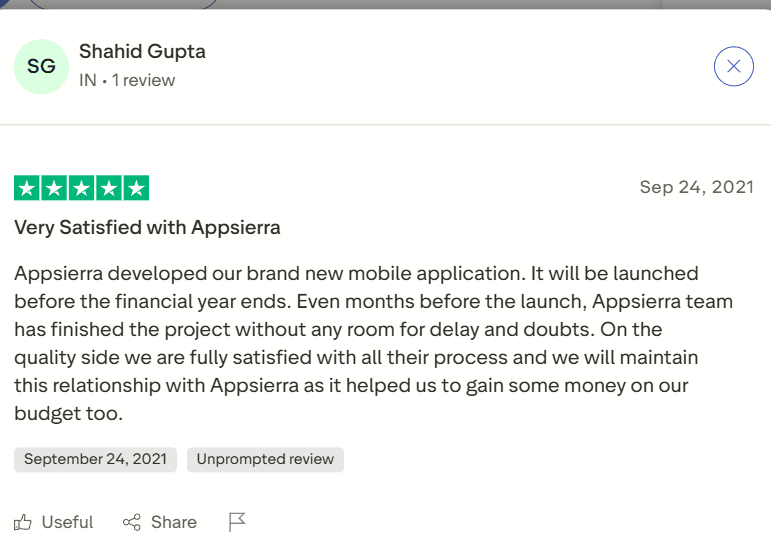
“Appsierra developed our brand new mobile application. It will be launched before the financial year ends. Even months before the launch, the Appsierra team has finished the project without any room for delay and doubts. On the quality side we are fully satisfied with all their process and we will maintain this relationship with Appsierra as it helped us to gain some money on our budget too.”
– Shahid Gupta (Review on Trustpilot)
2. GoodFirms – Verified Detailed Client Review
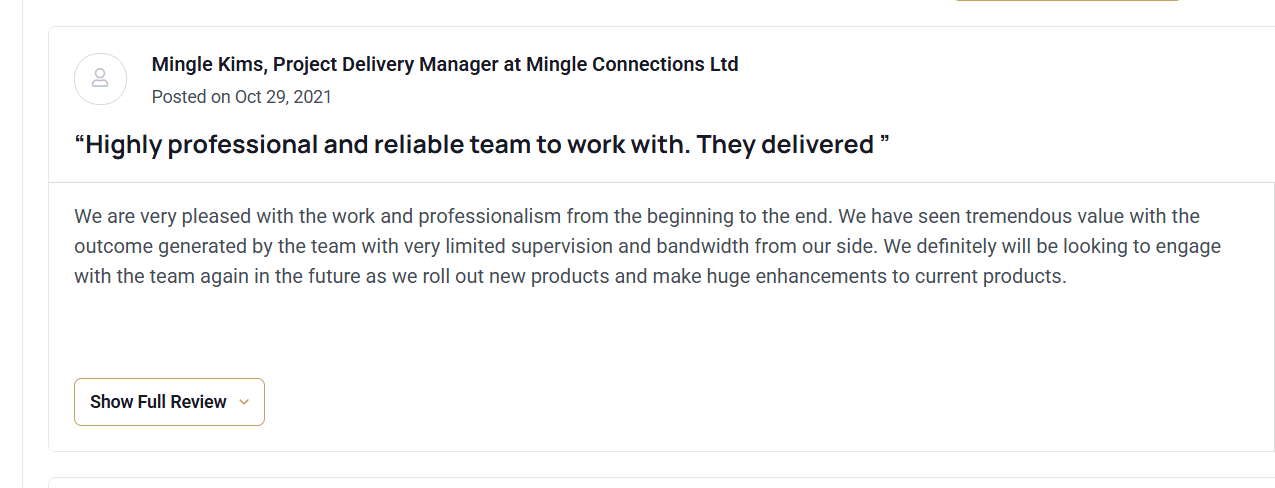
“Highly professional and reliable team to work with. They delivered. We are very pleased with the work and professionalism from the beginning to the end. We have seen tremendous value with the outcome generated by the team with very limited supervision and bandwidth from our side. We definitely will be looking to engage with the team again in the future as we roll out new products and make huge enhancements to current products.”
– Mingle Kims, Project Delivery Manager at Mingle Connections Ltd
3. Clutch – Verified Business Client Review
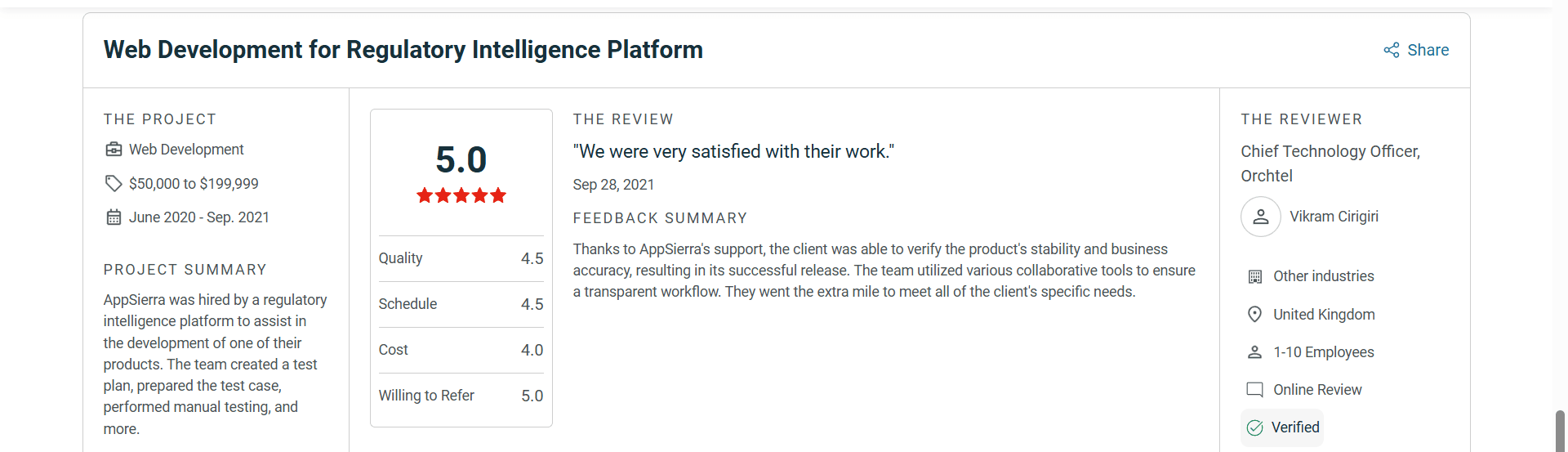
“Thanks to AppSierra's support, the client was able to verify the product's stability and business accuracy, resulting in its successful release. The team utilized various collaborative tools to ensure a transparent workflow. They went the extra mile to meet all of the client's specific needs.”
– Vikram Cirigiri ,Chief Technology Officer, Orchtel (Verified Clutch review)
4. DesignRush – Real Client Testimonial
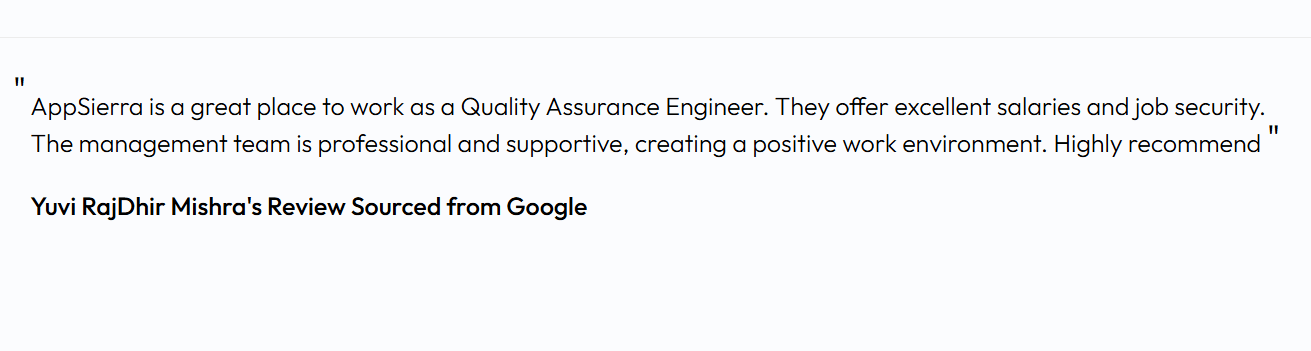
“Appsierra is our all‑time favourite for software development services. They support efficient deployment and they are always responsive to our questions 24×7. They meet all the deadlines and they were active throughout the project timeframe. The most commendable feature of Appsierra is their project management. It is well organized, coordinated and smooth. Highly recommended.”
— Yuvi RajDhir Mishra (Review sourced via DesignRush, originally from Google)
Why Appsierra is a Preferred Partner for Insurance Companies
Appsierra's positioning as preferred insurance app development company services partner reflects several reinforcing advantages. First, specialized focus on regulated industries (insurance, fintech, healthcare) means the company understands compliance complexity that horizontal development firms struggle to navigate. Compliance isn't treated as an add-on but embedded in architecture, development processes, and quality practices.
Second, security expertise distinguishes Appsierra significantly as an insurance application development company. The company practices DevSecOps—embedding security consideration into continuous integration and continuous deployment pipelines rather than treating security as a separate gate. This ensures security practices scale with development velocity rather than creating bottlenecks.
Third, the company's operational flexibility enables engagement with organizations of vastly different scales—from funded startups building initial products through Fortune 500 enterprises undertaking large-scale modernization initiatives. This flexibility reflects project management discipline and organizational agility..
How to Choose the Right Insurance Software App Development Company
Selecting an insuretech app development services partner represents a critical strategic decision with implications extending across years of engagement and potentially evolving into long-term partnerships. Comprehensive evaluation processes should assess capabilities across multiple dimensions rather than defaulting to single-factor decisions based on price or brand recognition.
Experience with Insurtech Software and Mobile Apps
Specialized software development for insurance demands nuanced understanding of insurance operations that general app development firms cannot replicate. Effective evaluation should assess demonstrated experience across multiple insurance domains—whether insurance tech software developers understand distinctions between P&C insurance operations, health insurance workflows, and life insurance administration.
Developers fluent in insurance terminology (loss ratios, underwriting guidelines, policy endorsements, claims adjudication) will ask more intelligent questions during requirements discovery and avoid misunderstanding critical business requirements. Beyond insurance familiarity, evaluate mobile app development firm for insurance expertise specifically. Insurance apps present unique challenges—secure credential storage for customer authentication, offline functionality for field claims adjusters, real-time data synchronization when connectivity resumes, and biometric integration for identity verification.
Client Portfolio and Case Studies
A development company's portfolio provides invaluable signals about capability, specialization, and credibility. When evaluating potential hire insurance app developer candidates, request case studies demonstrating engagement scope and complexity. Effective case studies identify the business problem, solution architecture, implementation challenges overcome, and measurable outcomes achieved.
Pay particular attention to whether case studies demonstrate enterprise-scale projects (multi-year engagements, complex integrations, hundreds of thousands or millions of users) or primarily smaller projects. Enterprise experience indicates ability to manage project complexity, coordinate large technical teams, and maintain quality through extended engagements.
References from companies in your competitive space provide valuable context when you hire best insurance mobile app developer teams. If possible, speak with insurance company leaders who engaged the development firm for similar initiatives—understanding their experience with timeline predictability, quality, and support responsiveness provides context no marketing material can offer.
Technology Stack Expertise (iOS, Android, Web, Cloud)
Insurance mobile app development services increasingly adopt multi-platform strategies supporting iOS, Android, web, and backend infrastructure across cloud platforms. Development teams should demonstrate expertise across this full technology stack rather than specializing narrowly.
For mobile platforms, evaluate whether the team has deep experience with native development (Objective-C/Swift for iOS, Kotlin/Java for Android) versus reliance on cross-platform frameworks like React Native or Flutter. While cross-platform frameworks offer development efficiency benefits, insurance app developer implementations often benefit from native development enabling platform-specific security capabilities and optimal performance.
Web development expertise should span modern frameworks (React, Vue, Angular) with demonstrated experience building responsive interfaces, implementing complex workflows, and integrating with backend systems. Backend expertise should include REST APIs and GraphQL for efficient data transfer, database architecture for complex data models, and cloud platform expertise that professional insurance app development company teams provide.
Support, Maintenance, and Uptime Guarantees
Development partnerships ideally extend beyond initial deployment into ongoing maintenance and optimization when you hire best insurance mobile app developers. Evaluate development companies based on their support capabilities, not just development capabilities.
Quality support means responsive communication addressing production issues, proactive monitoring identifying problems before users notice, and consistent security patching maintaining compliance with evolving threat landscapes. Uptime guarantees (typically expressed as "99.9% availability" or similar Service Level Agreements) provide contractual commitments ensuring infrastructure reliability.
Clarify maintenance expectations around what's included in baseline support, what constitutes billable consulting, and what escalation procedures exist for critical issues. Companies enabling continuous improvement (A/B testing, analytics monitoring, ongoing UX optimization) provide ongoing value beyond initial deployment through hire insurance mobile app developer partnerships.
Transparent Pricing and Delivery Timelines
Insurance software development engagements involve significant financial commitments with implications across organizational budgets. Demand transparent pricing models, not vague estimates requiring contract negotiation once engagement begins.
Fixed-price engagements work well for well-defined scope with clear requirements, enabling budget certainty. Time-and-materials engagements work better for exploratory projects or evolving requirements where scope cannot be precisely defined. Hybrid models combining fixed-price components (core features) with time-and-materials components (ongoing optimization) often balance budget certainty with flexibility.
Delivery timeline transparency means realistic assessment of effort required based on specified scope. Be cautious of unrealistically aggressive timelines—most complex projects benefit from appropriate contingency buffers for testing, integration, and unexpected challenges when working with app developers insurance specialists.
Methodology for Selecting the Best Insurance App Development Partner
Systematic evaluation processes improve partner selection outcomes significantly compared to informal approaches. The following framework guides structured partner evaluation when you hire insurance app designers and development teams.
Evaluation Criteria: Security, Compliance, and Scalability
Insurance app development solutions must prioritize security, compliance, and scalability above aesthetic considerations or trendy technologies. Evaluation frameworks should weight these dimensions heavily in partner selection decisions.
Security evaluation encompasses multiple dimensions: architectural security practices (threat modeling, security by design), implementation practices (secure coding standards, vulnerability scanning), operational practices (security monitoring, incident response processes), and certification credentials (ISO 27001, SOC 2). Assess whether hire software developer for insurance candidates have security practices that are documented, regularly audited, and continuously improving.
Compliance evaluation determines whether hire insurtech developers understand insurance regulatory requirements. Verify whether developers have worked with HIPAA, GDPR, FCA, or other relevant frameworks. Request documentation of compliance-related features built into systems (audit logging, data retention policies, consent management).
Scalability evaluation considers infrastructure architecture, database design, and caching strategies supporting growth without performance degradation. Ask how systems have performed under load testing and whether the hire insurance software developers team has experience with auto-scaling infrastructure, database optimization, and performance monitoring.
Shortlisting Companies Based on Portfolio and Reviews
Initial shortlisting relies on demonstrated portfolio relevance and verifiable reputation signals. Develop screening criteria identifying must-have qualifications—insurance domain experience, mobile app expertise, cloud platform specialization—enabling elimination of obviously mismatched candidates.
For surviving candidates, evaluate portfolio breadth across company sizes (did they work with startups and enterprises?), project complexity (simple apps through enterprise systems?), and geographic markets (experience with your target markets?). Portfolio diversity indicates adaptability to varied client contexts.
Reputation verification through multiple channels reduces risk. Industry review sites (Clutch, G2, GoodFirms) provide aggregated customer feedback identifying common themes about strengths and weaknesses. LinkedIn endorsements and recommendations from industry peers provide signal about professional respect. Direct references from comparable companies provide detailed context about actual engagement experience.
Comparing Technology Stack, Cost, and Delivery Timelines
Once shortlist candidates are identified, detailed comparison across technology stack, cost, and timelines enables differentiated assessment.
Technology stack comparison determines whether proposed approaches align with your strategic direction. If you prefer native mobile development for optimal security and performance, candidates proposing cross-platform frameworks may be misaligned. If you're committed to AWS cloud infrastructure, candidates proposing Azure or proprietary infrastructure may create future operational challenges.
Cost comparison must move beyond headline numbers to detailed service breakdowns. Comparable proposals should specify exactly what's included (development, QA, infrastructure, maintenance), what's excluded (additional testing environments, enhanced infrastructure), and what triggers additional charges. Cheapest proposals often eliminate important quality activities—be suspicious of bids dramatically lower than comparable competitors.
Timeline comparison should assess whether proposed schedules appear realistic. Engineering estimates depend on clear requirements and architectural decisions—if requirements remain fuzzy during estimation, timeline estimates carry elevated risk. Be cautious of aggressive timelines promising completed enterprise systems in improbable durations.
Ensuring Support, Maintenance, and SLA Compliance
Beyond development completion, ongoing support quality affects application success. Evaluate support models clarifying response times for critical issues, escalation procedures, and included support hours (24/7 coverage, business hours only).
SLA documentation should specify availability guarantees (e.g., "99.9% uptime"), define how availability is measured, and clarify remedies if availability targets are missed. Well-structured SLAs incentivize service quality while providing contractual recourse if service quality degrades.
Maintenance commitment timelines indicate whether ongoing security patching and dependency updates are included or require negotiation. Long-term partnership success depends on continuous maintenance ensuring security, compliance, and compatibility as technology landscapes evolve.
Cost of Developing an Insurance Mobile App in 2026
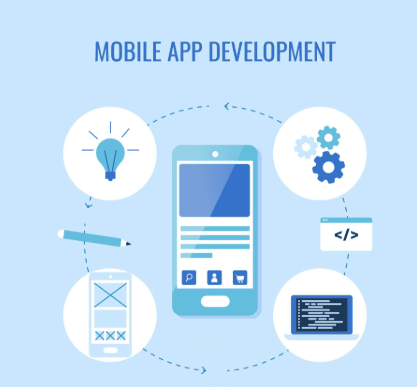
Insurance mobile app development involves multiple cost dimensions reflecting scope, complexity, platform strategy, and required integrations. Understanding cost drivers enables realistic budget planning and vendor comparison.
Factors Affecting Pricing (Complexity, Integrations, Features)
Development cost fundamentally depends on application scope and complexity. Basic insurance apps with core policy management, claims filing, and document access start at $20,000 to $50,000. These applications typically include user authentication, basic policy viewing, simple claims submission, and push notifications—sufficient for basic digital presence but lacking sophisticated capabilities.
Mid-level applications incorporating payment processing, advanced analytics, customer dashboards, and integration with CRM or underwriting systems cost $50,000 to $120,000. These applications serve more sophisticated business requirements, supporting complex workflows and multi-team coordination.
Advanced applications incorporating AI capabilities (chatbots, predictive underwriting, fraud detection), blockchain security, sophisticated third-party integrations, and enterprise-scale architecture exceed $250,000. These applications address complex business problems and serve multi-million user bases requiring sophisticated infrastructure and operational discipline.
Feature selection dramatically impacts pricing. Real-time video consultations, E-signature integration, biometric authentication, OCR document scanning, and AI-powered chatbots each represent meaningful development effort. Integrations with legacy systems (often the most expensive component) require middleware development, data transformation logic, and extensive testing ensuring consistency between systems.
Approximate Cost for Small, Mid-size, and Enterprise Apps
Insurance app cost varies significantly by platform selection and deployment architecture. iOS app development typically costs $25,000 to $120,000 for standard applications with core features, expanding to $250,000+ for advanced capabilities including custom UI design, biometric login, and third-party integrations.
Android app development similarly costs $25,000 to $130,000+ depending on feature complexity and integration requirements. Web applications adding desktop-accessible functionality typically cost $70,000 starting price, expanding to $400,000+ for enterprise platforms with backend integrations and advanced analytics.
Cross-platform development using frameworks like React Native can reduce development cost by 20-30% compared to native development for iOS and Android, but requires careful technology selection ensuring framework capabilities match insurance security and performance requirements.
How Outsourcing vs. In-House Development Impacts Budget
Outsourcing versus in-house development presents different cost and timeline trade-offs. In-house development provides maximum control and knowledge retention but requires recruiting and retaining specialized talent in competitive labor markets. A capable in-house team including iOS/Android developers, backend engineers, QA specialists, and technical leads represents significant fixed-cost investment.
Outsourcing to specialized development firms provides cost efficiency through leverage of established processes, delivery infrastructure, and risk transfer. Developers in India, Eastern Europe, and other offshore markets operate at significantly lower labor rates than US-based developers—the same functionality costing $120,000 to $300,000 in the US market might cost $30,000 to $80,000 in India.
However, outsourcing introduces trade-offs around communication overhead, time zone coordination, intellectual property protection, and vendor dependence. Reputable outsourcing partners mitigate these risks through dedicated teams, professional management, and comprehensive documentation enabling knowledge transfer.
Hybrid approaches combining onshore strategic leadership with offshore execution provide balanced solutions. Senior architects and product managers based onshore provide vision and oversight while distributed development teams execute delivery at reduced cost and extended capacity.
Leading Insurance App Development Companies and Partners
Insurance software development marketplace includes established players demonstrating specialized expertise alongside emerging competitors bringing fresh approaches to traditional industry challenges.
Best Insurance App Development Companies in USA & India
Leading insurance software development companies in the USA include established consultancies (Accenture, Deloitte, IBM) offering enterprise-scale insurance transformation services alongside specialized boutiques focusing specifically on insurance software. Specialized US firms typically serve enterprise clients requiring geographic proximity, extensive compliance support, and cultural alignment with American insurance industry practices.
India-based insurance software development company in india providers have emerged as significant providers, particularly for offshore delivery models balancing cost efficiency with quality outcomes. Indian firms like TechaHead (recognized as Clutch Global Leader 2023 with clients including Allianz and AXA), Diceus (13 years insurance domain experience with 20+ custom solutions), and others combine deep insurance expertise with cost-efficient delivery models. These firms have invested in insurance domain expertise, compliance certifications, and delivery infrastructure supporting enterprise clients globally.
Recommended Insurtech App Development Agencies
Recommended insurtech app development agencies combine specialized insurance expertise, modern technology practices, and demonstrated client success. Diceus exemplifies these characteristics—operating since 2011 with 13 years insurance focus, having delivered 20+ custom solutions for UNIQA, BriteCore, WTW, BenefitNet, and other insurance companies. The firm provides full-cycle development (ideation through deployment through maintenance), digital product portfolio (Vitaminise), and specialized expertise in insurance portals, chatbots, data analytics, and fraud detection.
Appsierra, as previously detailed, represents another recommended partner combining security rigor, deployment velocity, and enterprise-scale capabilities.
Code Brew Labs (UAE-based) differentiates through multi-UI architecture encompassing user sides, agent panels, and administrative dashboards combined with cutting-edge technology integration (blockchain, data analytics, virtual assistants) within single applications.
Diceus and Other Notable Providers for 2026
Diceus has positioned itself as a thought leader in software development insurance application through specialized insights into 2026 insurance technology trends. The firm's research indicates digital engagement improvements for group insurance, adoption of new technologies depending on effective data management, implementation of real-time engagement platforms, and strategic integration of AI and automation.
Other notable providers include Axxis Systems (specializing in API-first, scalable architecture), EPAM (focus on startup and SMB insurance solutions), Techahead (enterprise clients globally), and Sapphire Software Solutions (specialized vehicle insurance expertise with SEO-friendly design).
Case Studies and Success Stories
Real-world insurance software development implementations demonstrate patterns distinguishing successful transformations from implementations yielding disappointing results. Examining case study themes reveals replicable success factors.
Scalable Health Insurance Software Implementation
A regional health insurance carrier with 250,000 enrollees engaged application developer insurance specialists for custom software development to modernize member experience and streamline operations. The carrier operated legacy systems limiting policy modification capabilities, requiring phone calls for even simple changes. Digital transformation goals included enabling member self-service, reducing call center volume, and improving member retention.
The engagement combined mobile app development (enabling members to view coverage, update contact information, request changes, and file claims from smartphones) with backend system modernization integrating with core insurance systems. Mobile app development deployed on both iOS and Android platforms. Backend system integration required middleware development translating between legacy core systems and modern APIs enabling seamless data flow.
Implementation results included 40% reduction in call center volume (members handling previously phone-only transactions through mobile app), 35% improvement in member satisfaction scores (enabling immediate self-service rather than scheduling call center appointments), and 15% reduction in member churn (improved digital engagement correlating with higher retention). Implementation cost of $180,000 yielded measurable ROI through operational cost reduction and improved retention within 18 months.
Mobile Policy Administration System Deployment
An independent insurance agency managing multiple carriers' policies on behalf of 15,000 clients struggled with disconnected systems—policy lookup required checking multiple carrier portals, renewal tracking occurred through manual spreadsheets, commission calculations required error-prone manual processes. Digital transformation goals included unified policy management system, automated renewal tracking, and streamlined commission management through application development consultancy specializing in insurance workflows.
Custom development engaged to build mobile policy administration system consolidating all policies within single platform. The application integrated with each carrier's policy APIs automatically syncing policy data. Renewal tracking automated based on policy expiration dates. Commission calculations automated based on configured commission schedules.
Deployment results included 50% reduction in administrative labor (policy staff replacing manual processes with automated workflows), 25% improvement in renewal close rates (proactive renewal tracking preventing policy lapses), and 90% improvement in agent satisfaction with administrative processes. Implementation cost of $95,000 achieved payback within 12 months through labor efficiency alone.
Multi-Line Insurance App Development with High Uptime
A multi-line insurance carrier with nationwide operations required mobile app enabling customers to view all policies (auto, home, umbrella, life), file claims across all line types, pay premiums, and access documents through single platform. Technical requirements included 99.99% uptime, support for 2 million concurrent users during peak periods, and seamless integration with legacy core systems across four different carrier platforms.
Development architecture employed microservices patterns—policy service, claims service, payment service, document service operating independently. Cloud infrastructure scaled dynamically based on load. Content delivery networks reduced latency for end users. Database replication and failover ensured data consistency across availability zones.
Performance results demonstrated 99.98% uptime (exceeding 99.99% requirement), sub-second response times for policy lookup despite millions of concurrent users, claims processing automation reducing average claims resolution time by 45%, and customer satisfaction improvement of 40 NPS points. Total development investment of $480,000 enabled sustainable competitive advantage and measurable customer experience improvement.
Frequently Asked Questions (FAQs)
How long does it take to develop a custom insurance app?
Insurance app development timelines depend significantly on scope, complexity, and team capacity. Basic applications with core features typically require 3-4 months for MVP (minimum viable product) development. Mid-level applications with sophisticated features, multiple integrations, and enterprise quality practices require 5-7 months. Enterprise-scale applications may require 9-12 months or longer.
Timeline estimates should account for requirements definition (often underestimated), design iteration, development, comprehensive testing, and final deployment. Agile development methodologies enable incremental deployment reducing overall timeline compared to waterfall approaches.
What platforms do insurance apps support in 2026?
Modern insurance apps typically support iOS, Android, and web platforms, with leadership strategy determining platform sequencing. iOS and Android apps provide optimal mobile experience with platform-specific security and performance capabilities. Web applications provide desktop access and browser compatibility for users preferring larger screens.
Progressive web app (PWA) approaches enable web-based applications with offline functionality and mobile-like capabilities, sometimes eliminating need for separate app development. However, insurance apps often benefit from native development enabling biometric authentication and secure credential storage.
How can insurance apps ensure compliance with GDPR, HIPAA, and FCA?
GDPR compliance requires data minimization practices (collecting only necessary data), explicit user consent for data usage, encryption of personal data in transit and at rest, rapid breach notification (within 72 hours), and user rights implementation (data access, deletion, portability). Custom insurance apps implement these practices directly into architecture.
HIPAA compliance (for health insurance) mandates Protected Health Information (PHI) access restrictions to authorized personnel only, comprehensive audit logging, encryption standards, and Business Associate Agreements with any technology vendors. Applications handling PHI must implement these requirements technically and organizationally.
FCA compliance (UK insurance) requires consumer-friendly business models, fair treatment throughout customer lifecycle, and transparent pricing and policy terms. Custom applications demonstrate FCA compliance through audit trails, transparent pricing displays, and documented fair treatment processes.
Effective compliance combines technical measures (encryption, access controls, audit logging) with organizational practices (documentation, training, vendor management) and continuous monitoring (compliance audits, security assessments, regulatory updates).
What is the average cost of an enterprise-grade insurance mobile app?
Enterprise-grade insurance mobile app costs vary based on scope but typically range from $300,000 to $1,000,000+. Minimal enterprise applications with limited features and straightforward integrations cost $300,000-$400,000. Standard enterprise applications with comprehensive features, multiple integrations, and sophisticated architecture cost $500,000-$800,000. Complex enterprise applications with advanced AI, blockchain, and sophisticated infrastructure exceed $1,000,000.
These estimates assume comprehensive quality assurance, security hardening, compliance implementation, and production-grade infrastructure. Costs exclude post-deployment maintenance, ongoing optimization, and future feature development.
Can existing insurance systems be integrated with mobile apps?
Yes, existing insurance systems can be integrated with mobile apps through multiple architectural approaches. API-based integration enables mobile applications to communicate with legacy systems through well-defined interfaces. This approach works well when legacy systems expose APIs or when middleware can translate between systems.
Database-level integration directly queries legacy system databases, enabling data access without API intermediaries. This approach requires careful consideration of database consistency, backup recovery, and upgrade implications.
Message-queue integration enables asynchronous communication between systems, useful when mobile app transactions must update legacy systems without requiring synchronous responses. This approach decouples mobile app operations from legacy system availability.
Effective integration requires careful planning, comprehensive testing, and ongoing monitoring ensuring data consistency between systems.
Why Partnering with a Professional Insurance App Development Company Matters
Insurance software development requires specialized expertise, regulatory compliance understanding, and operational discipline that general app development firms cannot replicate. Strategic partnership with professional insurance app development company teams generates transformational business value.
Expertise, Experience, and Trustworthiness
EEAT represents the cornerstone of Google's search quality evaluation framework and reflects broader principles underlying insurance customer trust. Expertise encompasses deep understanding of insurance operations, regulatory requirements, and technical architecture. Experience reflects demonstrated track record through case studies, client testimonials, and industry recognition. Authoritativeness demonstrates credibility within insurance industry through publications, conference presentations, and thought leadership. Trustworthiness builds confidence through transparent communication, security practices, and client advocacy.
Professional insurance software developers demonstrate EEAT through specialized insurance focus rather than generalist approaches, documented experience with comparable projects, recognized expertise through industry affiliations and publications, and transparent communication throughout engagement. These characteristics distinguish firms adding genuine value from those offering commodity development services.
Advanced Technology and Security Standards
Insurance data represents crown jewels to malicious actors—customer personal information, financial details, health information, and policy terms enable identity theft, fraud, and account takeover. Protecting this data demands advanced technology practices and security standards exceeding typical consumer app development.
Professional insurance software developers implement DevSecOps practices embedding security into continuous integration and deployment pipelines rather than treating security as separate gate. Regular security assessments, penetration testing, and vulnerability scanning identify security gaps proactively. Security training for development teams ensures coding practices prevent common vulnerabilities (SQL injection, cross-site scripting, authentication bypasses).
Advanced technology practices include infrastructure-as-code enabling security baseline consistency across environments, container orchestration enabling isolated application instances, and observability enabling security monitoring across distributed systems.
Faster Time-to-Market and Scalable Solutions
Professional development partners compress time-to-market through proven methodologies, established infrastructure, and experienced teams. Rather than starting from blank slate, firms leverage architectural patterns, code libraries, and infrastructure templates accelerating development. Established quality practices enable confidence moving to production faster than teams learning quality practices during initial project.
Scalable solution architecture enables applications to grow with business. Microservices architecture enables independent scaling of high-demand components. Cloud-native infrastructure enables dynamic scaling matching varying demand. API-first architecture enables future integrations without architectural rework.
Lead Generation and Business Growth Through Digital Transformation
Insurance software development investments generate tangible business impact through improved customer acquisition, enhanced retention, and operational efficiency. Digital-first customer experiences attract tech-savvy customers increasingly purchasing insurance online. Seamless digital experiences improve retention by reducing friction compared to traditional channels. Operational efficiency through automation reduces cost-to-serve improving profitability.
These business outcomes—customer acquisition, retention improvement, operational efficiency—directly drive lead generation and revenue growth justifying software investment.
Call-to-Action (CTA)

Contact Us to Build Your Custom Insurance App in 2026
The insurance landscape continues evolving rapidly in 2026. Organizations that invest in custom insurance software development service company partnerships now position themselves to compete effectively in emerging digital-first markets. Whether you're an established carrier modernizing legacy operations, a regional agency automating workflows, or an insurtech startup launching innovative products, professional software development partners enable digital transformation at scale.
Strategic investment in insurance software development generates measurable returns—operational efficiency improvements, customer experience enhancements, and competitive differentiation justifying significant capital investment. The question isn't whether to modernize, but when and with which partner.
Schedule a Free Consultation with Expert Insurtech and AI App Developers
Professional insurtech software development firms offer free initial consultations enabling assessment of custom development fit for your business challenges. These consultations should explore your business requirements, competitive pressures, technology landscape, budget constraints, and strategic priorities.
Effective consultations leave organizations with clarity regarding: what insurance software development could accomplish for your specific business, realistic investment required to achieve objectives, expected timeline to deployment, and recommended partnership approaches. Professional consultants should ask penetrating questions about your business, listen carefully to responses, and provide honest assessment of your opportunity rather than overselling capabilities.
Request a Quote for Enterprise Insurance & AI-Augmented App Development
For organizations ready to evaluate specific custom development opportunities, request detailed project quotes from 2-3 short-listed development partners. Effective quotes should specify exactly what's included, deliverables at each phase, investment required, and expected timeline.
Compare quotes not on price alone but on approach, team composition, timeline feasibility, and support commitments. The cheapest quote often correlates with lowest quality—be suspicious of bids dramatically lower than comparable competitors as these typically indicate eliminated quality assurance, reduced compliance focus, or unrealistic scope underestimation.
Selected partners should work collaboratively during proposal development, asking clarifying questions and collaborating on realistic project scope. This pre-engagement partnership quality predicts ongoing engagement quality.
Ready to put this into practice?
Appsierra's expert-supervised QA and AI engineering pods help teams ship higher-quality software faster — with senior accountability and a low-risk pilot. Tell us what you're working on.