
Insurance Application Testing: Top Software Domain Testing Company
Expert insurance application testing company specializing in policy, claims, and compliance testing.
Insurance Application Testing 2026
About The Author
Written by: Shivam Gupta, Content Writer, AppSierra
- Experience: Building and scaling QA testing, software quality assurance, and test automation solutions for startups, healthcare, and enterprise businesses across global markets.
- Current Position: Content Writer and Industry Analyst specializing in HR technology, recruitment optimization, and enterprise software solutions, with a strong focus on research-driven, high-impact content for global technology markets.
- Expertise Focus: Healthcare app development, medicine delivery platforms, enterprise software solutions, and technology strategy
About Appsierra
● Founded: 2015
● Headquarters: Noida, Uttar Pradesh, India
● What They Do: Appsierra builds tailor-made software solutions that meet specific business needs. This includes web applications, mobile applications, desktop software, and integrated systems designed to solve real business challenges.
● Team Size: 150+ technology experts globally
● Global Offices: India, USA
● Track Record: 1,251+ projects delivered | 60% average cost savings | Fortune 1000 client relationships
Introduction
The insurance industry is undergoing a profound digital transformation that's reshing how companies approach software quality. Legacy systems that once sufficed are becoming operational liabilities, while regulatory oversight has intensified dramatically. In this landscape, insurance application testing has evolved from a post-development quality gate into a strategic imperative that directly impacts competitive advantage, compliance posture, and revenue protection.
This comprehensive guide unpacks the full scope of insurance software testing—from foundational domain knowledge through advanced automation strategies, compliance frameworks, and emerging technologies. Whether your organization is modernizing legacy platforms, deploying InsurTech innovations, or optimizing Guidewire implementations, these insights represent current industry best practices and proven methodologies.
What Is Insurance Application Testing?
Insurance application software testing is a specialized software quality assurance discipline designed to validate that insurance software systems function correctly, securely, and in full compliance with regulatory mandates. Unlike generic software testing, testing insurance applications must account for the unique intersection of financial criticality, regulatory intensity, and operational complexity that defines the insurance industry.

At its core, insurance company software testing verifies that all business processes—from policy origination through claims settlement—execute with precision. It confirms that premium calculations are mathematically accurate, that policy endorsements propagate correctly through downstream systems, that claims are processed without data corruption, and that sensitive customer information remains protected throughout every transaction.
The stakes in insurance testing are fundamentally different from other industries. A misconfigured policy renewal algorithm doesn't just frustrate one customer—it cascades across thousands, generating systemic compliance exposures, billing errors, and regulatory scrutiny. A security vulnerability in a claims portal creates liability under GDPR, HIPAA, PCI-DSS, and industry-specific regulations that carry fines reaching millions of dollars.
The evolution of QA testing services in 2025 plays a key role in improving policy management, claims processing, and customer experience.
Understanding Insurance Domain Testing

Insurance domain testing represents the intersection of software quality assurance and specialized industry knowledge. Software testing in insurance domain requires proficiency in multiple dimensions that generic testers simply don't possess.
The Three Pillars of Insurance Domain Expertise
Insurance domain expertise encompasses three critical areas:
First, functional domain knowledge: Understanding how insurance products work, how premiums are calculated, how underwriting decisions are made, and how claims are processed and adjudicated. A domain tester doesn't just verify that a button click produces a response—they verify that the action conforms to the policy contract language, that the downstream billing system receives the correct premium adjustment, and that audit trails capture modifications for regulatory review.
Second, regulatory domain knowledge: Familiarity with compliance frameworks like GDPR for data privacy, HIPAA for health information, PCI-DSS for payment processing, and insurance-specific regulations like IRDAI (in India), FCA rules (in the UK), and state-level insurance codes (in the US). This insurance domain knowledge software testing expertise separates effective insurance testing from superficial test execution.
Third, technical domain knowledge: Expertise in insurance-specific platforms like Guidewire, integration patterns common to insurance systems, and the technical nuances of policy administration systems, billing systems, and claims management platforms.
Insurance Application Testing vs Insurance Software Testing
While these terms are often used interchangeably, meaningful distinctions exist. Insurance application testing services specifically focus on testing software applications built by or for insurance companies—whether custom-built policy administration systems, claims processing platforms, or customer-facing digital portals.
Insurance software testing services, on the other hand, encompass the broader discipline of testing any software used within the insurance business context, including third-party tools, middleware integrations, data warehouses, and supporting systems. Both perspectives are essential for comprehensive quality assurance.
Many insurance companies choose QA testing services in India to efficiently test large-scale policy administration and claims management systems.
Why Insurance Application Testing Is Critical in 2026

The insurance domain in 2026 faces converging pressures that elevate testing in insurance domain from a quality function to a business-critical capability.
Business Risks in Insurance Applications
Undetected defects in insurance app testing create direct financial exposure. A policy management system bug that fails to correctly apply rate changes across 10,000 policies creates a premium collection problem that ripples through financial statements. A claims processing error that systematically underpays claims by 5% generates customer complaints, regulatory investigations, and reputational damage.
The financial impact extends beyond direct losses. Defects that surface in production require emergency patches, which introduce regression risk and business continuity concerns. When a policy administration system fails during renewal season, underwriting stops. When a claims portal goes down, customers cannot submit claims, and regulatory service-level agreements are violated.
Compliance & Regulatory Challenges
By 2026, the regulatory environment for insurance has fundamentally shifted. Compliance is no longer something that happens after software is deployed—it must be embedded into the development process itself.
QA services for insurance domain must now design test cases that explicitly validate compliance controls. Can the system automatically delete customer records after regulatory retention periods expire? Are personally identifiable information elements properly masked in logs? Do API integrations enforce encryption standards? Do automated decision systems include explainability documentation to satisfy AI governance requirements?
Regulators are also intensifying scrutiny around fair outcomes. They want proof that insurance decisions—especially those made using artificial intelligence or predictive analytics—do not systematically disadvantage protected classes. This means insurance domain testing services must now test for bias alongside functionality.
Customer Trust and Digital Excellence
In the digital insurance marketplace, customer trust is increasingly intertwined with software quality. Research consistently shows that customers who experience software failures are significantly more likely to switch insurance providers. The cost of acquiring new customers to replace those lost to poor software experiences often exceeds the savings from reduced testing investment.
Types of Insurance Applications That Require Testing
Life Insurance Application Testing
Life insurance applications present distinctive test insurance application challenges centered on mortality risk assessment, policy underwriting, and long-term premium calculation. Testing must validate actuarial calculations for different policy types: term insurance, whole life, universal life, and variable life policies.
Insurance policy life cycle testing for life insurance also requires extensive validation of underwriting workflows. These workflows capture applicant health information, validate information accuracy through third-party verification services, apply underwriting rules, and generate underwriting decisions.
Health Insurance Software Testing
Health insurance software testing requires specialized testing around claims adjudication, network management, and HIPAA compliance. Claims adjudication involves complex logic: validating that submitted claims comply with coverage limits, that provider discounts are applied correctly, that deductibles and out-of-pocket maximums are tracked accurately.
Network management testing validates that providers are correctly enrolled in networks, that network status changes are reflected in claims processing, and that network discounts are consistently applied. Additionally, HIPAA compliance testing validates that protected health information is encrypted, access-controlled, and subject to comprehensive audit trails.
Motor & General Insurance Application Testing
Motor insurance applications require specialized test insurace application procedures around vehicle data validation, telematics integration, and claims assessment. Vehicle data testing validates that vehicle identification numbers (VINs) are correctly validated and that vehicle specifications are accurately extracted from third-party databases.
Motor insurance is increasingly incorporating usage-based insurance technology, where customer driving behavior is tracked through telematics devices. Testing must validate that telematics data is accurately captured, that premium adjustments are calculated correctly, and that data privacy is maintained.
Testing InsurTech Software
Testing insurtech software presents distinctive challenges around customer experience, digital channel management, and regulatory compliance. InsurTech platforms often emphasize rapid digital onboarding, instant quote delivery, and seamless mobile experiences—requiring testing that validates not just functional correctness but also performance, usability, and conversion impact.
Testing for insurtech applications also requires extensive mobile testing across multiple OS versions, device types, network conditions, and screen sizes. Performance testing becomes critical, as slow mobile experiences directly impact customer conversion and retention.
When evaluating long-term QA partners, insurers compare capabilities of providers listed in the top software testing companies.
Core Testing Types in Insurance Applications

Functional Testing for Insurance Applications
Functional testing validates that insurance application software executes its intended functions correctly. This includes testing policy creation workflows, policy modification workflows, renewal workflows, and claims processing workflows.
Functional testing insurance applications requires deep domain expertise. A generic tester might confirm that policy data is stored in the database, while an insurance expert validates that policy data is stored according to insurance industry data standards, that fields are appropriately validated, and that derived fields are calculated correctly.
Insurance Policy Life Cycle Testing
Insurance policy life cycle testing spans from initiation through expiration or renewal. Policy inception testing validates that all required information is collected, that underwriting rules are applied, that premium is calculated correctly, and that policy documents are generated accurately.
Policy modification testing validates that subsequent changes to policy terms are correctly processed, including endorsements, changes to coverage amounts or deductibles, changes to beneficiaries, and changes to billing information. Renewal testing must preserve all existing policy modifications while recalculating premium based on current underwriting rules.
Integration & API Testing in Insurance Domain
Software testing insurance domain applications rarely exist in isolation—they integrate with policy administration systems, billing systems, claims systems, CRM systems, payment processors, fraud detection services, and regulatory reporting platforms.
API testing is particularly critical in modern insurance architectures. Insurance platforms expose APIs for policy inquiries, quote requests, claims submissions, and document retrieval. These APIs must be tested for functional correctness, performance, security, and resilience.
Regression Testing in Insurance Software
Insurance applications change frequently: new products are introduced, underwriting rules are updated, compliance requirements evolve, and software updates are deployed. Each change introduces the risk that existing functionality is inadvertently broken.
Regression testing in insurance application testing must be efficient, since insurance applications often experience compressed release cycles driven by business requirements. This efficiency comes from risk-based test selection, intelligent automation, and continuous testing.
Performance & Load Testing for Insurance Platforms
Insurance applications experience highly variable load patterns. Policy renewal periods see massive traffic spikes as millions of customers access renewal portals. Claims processing sees spikes following catastrophic events.
Performance testing must accurately simulate realistic load patterns. For renewal periods, load profiles should reflect distribution of customers accessing renewal services—with peak loads during evenings and weekends. For claims processing, load profiles should simulate catastrophe scenarios.
Security & Compliance Testing
Insurance applications handle sensitive data—personally identifiable information, financial information, health information, and financial account information for premium payments. Security testing validates that this data is protected through appropriate encryption, access controls, and audit trails.
Compliance testing validates that applications meet regulatory requirements, including data retention testing, audit trail testing, privacy testing, and fair lending testing for insurance products subject to fair lending requirements.
Test Automation for Insurance Applications
Test automation for insurance is critical given the scale of testing required and the high release frequency of modern insurance platforms. Automation allows insurance companies to test more thoroughly, more quickly, and more cost-effectively than manual testing alone.
Insurance automation frameworks must capture insurance business logic and edge cases. Pre-built test libraries for policy management, claims processing, and underwriting workflows allow rapid test development. Intelligent test frameworks reduce maintenance overhead as applications change.
Automation also enables continuous testing—incorporating testing into development pipelines so that changes are tested immediately as they're committed to version control. Continuous testing dramatically reduces the time required to discover and fix defects, improving software quality and accelerating time-to-market.
Insurance Platform Testing Services
Guidewire Testing Services
Guidewire InsuranceSuite is the dominant policy administration platform in the insurance industry. Insurance platform testing services for Guidewire have become a specialized discipline due to the platform's complexity, extensive customization capabilities, and importance to insurance operations.
Guidewire consists of three core modules: PolicyCenter (policy administration), BillingCenter (premium billing and receivables), and ClaimCenter (claims management and resolution). Each module requires specialized testing that validates core workflows and business rule configurations.
Independent Third-Party Software Support
Guidewire and similar megavendor platforms are so complex and critical that many insurance companies engage third-party support providers who bring specialized expertise, extended support hours, and augmented resources that vendor support alone cannot provide.
Third-party providers bring testing expertise through automation frameworks, pre-built test libraries, and Guidewire knowledge that internal teams often lack.
Global Market Perspectives
US Application Testing Services Market
The US application testing services market is characterized by complexity driven by state-by-state regulatory variation. Each state has distinct insurance codes, fair lending requirements, and regulatory expectations. This variation requires insurance application software testing services to be tailored to specific state requirements.
The US mobile application testing services market emphasizes consumer experience and mobile accessibility. Customers expect insurance apps to be as responsive and user-friendly as consumer technology apps, requiring performance optimization and seamless user experience design.
Europe Application Testing Services Market
The Europe application testing services market must navigate GDPR requirements, which are far more stringent than requirements in most other jurisdictions. GDPR compliance testing is central to European insurance software testing, requiring expertise in data retention policies, data subject access rights, and data localization requirements.
European providers also bring expertise with FCA requirements for UK operations, emerging ESG requirements affecting insurance, and climate risk disclosure requirements.
Canada Application Testing Services Market
The Canada application testing services market requires navigation of provincial insurance regulations that vary by province, federal privacy requirements under PIPEDA, and emerging cybersecurity requirements. This regulatory complexity requires testing providers to have multi-jurisdictional expertise.
Tools & Technologies for Insurance Testing

Automation & Functional Testing Tools
Selenium WebDriver remains the dominant open-source framework for web UI automation, widely used in insurance company software testing for policy portals, underwriting interfaces, and claims processing systems. Selenium's cross-browser support, active community, and extensive integration options make it ideal for complex insurance applications.
For behavior-driven development, frameworks like Cucumber and Robot Framework allow non-technical stakeholders to participate in test design, improving alignment between test cases and business requirements.
Performance & API Testing Tools
JMeter is the most widely used open-source performance testing tool in the insurance domain, enabling load testing, stress testing, and performance analysis. JMeter can simulate complex user workflows, validate performance under realistic load patterns, and identify performance bottlenecks.
For API testing, Postman is the de facto standard, providing intuitive interface for creating and executing API tests, support for authentication methods common in enterprise environments, and integration with CI/CD pipelines.
Static Code Analysis & Security Standards
Static code analysis tools like Coverity scan source code for security vulnerabilities, coding errors, and quality issues before code is executed. In insurance application testing where security and reliability are paramount, static analysis is critical.
Payment Card Industry Data Security Standard (PCI DSS) compliance testing validates that payment card information is handled securely. GDPR compliance testing validates that personal data is protected according to regulatory requirements. HIPAA compliance testing for health insurance validates that protected health information is secure and access-controlled.
AppSierra: Specialized Insurance Application Testing Company

About AppSierra
AppSierra is an insurance application testing services specialist with deep expertise in policy administration systems, claims platforms, and InsurTech applications. Founded with a mission to solve the testing challenges that plague insurance implementations, AppSierra brings together insurance domain experts, platform specialists, and quality engineering professionals.
AppSierra's approach centers on the principle that insurance testing is fundamentally different from generic software testing, requiring domain-specific expertise, regulatory awareness, and operational knowledge that most generalist firms simply don't possess.
AppSierra's Insurance Domain Expertise
AppSierra's insurance domain expertise spans the full insurance technology landscape, including policy administration systems from Guidewire and competitors, claims management platforms, underwriting engines, billing and premium systems, customer portals and digital channels, data warehouses and analytics systems, and integration platforms.
Within this landscape, AppSierra brings deep knowledge of insurance business logic. How do policy inception workflows validate required data elements? How do policy modifications trigger billing adjustments? How do renewals interact with prior modifications and claims? These operational nuances form the foundation of AppSierra's test design.
AppSierra also maintains current expertise in the regulatory landscape affecting the insurance domain. This includes data privacy (GDPR, state privacy laws), protected health information (HIPAA), payment security (PCI-DSS), insurance-specific regulations (IRDAI in India, state insurance codes in the US, FCA requirements in the UK), and emerging regulations like climate risk disclosure requirements.
Expert Reviews of Testing Service Providers
1. GoodFirms – Verified Client Review
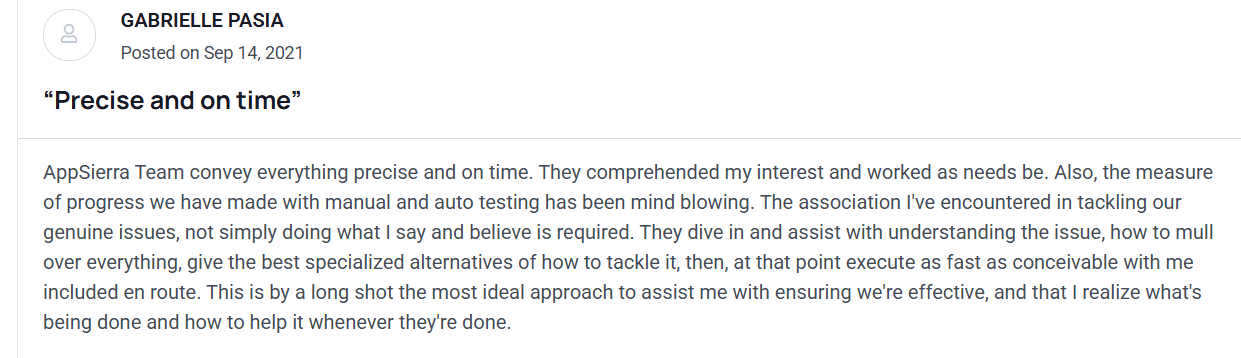
“They had an excellent workflow of ideas and suggestions. Thanks to AppSierra’s efforts, half of the content on the platform has been tested and completed. The team is also very timely on their deliverables, as they continue to find ways to improve the user experience and get it ready for launch.”
— Gaddiel Gitau, Director of IT (GoodFirms)
2. Trustpilot– Verified Client Review

“Highly recommend AppSierra not only for the quality of work but also for their follow-up support. The team was professional, responsive, and delivered exactly what was discussed. Communication was smooth throughout the project, and they ensured all concerns were addressed on time.”
— Solomon Korankye, Trustpilot Reviewer
3. Clutch – Verified Client Review
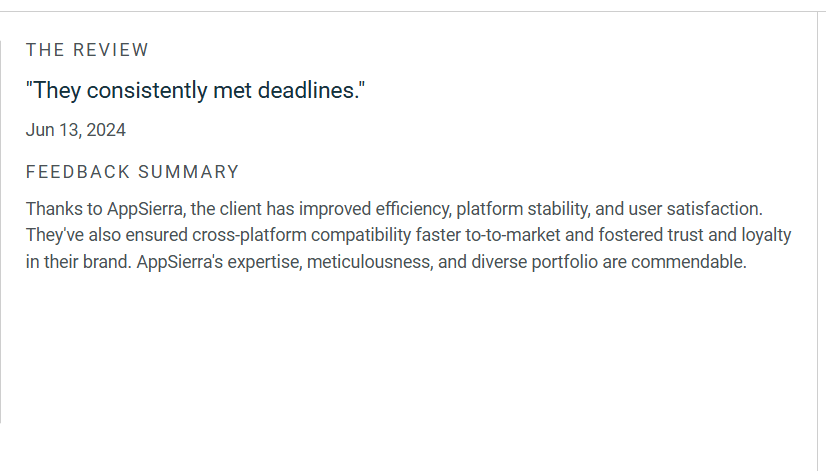
“Thanks to AppSierra, the client has improved efficiency, platform stability, and user satisfaction. They've also ensured cross-platform compatibility faster to-to-market and fostered trust and loyalty in their brand. AppSierra's expertise, meticulousness, and diverse portfolio are commendable.”
— Manager, HCL TECHNOLOGIES LTD
4.The Manifest – Verified Project Review
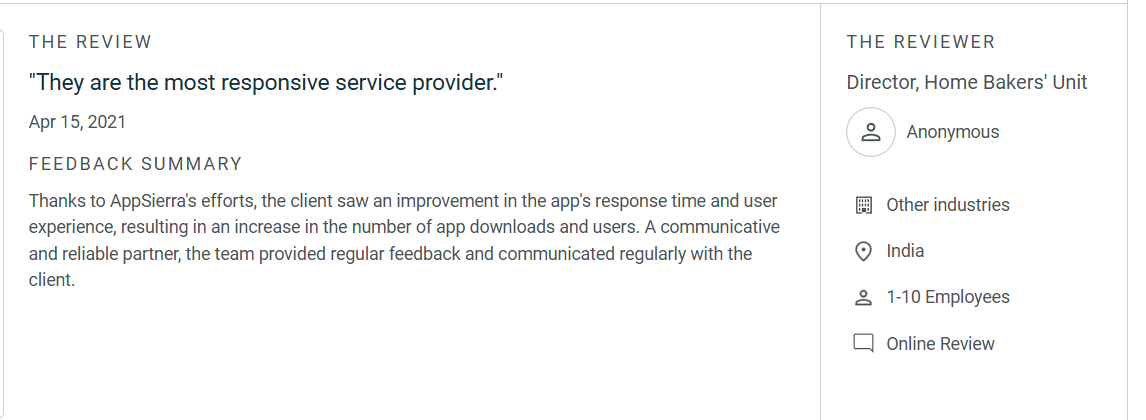
“AppSierra provided reliable manual testing support and worked closely with our internal team to streamline QA processes. Their resources were skilled, communicative, and consistent in delivering quality results. Regular check-ins and collaboration helped ensure alignment with our project goals.”
— Aparajita Chaturvedi, QA Manager, Wagepoint
AppSierra's Insurance Application Testing Services
AppSierra delivers comprehensive insurance application testing services across the insurance application lifecycle:
Functional testing validates that core insurance processes—policy creation, modification, renewal, claims processing—execute correctly. AppSierra's test cases reflect actual business requirements and insurance workflows, not generic use cases.
Integration testing validates that insurance applications work seamlessly with supporting systems, including policy data flow into billing systems, claims data flow into financial systems, customer data synchronization across platforms, and third-party integrations.
Regression testing ensures that software updates don't introduce unintended side effects. AppSierra maintains comprehensive test libraries covering critical insurance workflows, allowing efficient detection of regressions across multiple release cycles.
Compliance testing validates that systems meet regulatory requirements. AppSierra designs test cases that explicitly validate compliance controls, generating evidence that demonstrates regulatory alignment.
Performance and load testing validates that systems maintain acceptable performance during peak business periods, including policy administration systems during renewal seasons and claims portals during catastrophe events.
Security testing identifies vulnerabilities in authentication, authorization, data security, and API design through penetration testing, vulnerability scanning, and business logic testing.
AppSierra's Testing Methodology
AppSierra's insurance software testing services methodology reflects the unique demands of insurance applications. The approach begins with deep requirements analysis—not just reviewing documented requirements, but interviewing domain experts to understand edge cases, regulatory nuances, and operational workflows.
Test planning incorporates risk assessment—identifying which areas of the application pose the highest business risk if they fail. Test case design follows a scenario-driven approach that mirrors actual insurance operations, validating complete workflows rather than isolated functions.
Test execution is heavily automated, particularly for regression scenarios and high-volume test cases. AppSierra maintains pre-built automation libraries that dramatically accelerate test execution while maintaining comprehensive coverage.
Why Insurance Companies Choose AppSierra
Insurance companies select AppSierra primarily because the firm brings insurance domain testing expertise that generic testing providers cannot match. AppSierra testers understand insurance operations, not just how to execute test scripts. They design test cases that reflect actual policyholder interactions and regulatory requirements.
Efficiency is another key driver. By bringing specialized methodologies, pre-built test libraries, and insurance-specific automation frameworks, AppSierra delivers insurance software testing results faster and at lower cost than firms that must build insurance expertise from scratch.
Compliance confidence is a third factor. AppSierra's commitment to compliance-first testing design provides stakeholders with assurance that software will meet regulatory requirements and that testing will generate evidence acceptable to auditors and regulators.
Industry Standards and Best Practices

Insurance Industry Management Test Standards
The insurance industry management test standards have evolved to reflect the unique requirements of insurance software. These standards emphasize risk-based testing, compliance validation, and end-to-end scenario testing reflecting actual insurance workflows.
Standards also emphasize the importance of domain expertise in testing. Generic QA practitioners cannot effectively test insurance application systems—domain expertise is essential for designing appropriate test cases and identifying defects that only domain experts would recognize.
Business Benefits of Insurance Software Testing
Faster Time-to-Market
Effective insurance application software testing services accelerate time-to-market by discovering and enabling correction of defects earlier in the development process. Defects discovered in development are corrected faster and less expensively than defects discovered after release.
Mature testing practices incorporate continuous testing into development pipelines, allowing teams to receive testing feedback immediately as code changes are committed. This immediate feedback enables rapid iteration and keeps development velocity high.
Reduced Claims & Policy Errors
Insurance software testing directly prevents operational errors. A policy system defect that miscalculates premium results in incorrect billing. A claims system defect that miscalculates benefits results in incorrect claim payments. Comprehensive testing dramatically reduces these errors before they affect customers.
Improved Regulatory Readiness
Insurance companies face intense regulatory scrutiny. Regulators want evidence that applications are reliable, secure, and compliant. QA services for insurance domain generate this evidence through comprehensive test documentation and testing artifacts that satisfy auditor and regulator requirements.
ROI Through Insurance Software Testing
While insurance application testing requires investment, the ROI is substantial. Studies consistently demonstrate that preventing defects through testing is dramatically more cost-effective than fixing defects after release. A defect caught during development might cost $100 to fix, while the same defect caught in production could cost $10,000—including emergency patch costs, customer support costs, and regulatory response costs.
Insurance companies that invest in mature testing practices experience reduced post-release defects, reduced customer support costs, reduced regulatory costs, accelerated feature delivery, and improved customer retention.
FAQs on Insurance Application Testing

What is insurance application software testing?
Insurance application software testing is the discipline of validating that insurance software systems function correctly, securely, and in compliance with regulatory requirements. It encompasses functional testing, compliance testing, security testing, and performance testing.
How is insurance domain testing different?
Insurance domain testing differs from generic software testing because it requires specialized domain knowledge about insurance products, regulatory expertise regarding compliance frameworks, and understanding of insurance technology platforms. Generic testing approaches are insufficient for insurance applications.
Is test automation suitable for insurance applications?
Yes, test automation for insurance is essential. Insurance applications require high test coverage, frequent releases, and complex regression scenarios that manual testing alone cannot efficiently handle. Automation enables faster testing cycles, more comprehensive coverage, and reduced manual effort.
What are common defects in insurance applications?
Common defects in testing insurance applications include calculation errors in premium or benefit calculations, logic errors in underwriting or claims adjudication, data integrity issues, integration failures, performance problems, and security vulnerabilities. Many could be prevented through comprehensive testing.
Conclusion: The Strategic Imperative of Insurance Testing
Insurance application testing services in 2026 stand at a critical inflection point. The industry is simultaneously modernizing legacy platforms, deploying AI-driven systems, expanding into digital channels, and facing intensifying regulatory scrutiny. In this environment, insurance software testing is not a back-office function—it is a strategic capability that directly impacts competitive advantage, regulatory compliance, customer satisfaction, and financial performance.
Organizations that invest in mature insurance domain testing services—encompassing comprehensive domain expertise, intelligent automation, compliance validation, and continuous improvement—will deliver higher quality software faster, maintain stronger regulatory compliance, and retain customer trust.
The path forward is clear: embrace insurance testing as a strategic priority, invest in insurance domain expertise, adopt intelligent automation, and establish testing as a core part of software delivery excellence. The competitive advantages that result will compound across multiple release cycles, creating sustained differentiation in an increasingly competitive insurance marketplace.
Insurance application software testing services are not just about finding bugs. They're about building systems customers can trust, operations teams can rely on, and regulators can verify. They're about delivering insurance software that works flawlessly at the moments when customers need it most. And in 2026, that matters more than ever.
Ready to elevate your insurance testing capabilities? Contact specialized insurance software testing services providers to conduct a free QA assessment, speak with insurance domain experts, or request a comprehensive testing proposal tailored to your specific needs. The investment in quality today protects your competitive position tomorrow.
Ready to put this into practice?
Appsierra's expert-supervised QA and AI engineering pods help teams ship higher-quality software faster — with senior accountability and a low-risk pilot. Tell us what you're working on.