
Hire Python Developers 2026
Hire Python Developers 2026 for scalable, secure, and high-performance applications using modern frameworks, automation, AI, and backend solutions.
Hire Python Developer 2026
About The Author
Written by: Arpit Singhal, Founder & CEO, AppSierra
- Experience: Founder-led experience in building and scaling technology solutions for healthcare and enterprise businesses
- Current Position: Founder & Chief Executive Officer, AppSierra
- Expertise Focus: Healthcare app development, medicine delivery platforms, enterprise software solutions, and technology strategy
- LinkedIn: Arpit Singhal
About Appsierra
● Founded: 2015
● Headquarters: Noida, Uttar Pradesh, India
● What They Do: Appsierra is a premier mobile app development and QA testing specializing in healthcare, fintech, and enterprise solutions. They deliver AI-augmented medicine delivery apps, pharmacy delivery platforms, and healthcare software with zero-defect quality assurance and HIPAA compliance built into every line of code.
● Team Size: 150+ technology experts globally
● Global Offices: India, USA
● Track Record: 1,251+ projects delivered | 60% average cost savings | Fortune 1000 client relationships
Introduction to Hiring Python Developers in 2026
The Python development landscape has transformed dramatically as we navigate through 2026. When you hire Python developers, you're no longer simply looking for someone who can write basic scripts—you're partnering with professionals who understand cutting-edge frameworks, security architectures, and scalable system design principles. Whether you need to hire Python 3x developers for modern applications or hire Python 27 developers for legacy system maintenance, the expectations are higher and the opportunities are exponentially greater than ever before.
In today's digital ecosystem, Python serves as the backbone for artificial intelligence, data science, web applications, automation, and enterprise systems. Businesses of all sizes recognize that strategically hiring the right Python talent can drive innovation, increase operational efficiency, and build competitive advantages. However, the journey from identifying talent to building a thriving, productive development team requires strategic thinking, technical expertise, and careful partner selection.
This comprehensive guide walks you through every aspect of hiring Python developers in 2026, from understanding current market trends to evaluating developer skills, comparing hiring models, and making informed decisions that align with your business objectives. Whether you're looking to hire remote Python 3x developers, hire a dedicated Python developer, or hire a Python development agency, this guide provides the roadmap you need.
Why Python Development Is a Priority for Businesses in 2026
The numbers speak for themselves. Python continues its dominance as one of the most sought-after programming languages globally, with the Python ecosystem generating billions in economic value. Here's why businesses are making Python development a top priority:
Artificial Intelligence and Machine Learning Dominance. Python has become the lingua franca of AI and machine learning. When organizations need to hire Python app developers for AI projects, they're tapping into an ecosystem rich with libraries like TensorFlow, PyTorch, scikit-learn, and Keras. Companies building intelligent systems need developers who understand these frameworks deeply.
Data Science and Analytics Leadership. Python's dominance in data science means businesses needing analytics capabilities must hire scipy developers and hire matplotlib developers who can transform raw data into actionable insights. The combination of NumPy, pandas, SciPy, and Matplotlib creates powerful analytical capabilities that drive data-driven decision-making.
Web Development Versatility. Frameworks like Django and Flask make Python an excellent choice for web development. Organizations building web applications can hire Python 3x developers who leverage these modern frameworks to create secure, scalable web platforms rapidly.
Financial Technology Innovation. The fintech startup postgres ecosystem increasingly relies on Python for backend development, algorithmic trading, risk analysis, and financial modeling. Python's combination with PostgreSQL creates robust financial applications that handle complex transactions securely.
Automation and DevOps Excellence. Python's readability and extensive library ecosystem make it ideal for automation scripts, DevOps tools, and infrastructure management. Companies modernizing their operations need developers who can create automated workflows that improve efficiency.
Cross-Industry Applications. From healthcare to e-commerce, education to manufacturing, Python's versatility means virtually every industry benefits from Python expertise. This universal applicability makes Python developers valuable across organizational types.
Understanding Python Development in 2026
What Is Python Development in 2026?
Python development in 2026 represents a sophisticated convergence of multiple specializations, methodologies, and best practices. It encompasses everything from AI model deployment to web application backends, from data pipeline construction to automation scripting.
Modern Python development goes far beyond basic coding. It includes:
Multi-Version Considerations. Developers must navigate the complexities of Python 2.7 legacy systems while building modern applications with Python 3.x. Organizations often need to simultaneously hire Python 27 developers for maintaining critical legacy systems and hire Python 3x developers for building new capabilities. The transition from Python 2.7 (which reached end-of-life in 2020) to Python 3.x continues to create demand for developers who understand both environments.
Framework Expertise. Modern Python developers must be proficient in relevant frameworks. Web developers need Django or Flask expertise. Data scientists need familiarity with scikit-learn and pandas. ML engineers need TensorFlow or PyTorch proficiency. When you hire a dedicated Python developer, you're often hiring for specific framework expertise aligned with your project needs.
Cloud Integration and Scalability. Modern Python applications leverage cloud infrastructure for deployment, storage, and processing. Developers must understand containerization with Docker, orchestration with Kubernetes, and deployment on AWS, Google Cloud, or Azure. Scalable Python applications handle growing user bases and data volumes without performance degradation.
Security and Compliance. With data breaches becoming increasingly common, Python developers must implement robust authentication systems, data encryption, secure APIs, and compliance frameworks. Whether building fintech startup postgres applications subject to financial regulations or healthcare systems requiring HIPAA compliance, security expertise is non-negotiable.
Real-Time Processing and Asynchronous Programming. Modern Python applications increasingly require real-time data processing and asynchronous operations. Developers need expertise in asyncio, websockets, and event-driven architectures that enable responsive, real-time applications.
Expert Reviews of Appsierra for Python Development
Expert Ratings from Verified Platforms:
1. Trustpilot – Real User Review
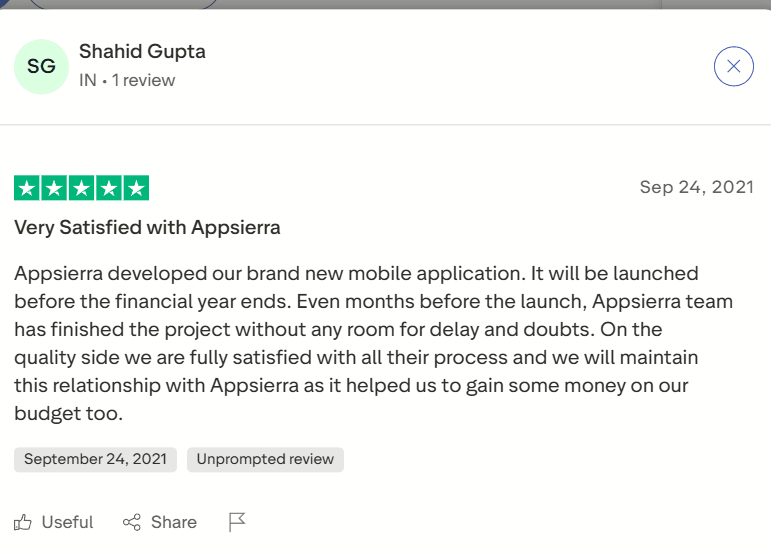
“Appsierra developed our brand new mobile application. It will be launched before the financial year ends. Even months before the launch, the Appsierra team has finished the project without any room for delay and doubts. On the quality side we are fully satisfied with all their process and we will maintain this relationship with Appsierra as it helped us to gain some money on our budget too.”
– Shahid Gupta (Review on Trustpilot)
This review highlights timely delivery, process transparency, and overall satisfaction with product quality and budget control — which reflects real client experience.
2. GoodFirms – Verified Detailed Client Review
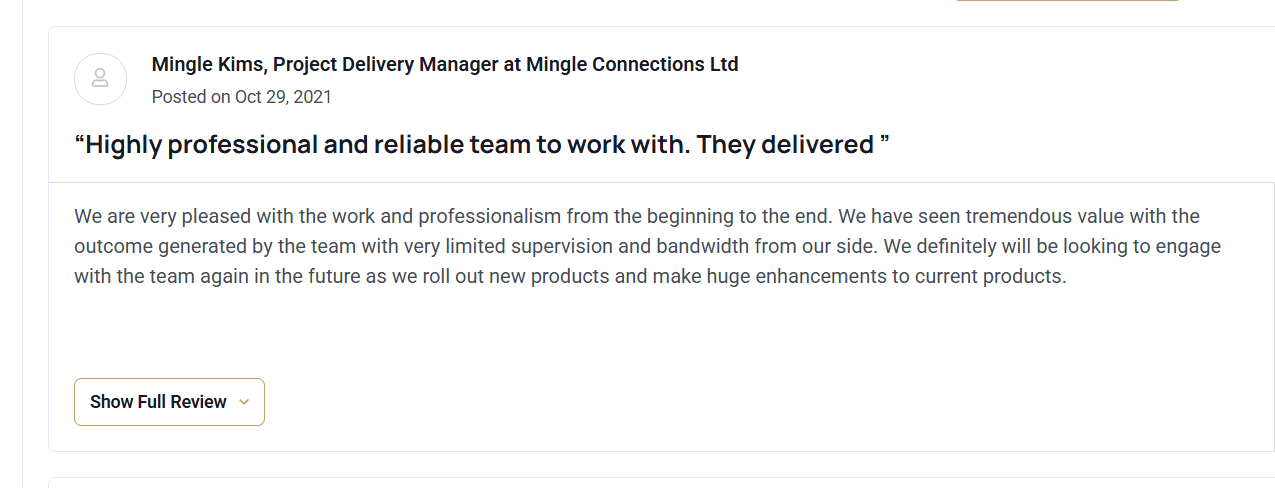
“Highly professional and reliable team to work with. They delivered. We are very pleased with the work and professionalism from the beginning to the end. We have seen tremendous value with the outcome generated by the team with very limited supervision and bandwidth from our side. We definitely will be looking to engage with the team again in the future as we roll out new products and make huge enhancements to current products.”
– Mingle Kims, Project Delivery Manager at Mingle Connections Ltd
3. Clutch – Verified Business Client Review
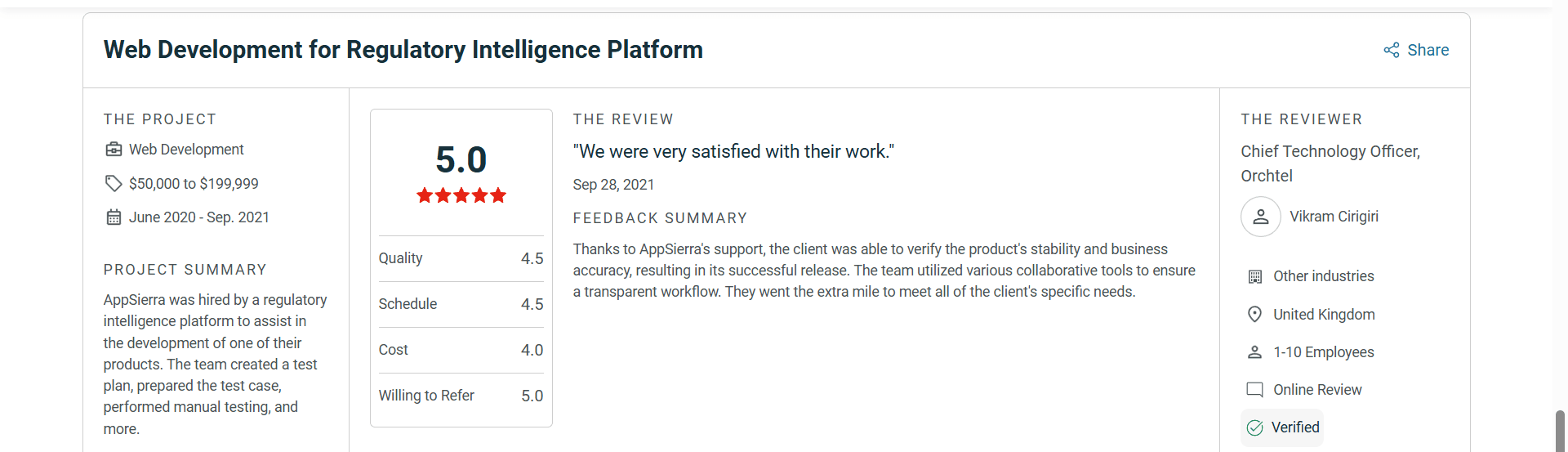
“Thanks to AppSierra's support, the client was able to verify the product's stability and business accuracy, resulting in its successful release. The team utilized various collaborative tools to ensure a transparent workflow. They went the extra mile to meet all of the client's specific needs.”
– Vikram Cirigiri ,Chief Technology Officer, Orchtel (Verified Clutch review)
4. DesignRush – Real Client Testimonial
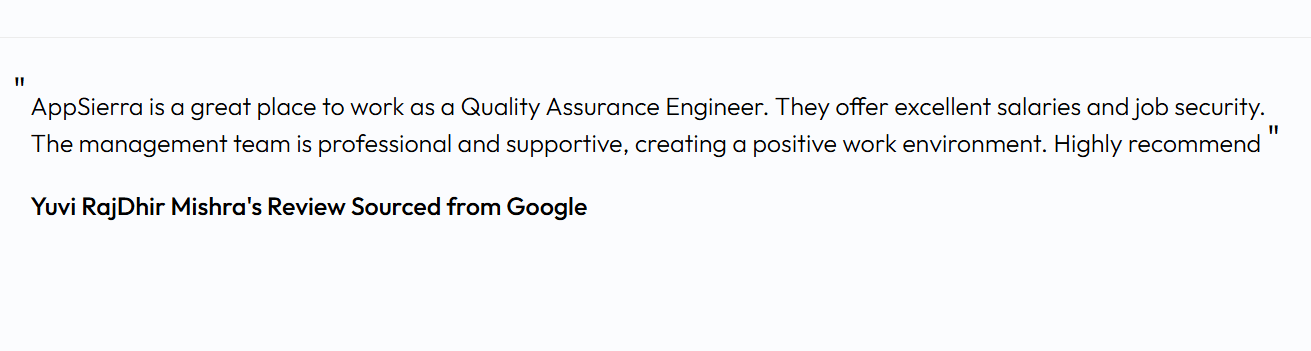
“Appsierra is our all‑time favourite for software development services. They support efficient deployment and they are always responsive to our questions 24×7. They meet all the deadlines and they were active throughout the project timeframe. The most commendable feature of Appsierra is their project management. It is well organized, coordinated and smooth. Highly recommended.”
— Yuvi RajDhir Mishra (Review sourced via DesignRush, originally from Google)
Appsierra's Security-First & Scalable Development Approach
What distinguishes Appsierra is their security-first development philosophy. They understand Python applications often handle sensitive data and design applications with security embedded at every layer. From secure authentication to encrypted data transmission and storage, Appsierra builds applications users can trust.
Their scalable development approach ensures applications grow with business needs. They design architectures that handle increasing user loads, implement efficient data management, and optimize performance as applications scale.
What Makes Appsierra a Trusted Python Development Partner in 2026
Appsierra's reputation stems from combining technical excellence, security consciousness, and business acumen. They don't simply execute requirements—they collaborate to understand business objectives, identify potential challenges, and design solutions delivering measurable business value.
Their dedicated team model, structured delivery governance, and proven methodologies ensure predictable outcomes and consistent quality. Clients benefit from developers who understand their business, maintain continuity throughout development, and provide long-term support necessary for application success.
Latest Trending Python Development Technologies, Frameworks & Tools 2025–2026
The Python technological landscape continues evolving rapidly. Understanding the most relevant frameworks and tools is crucial for making informed hiring decisions.
Django remains the most popular full-stack Python web framework. Its "batteries included" philosophy provides authentication, admin interface, ORM, and security features out of the box. Django's maturity and extensive ecosystem make it invaluable for building complex web applications quickly. When you hire Python 3x developers for web projects, Django expertise is often essential.
Flask continues its dominance as a lightweight, flexible micro-framework. For applications requiring fine-grained control and minimal overhead, Flask enables developers to build exactly what they need without framework constraints. Its simplicity makes it ideal for APIs, microservices, and prototypes.
FastAPI has emerged as the modern choice for building APIs. Its automatic API documentation, type safety, and exceptional performance make it the framework of choice for new API projects. FastAPI's async capabilities enable highly concurrent applications with excellent performance characteristics.
TensorFlow and PyTorch dominate the machine learning landscape. Organizations building AI capabilities need developers proficient in these frameworks. TensorFlow's production readiness and PyTorch's research-friendly design create complementary ecosystems serving different ML needs.
Pandas and NumPy remain fundamental for data manipulation and numerical computing. Any serious data work requires expertise in these libraries. When you hire scipy developers, you're typically also seeking pandas and NumPy proficiency for comprehensive data science capabilities.
Jupyter Notebooks have become essential tools for exploratory data analysis, reproducible research, and collaborative data science. Organizations doing data science work should hire jupyter developers who can leverage notebooks effectively for analysis, visualization, and communication of findings.
Streamlit and Dash enable rapid development of data applications and dashboards. These frameworks allow data scientists to create interactive web applications without extensive frontend development knowledge, accelerating deployment of data insights.
Celery and Redis power asynchronous task processing in Python applications. Complex workflows requiring background processing, scheduled tasks, and distributed computing rely on these tools. Developers building scalable systems need expertise in asynchronous processing architectures.
Poetry and Pipenv have modernized Python dependency management. These tools replace traditional requirements.txt files with more sophisticated dependency resolution, virtual environment management, and reproducible builds. Modern Python projects increasingly adopt these tools for better dependency control.
Applications for 2026: Future-Ready Python Development Trends
Python applications thriving in 2026 share characteristics aligned with current and emerging trends:
AI-Powered Business Intelligence. Organizations increasingly deploy Python-powered AI systems that analyze business data, predict trends, recommend actions, and automate decision-making. These systems combine machine learning models with business logic, requiring developers who understand both technical AI implementation and business context.
Real-Time Data Pipelines. Modern businesses need real-time data processing pipelines that ingest, transform, and analyze data continuously. Python's ecosystem of tools like Apache Kafka bindings, Apache Spark via PySpark, and real-time databases enable developers to build sophisticated data pipelines.
Microservices Architectures. Monolithic Python applications are giving way to microservices architectures. Developers must understand service decomposition, API design, inter-service communication, and distributed system challenges. When you hire a Python development agency, look for teams experienced in microservices patterns.
Serverless Python Applications. AWS Lambda, Google Cloud Functions, and Azure Functions enable serverless Python deployment. Applications scale automatically, eliminate server management, and reduce costs. Developers need to understand serverless patterns, cold start optimization, and event-driven architectures.
IoT and Edge Computing. Python's lightweight interpreters enable deployment on IoT devices and edge computing platforms. Applications process data locally, reducing latency and bandwidth while enhancing privacy. This trend creates demand for Python developers who understand constrained computing environments.
Automated Testing and CI/CD. Python's excellent testing frameworks (pytest, unittest) and CI/CD tool integration enable automated quality assurance. Modern Python projects implement comprehensive test suites, continuous integration, and automated deployment pipelines.
Role of a Python Developer in Modern Projects
The role of Python developers in 2026 has expanded significantly beyond traditional coding responsibilities. Modern developers are expected to be versatile, security-conscious, and business-oriented.
Full-Stack Capability. When you hire Python app developers, you increasingly seek professionals who work across the entire technology stack. This includes frontend integration (even if using JavaScript frameworks), backend API development, database design, cloud infrastructure configuration, and DevOps practices. This full-stack understanding enables holistic architectural decisions.
Data Science and ML Integration. Python developers increasingly need data science skills. Understanding statistical analysis, data visualization, and machine learning model deployment becomes valuable even for traditional web developers. Organizations building data-driven applications need developers who bridge software engineering and data science.
Security and Compliance Expertise. Python developers must have deep knowledge of security best practices, including secure authentication mechanisms, data encryption, API security, SQL injection prevention, and CSRF protection. When building fintech startup postgres applications, developers need financial regulatory compliance expertise. Healthcare applications require HIPAA knowledge. GDPR compliance affects applications serving European users.
Performance Optimization. Users expect instant response times and efficient resource usage. Developers need skills in profiling applications, identifying bottlenecks, optimizing database queries, implementing caching strategies, and leveraging asynchronous programming where appropriate. Python's Global Interpreter Lock (GIL) creates unique performance considerations that expert developers navigate skillfully.
Cross-Language Collaboration. Modern applications rarely use a single language. Python developers often integrate with systems written in JavaScript, Java, Go, or other languages. When organizations need to hire Java Python experts, they're seeking professionals who can bridge Python and Java ecosystems, enabling polyglot architectures.
DevOps and Infrastructure Management. Modern Python developers understand CI/CD pipelines, containerization with Docker, orchestration with Kubernetes, infrastructure as code, and monitoring solutions. This ensures applications deploy reliably and scale appropriately.
Domain-Specific Expertise. Depending on the industry, specialized knowledge becomes invaluable. Fintech startup postgres developers need financial domain knowledge. Healthcare developers need medical terminology understanding. Scientific computing requires understanding of the specific scientific domain.
What Customers Search Before Hiring Python Developers
Skills to Look for When You Hire Python Developers in 2026
When evaluating Python developers, certain technical and soft skills become critical differentiators:
Python Version Expertise. Clarify whether you need to hire Python 3x developers for modern applications or hire Python 27 developers for legacy system maintenance. Python 3.x (especially 3.9, 3.10, 3.11, and 3.12) represents modern development with improved features, better performance, and active support. Python 2.7 knowledge remains valuable for organizations maintaining legacy systems, though migration planning should be underway.
Framework Proficiency. Assess expertise in frameworks relevant to your project. For web development, look for Django or Flask experience. For data science, verify pandas, NumPy proficiency, and ability to hire scipy developers and hire matplotlib developers for visualization needs. For machine learning, assess TensorFlow or PyTorch skills. For interactive data applications, consider whether you need to hire jupyter developers for notebook-based development.
Database Expertise. Python developers should understand database design and optimization. For relational databases, look for PostgreSQL, MySQL, or SQLite experience. Fintech startup postgres projects particularly benefit from PostgreSQL expertise given its reliability, ACID compliance, and advanced features. For NoSQL needs, assess MongoDB, Redis, or Cassandra knowledge.
API Design and Development. Modern applications rely on APIs for integration. Developers should understand RESTful API design principles, API authentication and authorization, API documentation best practices, and increasingly GraphQL. FastAPI experience indicates modern API development skills.
Testing and Quality Assurance. Excellent developers prioritize testing. Look for experience with pytest or unittest frameworks, test-driven development (TDD) practices, integration and end-to-end testing, and continuous integration configuration. Quality-conscious developers write maintainable, reliable code.
Version Control and Collaboration. Git proficiency is non-negotiable. Developers should understand branching strategies, pull request workflows, code review practices, and collaborative development patterns. GitHub, GitLab, or Bitbucket experience indicates professional development practices.
Cloud Platform Knowledge. Modern Python applications deploy to cloud platforms. Assess experience with AWS (Lambda, EC2, RDS, S3), Google Cloud Platform (Cloud Functions, Compute Engine, Cloud SQL), or Microsoft Azure (Azure Functions, Virtual Machines, Azure Database). Containerization experience with Docker and Kubernetes indicates scalability expertise.
Communication and Soft Skills. Technical skills alone don't guarantee success. Look for developers who communicate clearly, ask clarifying questions to understand requirements, explain technical concepts to non-technical stakeholders, collaborate effectively with designers and product managers, and demonstrate problem-solving mindset. When you hire remote Python 3x developers or hire remote Python 27 developers, communication becomes even more critical.
Industry-Specific Knowledge. Depending on your domain, specialized knowledge becomes valuable. Fintech startup postgres developers need financial domain understanding. Healthcare applications benefit from HIPAA compliance knowledge. Scientific computing requires understanding domain-specific requirements.
Python 2.7 vs Python 3.x: Which Developers Should You Hire?
This fundamental decision impacts your hiring strategy, timeline, and project trajectory.
Python 3.x Development Considerations. Python 3.x represents the current and future of Python development. All new projects should use Python 3.x. When you hire Python 3x developers, you're accessing:
- Modern language features (f-strings, type hints, async/await)
- Better performance and memory efficiency
- Active security updates and bug fixes
- Extensive library support and community engagement
- Better Unicode support for international applications
- Improved exception handling and syntax
Python 3.x is essential for new projects, greenfield development, and forward-looking applications. Most Python job postings now explicitly target Python 3.x experience.
Python 2.7 Development Considerations. Despite reaching end-of-life in January 2020, Python 2.7 codebases persist in production environments. Organizations may need to hire Python 27 developers for:
- Maintaining critical legacy systems
- Supporting long-running production applications
- Managing dependencies on Python 2.7-only libraries
- Gradual migration planning and execution
- Understanding legacy code for modernization
Python 2.7 expertise becomes valuable in specific scenarios—maintaining existing systems and planning migrations. However, this represents maintenance rather than innovation.
The Strategic Approach. Most successful businesses adopt a dual strategy:
- Hire Python 3x developers for all new development, ensuring modern capabilities and long-term maintainability
- Hire Python 27 developers (or Python 3.x developers with 2.7 experience) for maintaining legacy systems while planning migration
- Prioritize Python 2.7 to 3.x migration to avoid accumulating technical debt
- Allocate resources for gradual migration rather than risky "big bang" rewrites
If your organization still runs Python 2.7 in production, prioritize migration planning. The longer you delay, the more expensive and risky migration becomes.
Python Security, Best Practices & Architecture Expectations in 2026
Security has evolved from a compliance checkbox to a fundamental architectural principle. Here's what you should expect from modern Python developers:
Secure Authentication and Authorization. Python developers should implement robust authentication mechanisms including OAuth 2.1 for authorization, JWT or opaque tokens for stateless authentication, multi-factor authentication where appropriate, and secure session management. Understanding security libraries like PyJWT, python-jose, and authlib indicates security consciousness.
Input Validation and Sanitization. Python applications face injection attacks (SQL injection, command injection, XSS). Developers must validate all input data, use parameterized queries to prevent SQL injection, sanitize user-provided content, and implement appropriate output encoding. Django's built-in protections help, but developers must understand the underlying threats.
Data Encryption. Sensitive data requires encryption at rest and in transit. Python developers should understand cryptography libraries like cryptography and PyCryptodome, implement TLS/SSL for data transmission, encrypt sensitive database fields, and manage encryption keys securely.
Dependency Security. Python projects typically include numerous dependencies, creating supply chain security risks. Developers should regularly audit dependencies for vulnerabilities using tools like Safety or Snyk, keep dependencies updated with security patches, and minimize dependency footprint where possible.
API Security. Python APIs must implement proper authentication and authorization, rate limiting to prevent abuse, input validation, CORS configuration, and API versioning. When building fintech startup postgres APIs, security takes on heightened importance given financial data sensitivity.
Security Architecture. Modern Python applications implement security as a foundational principle:
- Defense in depth with multiple security layers
- Principle of least privilege for system access
- Secure defaults in configuration
- Regular security audits and penetration testing
- Security monitoring and incident response procedures
Architecture Expectations. In 2026, good Python architecture means:
- Designing applications that are secure by default
- Scalable for growing user bases and data volumes
- Testable with comprehensive automated testing
- Maintainable over years of development
- Observable with proper logging and monitoring
- Deployable through automated CI/CD pipelines
Types of Python Developers You Can Hire
Hire Python Web Developers for Django & Flask Applications
Web development remains one of Python's primary use cases. When you hire Python app developers for web projects, look for:
Django Expertise. Django developers should demonstrate:
- Deep understanding of Django's MTV architecture
- Experience with Django ORM for database operations
- Knowledge of Django's authentication and authorization system
- Ability to build custom Django admin interfaces
- Understanding of Django REST Framework for APIs
- Experience with Django deployment and production configuration
Django's comprehensive feature set makes it ideal for complex web applications requiring rapid development with built-in security and scalability.
Flask Proficiency. Flask developers should demonstrate:
- Understanding of Flask's lightweight, flexible approach
- Experience with Flask extensions for added functionality
- Ability to structure Flask applications for scalability
- Knowledge of Flask-SQLAlchemy for database integration
- Experience with Flask-RESTful or similar API libraries
- Understanding of when Flask's minimalism is advantageous
Flask works well for microservices, APIs, and applications requiring fine-grained control over components.
Modern Web Development. Whether using Django or Flask, web developers need:
- Frontend integration skills (REST APIs, GraphQL)
- Understanding of asynchronous request handling
- Experience with websockets for real-time features
- Knowledge of caching strategies (Redis, Memcached)
- Database optimization and query performance
- Security best practices for web applications
Hire Python Data Science Developers for Analytics & ML
Data science and machine learning represent Python's strongest domain. When hiring for these roles:
Data Science Specialists. Look for developers proficient in:
- Pandas for data manipulation and analysis
- NumPy for numerical computing
- Hire scipy developers for scientific computing and advanced statistics
- Hire matplotlib developers for data visualization and plotting
- Seaborn for statistical data visualization
- Scikit-learn for machine learning algorithms
Data scientists transform raw data into insights, requiring both technical expertise and domain understanding.
Machine Learning Engineers. ML engineers need:
- TensorFlow or PyTorch for deep learning
- Experience training, evaluating, and deploying models
- Understanding of feature engineering and model selection
- Knowledge of MLOps practices and model monitoring
- Experience with GPU programming for training acceleration
- Ability to optimize model inference for production
Jupyter Notebook Developers. Organizations doing exploratory analysis should hire jupyter developers who:
- Use Jupyter notebooks effectively for analysis
- Create reproducible research and documentation
- Build interactive visualizations and reports
- Understand best practices for notebook organization
- Can transition notebook code to production applications
Data science and ML expertise creates competitive advantages through data-driven insights and automated decision-making.
Hire Python Backend Developers for API & Microservices
Backend development requires specific expertise in building scalable, maintainable server-side applications:
API Development Specialists. Backend developers should demonstrate:
- FastAPI or Django REST Framework expertise
- RESTful API design principles and best practices
- API authentication and authorization mechanisms
- API documentation using OpenAPI/Swagger
- Rate limiting and API security
- Versioning strategies for API evolution
Microservices Architecture. Developers building microservices need:
- Understanding of service decomposition principles
- Experience with inter-service communication (REST, gRPC, message queues)
- Knowledge of API gateways and service discovery
- Understanding of distributed system challenges
- Experience with containerization and orchestration
- Monitoring and logging in distributed systems
Database Expertise. Backend developers must understand:
- Database design and normalization
- Query optimization and performance tuning
- ORM usage and when to write raw SQL
- Transaction management and ACID properties
- Database migrations and schema evolution
- Fintech startup postgres applications particularly benefit from PostgreSQL expertise
Backend developers create the foundation that powers web and mobile applications, requiring strong technical fundamentals.
Hire Python Automation & DevOps Engineers
Automation and infrastructure management leverage Python's scripting capabilities:
Automation Specialists. These developers should demonstrate:
- Experience with automation frameworks (Ansible, SaltStack)
- Ability to write efficient automation scripts
- Understanding of system administration and infrastructure
- Knowledge of scheduling and job management (Cron, Celery)
- Testing automation and quality assurance scripts
- Process automation for business workflows
DevOps Engineers. DevOps-focused Python developers need:
- CI/CD pipeline design and implementation
- Infrastructure as code (Terraform, CloudFormation)
- Containerization and orchestration (Docker, Kubernetes)
- Monitoring and alerting system implementation
- Log aggregation and analysis
- Cloud platform expertise (AWS, GCP, Azure)
Automation expertise increases operational efficiency and reduces manual toil, freeing teams for higher-value work.
Hire Python Fintech Developers for Financial Applications
Financial technology applications have specialized requirements. When building fintech startup postgres applications:
Financial Domain Expertise. Fintech Python developers should demonstrate:
- Understanding of financial concepts and terminology
- Experience with payment gateway integration
- Knowledge of financial regulations and compliance
- Ability to handle monetary calculations accurately (using Decimal)
- Understanding of financial data security requirements
- Experience with financial data sources and APIs
PostgreSQL Expertise. Fintech startup postgres combinations are popular because:
- PostgreSQL provides ACID compliance for financial transactions
- Strong data integrity constraints prevent corruption
- Advanced features support complex financial queries
- Excellent performance for transactional workloads
- Robust backup and recovery capabilities
Security and Compliance. Fintech developers must understand:
- PCI DSS compliance for payment processing
- AML (Anti-Money Laundering) and KYC requirements
- Data encryption and secure communication
- Audit logging for regulatory compliance
- Fraud detection and prevention
Fintech applications demand the highest levels of security, reliability, and regulatory compliance.
Hire Remote Python Developers Globally
Remote hiring has become standard practice. When you hire remote Python 3x developers or hire remote Python 27 developers, consider:
Global Talent Access. Remote hiring enables access to worldwide Python talent pools, overcoming geographic constraints and accessing specialized expertise unavailable locally.
Cost Optimization. Geographic arbitrage allows hiring talented developers from regions with lower cost of living while maintaining quality standards.
Communication Requirements. Successful remote relationships require:
- Clear communication protocols and tools
- Timezone overlap for synchronous collaboration
- Regular video meetings for relationship building
- Written documentation of decisions and requirements
- Explicit expectations and accountability
Cultural Considerations. When hiring globally, consider language proficiency, cultural work style differences, holiday and availability variations, and time zone coordination needs.
Remote Python developers can be highly effective when proper communication structures and management practices are established.
Hiring Models for Python Developers in 2026

Hire Dedicated Python Developers on Monthly Contract
When you hire a dedicated Python developer on monthly contract, you're establishing an exclusive working relationship:
Predictable Costs and Availability. Monthly contracts provide budget certainty and guaranteed developer availability. You know exactly your monthly investment and can plan resources accordingly.
Continuity and Deep Knowledge. Dedicated developers build deep understanding of your codebase, business objectives, and architectural decisions. This continuity leads to faster development, better quality, and fewer knowledge transfer issues.
Flexibility and Responsiveness. Dedicated teams can pivot quickly to changing requirements, provide responsive communication, and adapt to evolving priorities. They attend your meetings, participate in planning, and integrate with your team culture.
Team Integration. Dedicated developers become part of your team, understanding your processes, working with your tools, and contributing to strategic discussions beyond just coding.
Cost Considerations. Dedicated Python developers typically range from $4,000 to $10,000+ per month depending on expertise level, geographic location, and specialization. Senior developers with expertise in areas like machine learning or fintech startup postgres applications command premium rates.
This model works best for:
- Long-term projects requiring sustained development effort
- Applications needing deep domain knowledge accumulation
- Teams needing responsive communication and quick iteration
- Projects with evolving requirements benefiting from flexibility
Fixed Cost vs Time & Material Python Development Model
These represent fundamentally different approaches to project pricing:
Fixed Cost Model. Define comprehensive requirements upfront and agree on fixed project cost. The development team bears the risk of overruns.
Advantages:
- Predictable total project cost for budget planning
- Clear scope and deliverables defined upfront
- Suitable for well-defined projects with stable requirements
- Budget certainty for financial planning
Disadvantages:
- Requires very detailed requirements specification upfront
- Changes trigger costly change orders
- Less flexibility for discovering new needs during development
- May incentivize cutting corners to maintain margins
- Can create adversarial dynamics around scope changes
Time & Material Model. Pay for actual development time and resources consumed, typically at hourly or daily rates.
Advantages:
- Flexibility to adjust scope and requirements as you learn
- Encourages quality over speed
- Pay for actual work performed
- Suitable for exploratory projects with evolving requirements
- Better aligns developer and client incentives
Disadvantages:
- Less budget certainty—final costs can vary
- Requires active management to control costs
- May be more expensive if poorly managed
- Requires trust in developer integrity
The Modern Approach. Many successful Python projects use hybrid models—fixed costs for well-defined core features with time & material for enhancements, experiments, and optimizations.
Choose fixed cost when requirements are clear and stable. Choose time & material for innovative projects, MVPs, or research-oriented work where requirements will evolve.
Hire Python Development Agency vs Freelancers vs In-House
Each approach offers different benefits and trade-offs:
Freelance Python Developers. Individual developers working independently.
Advantages:
- Often lower hourly rates than agencies
- Flexible engagement for small projects or part-time work
- Can provide specialized niche expertise
- Quick start on projects
Disadvantages:
- Limited availability and capacity
- Often juggling multiple projects simultaneously
- May lack project management structure
- Reliability can be inconsistent
- Difficult to scale team size
- Limited backup if developer becomes unavailable
- Quality highly variable
Python Development Agencies. Professional development companies with teams of developers. When you hire a Python development agency, you gain:
Advantages:
- Professional project management and established processes
- Access to diverse skills and expertise levels
- Ability to scale team size as needed
- Established quality standards and code review
- Backup resources if team members become unavailable
- Professional communication and reporting
- Experience across multiple projects and industries
Disadvantages:
- Higher costs than freelancers
- More formal processes that may slow decisions
- Communication sometimes less direct
- May not provide same personalization as dedicated freelancers
In-House Python Developers. Hiring developers as full-time employees.
Advantages:
- Complete control over team and priorities
- Deep organizational knowledge accumulation
- Aligned incentives with company success
- Better for long-term strategic projects
- Cultural integration with organization
- Immediate availability and communication
Disadvantages:
- Highest total costs including salary, benefits, equipment, and overhead
- Recruiting and hiring challenges in competitive markets
- Requires management infrastructure
- Difficult maintaining expertise across all Python specializations
- Geographic constraints on talent pool
- Fixed costs even during slower periods
The Strategic Approach. Many organizations use hybrid models—a small in-house core team supplemented by agency or freelance specialists as needed. This balances control, expertise, and flexibility.
Cost to Hire Python Developers in 2026
Average Cost of Hiring Python Developers by Region
Developer costs vary dramatically by region, reflecting cost of living, demand, and expertise:
North America & Western Europe. Python developers in these regions command $80-150+ per hour or $15,000-30,000+ per month for dedicated developers. Premium reflects high cost of living, strong local demand, and generally high expertise. Senior developers with specialized skills (hire Java Python experts, machine learning engineers) command even higher rates.
Eastern Europe. Poland, Ukraine, Romania, and Czech Republic offer excellent value at $40-80 per hour or $8,000-16,000 per month. These regions have strong technical education systems and mature development communities while offering reasonable costs.
India and South Asia. India remains a major Python development hub with experienced developers at $20-50 per hour or $4,000-10,000 per month. Quality varies significantly—top-tier Indian developers match Western quality at lower costs, while budget providers may have quality concerns.
Latin America. Brazil, Mexico, Argentina, and Colombia offer $30-70 per hour or $6,000-14,000 per month. Good quality with reasonable timezone alignment for North American companies and generally strong English communication.
Southeast Asia. Philippines, Vietnam, and Thailand offer competitive rates of $20-40 per hour or $4,000-8,000 per month with improving quality and growing Python communities.
Important Consideration. Cost alone shouldn't drive decisions. A developer charging $50/hour who produces clean, maintainable code may be far more cost-effective than a $25/hour developer producing problematic code requiring expensive fixes.
Python Development Cost Breakdown
Understanding total investment requires examining all components:
Development Team Costs. Core expense includes developers, technical leads, and architects. Team composition varies by project complexity—simple projects might need 1-2 developers, while complex systems require 5-10+ developers. Monthly team costs range from $4,000 for a single junior developer to $50,000+ for large senior teams.
Specialized Expertise Costs. Specialized skills command premium rates. When you need to hire scipy developers, hire matplotlib developers, or hire jupyter developers for data science work, expect 20-40% premium over general Python developers. Machine learning expertise, fintech startup postgres experience, and security specialization similarly command premium rates.
Project Management and Coordination. Dedicated project managers add oversight, coordination, and communication management. This typically adds 10-15% to overall costs but significantly improves project success rates.
Quality Assurance and Testing. Professional QA identifies bugs before they reach users. Plan for QA to represent 15-25% of development costs. Automated testing reduces long-term QA costs while improving quality.
Infrastructure and DevOps. Setting up cloud infrastructure, CI/CD pipelines, monitoring, and logging adds $1,000-5,000+ depending on complexity. Fintech startup postgres applications may require additional infrastructure for compliance and security.
Third-Party Services and Libraries. Projects integrate with APIs, databases, and services. Budget for service costs, API fees, and premium library licenses where applicable.
Maintenance and Support. Post-launch maintenance typically costs 20-25% of development costs annually. This covers bug fixes, dependency updates, performance optimization, and security patches.
Overall Cost Ranges. Based on current market data:
- Simple Python scripts/automation: $5,000-20,000
- Moderate complexity applications: $20,000-100,000
- Complex enterprise systems: $100,000-300,000+
- Large-scale platforms: $300,000+
When you hire remote Python 3x developers versus local developers, you can typically reduce costs 30-50% without sacrificing quality, assuming proper management.
How to Optimize Cost Without Sacrificing Quality
Several strategies reduce costs while maintaining quality:
Prioritize MVP Features. Don't build everything you imagine. Focus on minimum viable product solving core problems. Launch with essential features and enhance based on user feedback. This reduces initial costs and accelerates time to market.
Choose Appropriate Technology Stack. Use frameworks that accelerate development. Django provides rapid development for web applications. FastAPI enables fast API development. When you hire Python 3x developers experienced in modern frameworks, they'll build faster than developers working from scratch.
Leverage Existing Libraries. Python's rich ecosystem means most functionality exists in well-tested libraries. Hire scipy developers for scientific computing rather than reimplementing algorithms. Use established libraries for common functionality like authentication, data processing, and visualization.
Implement Agile Development. Agile reduces waste through iterative development and continuous feedback. Short sprints with frequent releases catch problems early when they're cheaper to fix.
Invest in Automated Testing. Upfront investment in testing infrastructure pays dividends throughout project lifecycle. Automated tests catch bugs early, reduce manual QA costs, and enable confident refactoring.
Consider Geographic Arbitrage. When you hire remote Python 3x developers or hire remote Python 27 developers from regions with lower costs of living, you access quality talent at reduced rates. Ensure communication infrastructure supports remote collaboration.
Plan for Maintainability. Poorly structured code becomes increasingly expensive to maintain and extend. Invest in clean architecture, comprehensive documentation, and code quality from the start to avoid expensive rewrites.
Step-by-Step Process to Hire the Right Python Developer
Define Your Python Development Requirements & Goals
Before engaging developers, establish clear requirements:
Project Type and Goals. What are you building? Web application? Data pipeline? Machine learning system? API backend? Automation scripts? Clear project type drives all subsequent decisions about who to hire.
Python Version Requirements. Do you need to hire Python 3x developers for new development, hire Python 27 developers for legacy maintenance, or both? This fundamental decision affects candidate pool and skillsets.
Technology Stack. What frameworks and libraries matter? Django or Flask for web? TensorFlow or PyTorch for ML? Do you need to hire scipy developers, hire matplotlib developers, or hire jupyter developers for data work? Specific requirements guide technical evaluation.
Performance and Scale Requirements. How many users will your application serve? What response times are acceptable? What data volumes must you handle? Performance requirements drive architectural decisions and needed expertise.
Security and Compliance. What security requirements exist? Building fintech startup postgres applications requires financial security expertise. Healthcare applications need HIPAA knowledge. E-commerce needs PCI DSS understanding. Define compliance requirements clearly.
Timeline and Budget. Establish realistic expectations for schedule and investment. Communicate these clearly to potential developers so they can assess feasibility.
Success Metrics. Define how you'll measure success. Performance benchmarks? User adoption targets? Revenue goals? Clear metrics guide development priorities.
Evaluating Python Developer Skills, Portfolio & Experience
Once you have clear requirements, evaluate potential developers:
Portfolio Review. Request examples of previous Python work. Look for:
- Projects similar in complexity and domain to yours
- Code quality in public repositories (GitHub, GitLab)
- Diversity of projects indicating versatility
- Documentation quality showing communication skills
- Contributions to open-source Python projects
Technical Assessment. Evaluate technical expertise through:
- Coding challenges relevant to your project type
- Code review of their previous work
- Discussion of architectural decisions they've made
- Questions about Python-specific concepts (GIL, memory management, async programming)
- Framework-specific knowledge questions
Experience Verification. Validate claims through:
- Reference checks with previous clients or employers
- LinkedIn profile and work history verification
- Contributions to Python community (talks, blog posts, packages)
- Certifications or formal training (though experience matters more)
Problem-Solving Assessment. Present a realistic problem from your domain and discuss their approach. Strong developers will:
- Ask clarifying questions to understand requirements
- Discuss multiple solution approaches and trade-offs
- Consider edge cases and error handling
- Explain their reasoning clearly
- Demonstrate understanding of your business context
Communication Evaluation. Assess communication skills, especially when you hire remote Python 3x developers or hire remote Python 27 developers:
- Clarity explaining technical concepts
- Responsiveness to questions
- Ability to understand your requirements
- Written communication quality
- Cultural and language compatibility
Technical Interview Checklist for Python Developers
Use this checklist during technical interviews:
Python Fundamentals:
- Core language features and idioms
- Understanding of Python's data structures
- Knowledge of standard library capabilities
- Memory management and garbage collection
- Understanding of Python's execution model
Framework Expertise:
- Experience with relevant frameworks (Django, Flask, FastAPI)
- Understanding of framework architecture and patterns
- Ability to extend and customize frameworks
- Knowledge of framework best practices
Database Knowledge:
- SQL proficiency and query optimization
- ORM usage and when to write raw SQL
- Database design and normalization
- Transaction management
- Experience with specific databases (PostgreSQL for fintech startup postgres applications)
Testing and Quality:
- Testing methodology and frameworks (pytest, unittest)
- Test-driven development experience
- Code quality practices
- Debugging and profiling skills
Security Awareness:
- Understanding of common security vulnerabilities
- Authentication and authorization implementation
- Input validation and sanitization practices
- Secure coding practices
Tools and Workflow:
- Version control proficiency (Git)
- CI/CD experience
- Development environment management
- Containerization knowledge (Docker)
Problem-Solving:
- Present coding challenges
- Discuss algorithm and data structure choices
- Evaluate debugging approach
- Assess optimization strategies
Communication:
- Clarity explaining technical decisions
- Ability to understand requirements
- Collaboration and teamwork approach
Security, NDA & Compliance Considerations
Establish proper legal and security frameworks:
Non-Disclosure Agreement (NDA). Protect intellectual property and business secrets through comprehensive NDAs covering technology, business strategies, user information, and proprietary processes.
Intellectual Property Assignment. Clearly establish that your business owns all code and IP created during development. This should be explicit in contracts.
Security Commitments. Establish expectations for secure development practices including secure authentication implementation, data encryption requirements, regular security updates, vulnerability remediation timelines, and security audit rights.
Compliance Requirements. Define compliance needs:
- GDPR for European users
- CCPA for California residents
- HIPAA for health information
- PCI DSS for payment processing
- Fintech startup postgres applications often need SOC 2 compliance
Data Protection. If developers access user data, establish strict protection requirements including secure storage, limited access, secure deletion upon termination, and audit logging.
Liability and Warranties. Establish reasonable liability caps and warranties regarding work performed. Balance protection with attracting quality developers.
Choosing Between a Python Development Company, Freelancers, and In-House

Benefits of Hiring a Python Development Agency
For most organizations, hiring a Python development agency like Appsierra offers optimal balance:
Professional Expertise. Agencies employ specialists across technologies, frameworks, and domains. When you hire a Python development agency, you access expertise that would be expensive to maintain in-house. Need to hire scipy developers for scientific computing? Hire matplotlib developers for visualization? Hire jupyter developers for data analysis? Agencies provide this breadth.
Proven Methodologies. Established agencies have refined development processes through hundreds of projects. Structured approaches reduce risk and improve outcomes compared to ad-hoc freelance arrangements.
Quality Assurance. Agencies invest in quality processes, testing infrastructure, and quality standards. Quality becomes systematic rather than dependent on individual developers.
Scalability. As project needs grow, agencies scale teams appropriately. You don't recruit individual developers; you scale to whatever team size the project requires.
Risk Mitigation. Agencies have backup resources, insurance, and processes handling risks. If a developer becomes unavailable, work continues without disruption.
Long-Term Support. Agencies maintain ongoing relationships beyond initial development, enabling quick response to bugs, performance issues, and enhancement requests.
Python Development Company vs Freelancers vs In-House
When to Hire Freelancers:
- Small projects or scripts
- Short-term specialized needs
- Budget constraints for minimal viable solutions
- Non-critical applications
When to Hire a Python Development Agency:
- Medium to large projects requiring multiple skills
- Projects needing professional project management
- When quality and reliability are critical
- Fintech startup postgres applications requiring compliance
- Long-term applications needing ongoing support
When to Build In-House:
- Python development is core competitive advantage
- Long-term strategic commitment to Python technology
- Sufficient scale to justify overhead
- Need for immediate, constant availability
- Proprietary knowledge requiring internal teams
Most organizations find that agencies provide the best balance of expertise, quality, flexibility, and cost-effectiveness.
Why Hire Python Developers from Appsierra
Appsierra's Python Development Expertise
Appsierra has established deep expertise across the Python landscape:
Framework Mastery. Proficiency in Django, Flask, and FastAPI enables optimal framework selection based on project requirements. Their developers don't dogmatically prefer one framework but choose appropriately.
Data Science and ML Capabilities. When you need to hire scipy developers, hire matplotlib developers, or hire jupyter developers, Appsierra provides experienced data scientists and ML engineers who transform data into insights and production-grade models.
Specialized Domain Knowledge. Experience with fintech startup postgres applications means Appsierra understands financial domain requirements, regulatory compliance, and security necessities. Similar domain expertise extends to healthcare, e-commerce, and other industries.
Full-Stack Approach. Appsierra's Python developers often possess full-stack capabilities, understanding frontend integration, database design, cloud infrastructure, and DevOps practices. This comprehensive expertise enables holistic solutions.
Version Flexibility. Whether you need to hire Python 3x developers for modern applications or hire Python 27 developers for legacy maintenance, Appsierra provides experienced professionals for both scenarios.
Dedicated Python Developers at Appsierra
Appsierra offers dedicated Python developer models where developers work exclusively on your project:
Team Continuity. Dedicated developers build deep understanding of your application, business objectives, and technical architecture. This continuity accelerates development and improves decision quality.
Responsive Communication. Dedicated teams provide responsive communication, attending your meetings, understanding your requirements in detail, and contributing to strategic discussions.
Flexible Scaling. Teams scale based on project phase needs. Ramp up during intensive development periods and scale down during maintenance phases.
Cost Effectiveness. For long-term projects, dedicated team models offer cost-effective access to senior expertise while providing quality and reliability that freelancers may not match.
Secure & Scalable Python Development Practices
Appsierra's commitment to security and scalability distinguishes them:
Security Architecture. Applications designed with security foundations including OAuth 2.1 authentication, encrypted data transmission and storage, regular security audits, compliance with industry standards, and secure API design with proper access controls.
Scalability Design. Applications architected to scale including distributed architecture supporting growth, efficient database design and optimization, caching strategies reducing load, load testing ensuring performance, and monitoring identifying scaling issues early.
DevOps Excellence. Professional infrastructure practices including CI/CD pipelines, automated testing, infrastructure as code, monitoring and alerting, and rollback capabilities.
Appsierra Interview Questions & Developer Screening Process

Appsierra maintains rigorous screening ensuring team quality:
Technical Assessment. Candidates undergo comprehensive evaluation covering Python fundamentals, framework expertise, database knowledge, security awareness, and problem-solving capabilities.
Practical Evaluation. Real-world coding challenges, architecture design exercises, and debugging scenarios assess practical skills beyond theoretical knowledge.
Experience Verification. Portfolio review, reference checks, code sample evaluation, and discussion of technical decisions validate claimed experience.
Communication Assessment. Evaluation of explanation clarity, requirement understanding, collaboration approach, and cultural fit.
This thorough screening ensures that when you hire a dedicated Python developer or hire remote Python 3x developers from Appsierra, you're getting vetted, qualified professionals.
Common Mistakes to Avoid While Hiring Python Developers
Choosing Low Cost Over Quality
The most costly mistake is prioritizing hourly rate above all else. A developer charging $30/hour producing problematic code requiring 50% rework has an effective rate of $60/hour—plus you risk launching poor-quality applications that fail with users.
The Right Approach: Focus on value rather than minimizing rates. Evaluate total cost including potential rework. Assess quality through portfolio and references. Balance cost with expertise and experience. Invest in quality that serves your business long-term.
Ignoring Security and Best Practices
Many organizations treat security as secondary, only to face costly breaches or technical debt. Python applications handle user data—often sensitive financial, health, or personal information. Security breaches destroy trust, create legal liability, and damage reputation.
The Right Approach: Make security a core requirement from project inception. Hire developers with security expertise. Require security architecture review. Implement security testing throughout development. Include security audits before launch. Plan for ongoing security monitoring and updates.
When building fintech startup postgres applications, security takes on heightened importance given financial data sensitivity and regulatory requirements.
Not Planning for Maintenance and Evolution
Many organizations focus solely on initial development, neglecting ongoing maintenance, enhancement, and scaling required for long-term success.
The Right Approach: Plan for post-launch support and evolution. Allocate budget for ongoing optimization and enhancement. Implement monitoring and analytics from launch. Establish feedback loops capturing user input. Plan for performance optimization as usage grows. Budget for security updates and dependency maintenance. Partner with developers or agencies offering long-term support.
Hiring Only for Technical Skills
Technical competence alone doesn't guarantee project success. Communication skills, business understanding, problem-solving approach, and collaboration abilities significantly impact outcomes.
The Right Approach: When you hire remote Python 3x developers or hire remote Python 27 developers, evaluate communication skills thoroughly. Assess their ability to understand business requirements. Evaluate problem-solving approach and collaboration style. Consider cultural fit and work style compatibility.
FAQs – Hire Python Developer 2026
How Long Does It Take to Hire a Python Developer?
Timeline depends on hiring approach:
Freelancers: Finding and evaluating freelancers takes 1-4 weeks, though assessing reliability requires longer. Initial availability is quick but quality varies significantly.
Development Agencies: Identifying agencies, reviewing proposals, and negotiating contracts typically takes 3-8 weeks. Once contracted, when you hire a Python development agency, they often begin immediately with pre-vetted developers.
Dedicated Developers: Professional companies offering dedicated Python developers can often onboard within 1-2 weeks with pre-screened candidates.
In-House Hiring: Recruiting full-time employees takes 8-12 weeks including posting, screening, interviewing, background checks, and onboarding.
Can I Hire Dedicated Python Developers Remotely?
Absolutely. In 2026, remote hiring is standard. When you hire remote Python 3x developers or hire remote Python 27 developers, you gain access to global talent pools, cost optimization through geographic arbitrage, and flexibility in work arrangements.
Success Factors:
- Clear communication protocols
- Timezone overlap for collaboration
- Well-defined requirements
- Proper collaboration tools
- Regular video meetings
- Strong project management
Which Python Version Should I Target?
For New Projects: Always use Python 3.x. When you hire Python 3x developers for new development, you're accessing modern language features, active security support, better performance, and extensive library ecosystem.
For Legacy Systems: If maintaining existing Python 2.7 applications, hire Python 27 developers familiar with migration planning. However, prioritize migrating to Python 3.x to avoid accumulating technical debt.
Strategic Approach: Most organizations need dual capability—hire Python 3x developers for new work while ensuring someone understands Python 2.7 for legacy maintenance and migration.
Is Hiring Remote Python Developers Secure?
Yes, when proper safeguards are implemented:
Legal Protections: Comprehensive NDAs, IP assignment agreements, service level agreements, and data protection agreements.
Operational Security: VPN requirements, encrypted communication, limited system access, regular security audits, and background checks for sensitive projects.
Vetting Process: Thorough evaluation through portfolio review, reference checks, technical assessment, and trial projects.
What Industries Benefit Most from Python Development?
Financial Technology: Fintech startup postgres applications leverage Python for backend development, algorithmic trading, risk analysis, and financial modeling.
Data Science and Analytics: Organizations needing data insights hire scipy developers, hire matplotlib developers, and hire jupyter developers for comprehensive analytics capabilities.
Healthcare and Life Sciences: Medical applications, research analysis, and health data processing benefit from Python's scientific computing capabilities.
E-commerce and Retail: Web applications, recommendation systems, and inventory management leverage Python frameworks.
Education Technology: Learning management systems, content delivery platforms, and educational analytics use Python extensively.
Hire Python Developers in 2026 – Get Started

Talk to Python Development Experts
Taking the first step begins with conversations with experienced Python developers. Come prepared to:
Share Your Vision:
- Business goals and objectives
- Problems your application solves
- Target users and use cases
- Key features and functionality
- Timeline and budget parameters
- Whether you need to hire Python 3x developers, hire Python 27 developers, or both
Ask Relevant Questions:
- Experience with similar projects
- Recommended technology approach
- Quality and security assurance methods
- Project management processes
- Post-launch support capabilities
- References from comparable projects
Evaluate Responses: Quality developers will ask clarifying questions, explain approaches clearly, discuss trade-offs thoughtfully, address concerns directly, and demonstrate interest in your business success.
Get a Free Consultation & Cost Estimate
Most reputable Python development companies offer free consultations to:
Understand Requirements: Through detailed discussion, they'll understand your business context, target users, required functionality, technical constraints, and timeline and budget parameters.
Recommend Approach: Based on understanding, they'll recommend optimal technology stack, development approach, team composition, phased implementation strategy, and realistic timeline.
Provide Cost Estimate: Though not binding, estimates should include development costs by phase, additional costs (QA, infrastructure, DevOps), ongoing maintenance costs, and cost optimization options.
Start Your Python Development Project Today
Once you've selected your development partner:
Formalize Agreement: Signed contract with clear terms, statement of work detailing deliverables, timeline with milestones, payment schedule, and IP ownership and confidentiality agreements.
Initiate Discovery: Comprehensive requirements gathering, technical architecture definition, detailed project planning, communication protocol establishment, and development infrastructure setup.
Begin Development: Structured sprint-based development, regular demonstrations showing progress, continuous feedback driving improvements, integrated testing and QA, and progress monitoring against plan.
Conclusion
Hiring the right Python developers in 2026 requires understanding the technology landscape, clearly defining requirements, evaluating candidates rigorously, and establishing partnerships with professionals combining technical excellence and business acumen. Whether you need to hire Python 3x developers for modern applications, hire Python 27 developers for legacy maintenance, hire remote Python 3x developers for cost optimization, or hire a Python development agency for comprehensive expertise, the investment in quality talent far exceeds the cost of fixing poor-quality solutions.
When you hire a dedicated Python developer or hire remote Python 27 developers, you're investing in your business's technical foundation. Make these decisions carefully, prioritizing value over cost alone, security over convenience, and long-term success over short-term savings.
Whether you need to hire scipy developers for scientific computing, hire matplotlib developers for visualization, hire jupyter developers for data analysis, build fintech startup postgres applications, or hire Java Python experts for polyglot architectures, the right development partner transforms your vision into reality.
Ready to put this into practice?
Appsierra's expert-supervised QA and AI engineering pods help teams ship higher-quality software faster — with senior accountability and a low-risk pilot. Tell us what you're working on.